CAZ charges for diesel vans: London, Birmingham and Bristol compared
Three cities, three schemes, one headache. I ran a small fleet into all three last year — here's what each one actually costs per van per week, and the thing fleets get wrong.
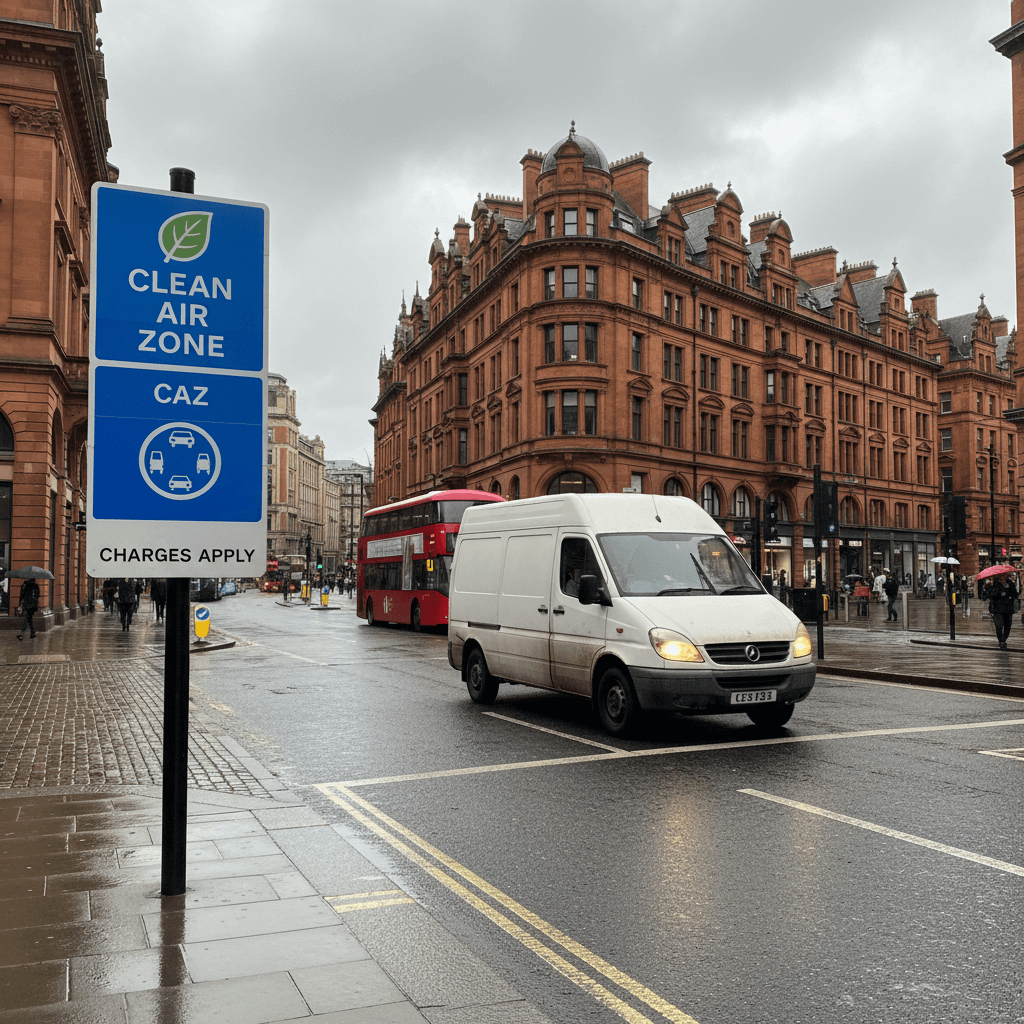
Three English cities charge non-compliant vans to come through their centres. Three different rulebooks. Three different checkers. Three different penalty regimes if you get it wrong. And zero patience from any of them if you park a Euro 5 Transit on Broad Street and assume the DVLA will sort it out.
I ran a delivery fleet of eight vans and two 7.5-tonners into all three of these zones last year. Some of it was planned. Some of it was the van I didn't want going to the job it needed to be at. Here's what I learned, what it cost me, and what I'd do differently.
The quick version
London has the biggest zone and it's active around the clock. Birmingham has a smaller zone but the charge applies pretty widely across the city centre. Bristol sits in between, geographically and commercially. All three use number-plate recognition cameras. All three use the DVLA vehicle database to work out whether your van is compliant. None of them rely on stickers, windscreen permits, or you telling them.
The broad rule for a van is this: if it's a diesel, it needs to meet Euro 6 to avoid a charge. If it's a petrol, it needs to meet Euro 4. If you don't know which you've got, put the registration into each city's online checker before you drive in. Don't guess.
London: the ULEZ
The Ultra Low Emission Zone now covers essentially all of Greater London, out to the M25 in most places. The daily charge for a non-compliant van has been published at £12.50 for some time – check it on Transport for London before you rely on my number, because they've adjusted the rate before and may again – and that charge is per calendar day. Midnight to midnight.
The catch is that the day starts at midnight, not at start of shift. A van that goes into the zone at 23:30 and comes out at 00:30 has crossed two charging days. You're paying for both. I've had drivers blindsided by this. One was sitting outside a customer at midnight doing a bulk drop-off and we ended up paying the charge twice for a job we'd only quoted once.
Penalty charge for non-payment is significant. Published at £180 reduced to £90 if paid within 14 days, last time I checked – always look at the current figure on the TfL site. Get a couple of those across a fleet and you're into real money. I set up direct debits under TfL's Auto Pay so I don't miss any. Recommend it.
The ULEZ does not stop running at weekends. Does not stop at night. Does not stop on bank holidays except Christmas Day. So a van driving through at 2am Sunday is liable.
Birmingham: the Class D zone
The Birmingham CAZ is a Class D zone – the kind that charges cars, vans, HGVs, buses and taxis. (Class A would be buses/coaches/taxis only. Class C adds LGVs/HGVs. Class D adds cars.) For an operator running diesel vans, this means your Euro 5 Sprinter is going to get picked up whether the driver's doing a delivery or nipping in for a McDonalds on a late shift.
The geography is basically the area within the A4540 Middleway ring road – the centre of the city. If you're servicing the ring itself, you're probably out of the charge; if you're crossing the Middleway inbound, you're in.
The daily charge for a non-compliant van is published lower than the HGV rate – the council has the exact current figures on their CAZ pages; expect it to be around the single-figure-tens-of-pounds range for vans and significantly higher for HGVs. Pay on the dedicated government-run portal within six days of the journey. Leave it longer than that and you're into PCN territory.
The thing that catches fleet operators out in Birmingham is vehicles that do meet the standard but aren't flagged as compliant in the DVLA record. There's a small percentage of vans, especially ones converted or re-registered, where the DVLA data is wrong. Run every van's plate through the checker before you dispatch. Keep a screenshot of the 'compliant' result in the vehicle file. If the PCN comes anyway, you've got evidence for the appeal.
Bristol: the inner zone
Bristol's CAZ is also a Class D – cars, vans, HGVs, taxis all in scope. The zone is the inner city, roughly the area bounded by the river on the south and the M32 to the north, with the centre squarely inside.
Charge level for a non-compliant van sits in similar range to Birmingham. Penalty charge for non-payment is broadly in line with the other two schemes, and again the operator pays on the national portal.
The wrinkle in Bristol, in my experience, is that the zone boundary is not circular. It follows the road network in a shape that makes sense on the map but less sense in the cab. I've had drivers go around what they thought was a sensible detour and still end up in the zone because one leg of the detour dipped inside it for 200 metres. If your drivers are using Google Maps, their routes will sometimes clip the boundary in ways you wouldn't choose. Build a route plan that avoids it on purpose.
One thing Bristol gets right: there's a more generous exemption and grant programme than the other two cities for small local businesses, and if you're a sole trader or small operator with a handful of vans in the area, it's worth checking whether you qualify for a time-limited discount. Those windows expire. The rules change. Don't assume you'll still qualify next year.
Planning and routing: the numbers that actually matter
If you have a single non-compliant van doing two London drops a day, five days a week, your annual ULEZ bill before discounts is into the multiple thousands. If you then take that van into Birmingham on a Wednesday night once a week, and Bristol on a Friday, you've now got three separate charges hitting three separate portals. The admin alone costs you.
Run the maths. For most fleets the right answer is: sell the non-compliant van and replace it. Not because of the moral duty to air quality – though that's a reasonable argument – but because the payback on a newer van, across three or four years of saved charges and reduced PCN risk, is shorter than people realise. I ran the numbers on a 2017 Transit doing London work and the point at which a Euro 6 replacement paid for itself was around 22 months. Faster than I expected.
If replacing isn't an option – cash flow, availability, particular fitment – then the next best thing is ruthless routing. Keep the non-compliant van out of the zones. Dedicate it to jobs that don't need to cross in. Put the compliant vehicles on the in-zone work. If a dispatcher tries to save five minutes by sending the nearest van to the nearest job, you'll pay for that five minutes.
Compliance paperwork for fleets
On the operator-licence side, CAZ charges aren't a compliance item in the TC's sense. The Traffic Commissioner doesn't audit your ULEZ payments. What she does care about is whether you knew what you were doing with your fleet and whether your drivers were briefed.
So document two things. First, a vehicle-by-vehicle compliance record: which vans are Euro 6 diesel, which are Euro 4 petrol, which are compliant in which zones. Update it when you buy or sell. Second, a driver-briefing record: every driver has been told which zones apply, which vehicles they can take into them, and what the cost is of getting it wrong. Five-minute tool-box talk. Signed attendance sheet. Dated.
If a driver ever argues they didn't know, you want to produce the briefing sheet they signed in 2024.
The mistake people make
The single biggest mistake I see from operators is treating the three cities as one problem. They aren't. They're three separate schemes, run by three separate authorities, with three separate payment portals and three separate appeal processes. A PCN from one doesn't talk to a PCN from another. Your compliance record for London tells you nothing about Birmingham. A missed deadline in one doesn't affect the other two.
The second biggest mistake is forgetting about Manchester. Greater Manchester looked set to introduce a charging CAZ for years; it was replaced with an investment-led plan that doesn't involve direct road charges. People still ring me saying 'have we got a Manchester CAZ problem'. No. Not right now. If the plan changes, it'll be on the news. Until then, drive in and out of central Manchester in whatever you like, provided your MOT is current and your tyres aren't bald.
What I'd do on day one of managing a new fleet
Three things.
First, pull every vehicle's Euro rating from the V5Cs and put them in a simple spreadsheet against the three cities' compliance rules. Flag anything non-compliant.
Second, set up Auto Pay for London. Do it once, it runs itself, direct debit takes the charge.
Third, brief every driver on what the three zones are, where they start and stop, and how the PCN process works if they get one. Do it as a proper toolbox talk with a signed register.
Then every quarter, check the charge rates and zone boundaries on each city's site. They move. Last year Bristol tweaked its discount policy and London adjusted one of its exemption categories. If you're still running to last year's rules, you're going to get stung.
Not dramatic. But quietly expensive, every week, until you sort it.