HGV speed limits by road type: the gap between England and Scotland most operators don't brief
My driver got a speeding ticket on the A9 in Perthshire doing 50mph. Legal in England. 10mph over the limit in Scotland. Here's the full table, the traps, and what your briefing needs to say.
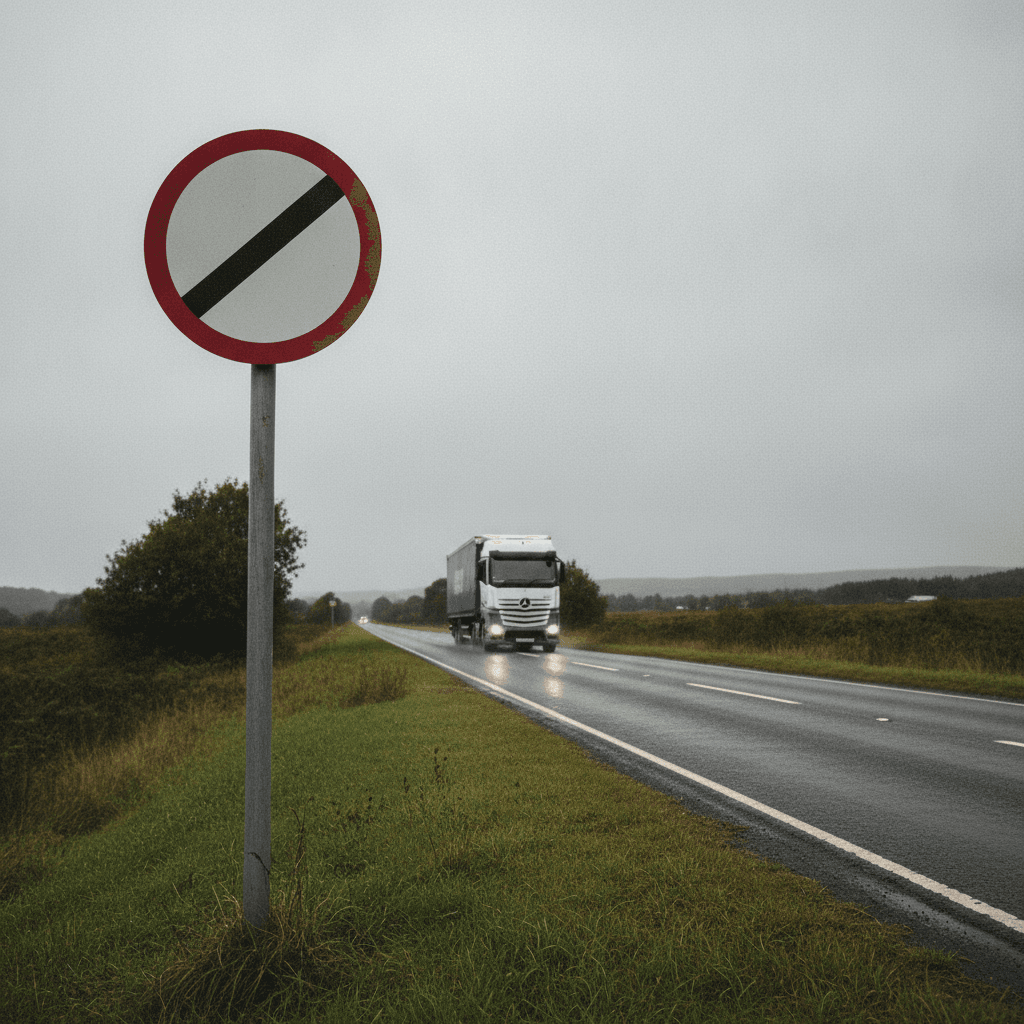
I'll be honest — I'd been running vehicles into Scotland for about six years before I properly understood the speed limits were different. Not different by a lot. But different enough that one of my drivers picked up a ticket on the A9 doing 50mph in what he believed was the national limit for an HGV. In England and Wales, he'd have been fine. In Scotland, he was 10mph over.
That was my fault, not his. The briefing I'd given him was about EU hours and walkaround checks. It said nothing about where he was going or how the speed limits changed once he crossed the border.
The table you actually need
UK speed limits for HGVs depend on two things: the type of road and the vehicle's maximum authorised mass. Here's what the Road Traffic Regulation Act 1984 sets for goods vehicles:
Goods vehicles up to 7.5 tonnes MAM:
- Built-up areas: 30mph (20mph in Wales)
- Single carriageway: 50mph
- Dual carriageway: 60mph
- Motorway: 70mph (60mph if articulated or towing a trailer)
Goods vehicles over 7.5 tonnes MAM — England and Wales:
- Built-up areas: 30mph (20mph in Wales)
- Single carriageway: 50mph
- Dual carriageway: 60mph
- Motorway: 60mph
Goods vehicles over 7.5 tonnes MAM — Scotland:
- Built-up areas: 30mph
- Single carriageway: 40mph
- Dual carriageway: 50mph
- Motorway: 60mph
That gap on single carriageways — 50mph in England vs 40mph in Scotland — is what caught my driver. The A9 between Perth and Inverness runs as a single carriageway for long stretches. At 50mph, most drivers feel like they're being cautious. In Scotland, they're not.
MAM is not the same as laden weight
This catches operators too. The speed limit category depends on the vehicle's maximum authorised mass — what's on the plate — not what it's actually carrying. So an unladen 18-tonne artic tractor is in the over-7.5-tonne category on Scottish roads. It doesn't matter that it's running empty. If it's plated at over 7.5 tonnes, the lower Scottish limits apply the moment it crosses the border.
I've seen operators argue this point. They lose.
The 60mph motorway limit and speed limiters
HGVs over 7.5 tonnes are subject to a 60mph motorway limit across Great Britain — England, Wales and Scotland. That's lower than the 70mph limit that applies to smaller goods vehicles and cars.
Most HGVs over 7.5 tonnes also have a speed limiter set at 90km/h (roughly 56mph) under UK law. So in practice, speed limiters usually keep vehicles within the legal limit without the driver needing to think about it on motorways.
Dual carriageways are where it gets trickier. A 56mph-limited lorry on a dual carriageway in England is under the 60mph legal limit. The same lorry on a Scottish dual carriageway is over the 50mph Scottish limit by 6mph. The speed limiter won't catch it. The driver has to know.
What "dual carriageway" means in practice
The legal category depends on the physical road. A dual carriageway is a road with a central reservation separating opposing traffic. The national speed limit sign — white circle, diagonal black bar — means different things for different vehicles.
The confusion comes on roads that look like dual carriageways but technically aren't — or sections of road that transition between single and dual status. The A9 is a good example again. Some sections are dual carriageway; others are single. The limits flip with the road. If a driver's not paying attention to road type, they'll carry the wrong limit across the transition.
Variable speed limits on smart motorways
Mandatory variable speed limit signs on smart motorways override the national limit. When a signal shows 40mph or 50mph overhead, that's the limit — for all vehicles, including HGVs. The 60mph HGV motorway limit drops to whatever the gantry shows.
DVSA officers stationed near smart motorway zones do check vehicle speed. The same graduated enforcement system applies — fixed penalty of £100 and 3 points for most speeding offences, rising to court summons and unlimited fines for serious excess speed.
Northern Ireland
Northern Ireland uses its own Road Traffic Regulation (NI) Order 1997. The limits for HGVs are broadly similar to England and Wales, but operators running vehicles from GB into Northern Ireland should check the current limits rather than assuming Great Britain rules apply. The Driver & Vehicle Agency (DVA) enforces these, not DVSA.
What the briefing should include
If your drivers do any Scottish runs — regular or occasional — the route briefing needs to explicitly name the speed limits by road type, not just reference the national limit. "National limit applies" isn't enough when the national limit for your vehicle on that road type is 10mph lower than it is on the equivalent road in England.
I include a one-page speed limit table in every new driver induction now. Single carriageway, dual carriageway, motorway — split between England/Wales and Scotland. It takes ten seconds to read. It would have saved my driver a fixed penalty, three points, and the conversation with the Traffic Commissioner that followed when his licence check came back the following quarter.
Employer liability doesn't disappear
When a driver gets a speeding conviction, the notification obligation to the Traffic Commissioner kicks in — 28 days from the date of the conviction, under the O-licence undertakings. That's the operator's obligation, not the driver's. If the conviction involves 6 or more penalty points, it's serious. If you've got a driver running regularly into Scotland who hasn't been briefed on the limits, that's a risk you're carrying quietly until something happens.
The briefing fix is free. The fixed penalty isn't. And a Traffic Commissioner conversation about why your driver was doing 50mph on a Scottish A-road when the limit was 40mph is entirely avoidable if you've told them what the limit is.