Drug and alcohol testing for HGV drivers: no, it's not legally mandatory in the UK — but DVSA still asks for the policy
UK law doesn't require random drug testing for HGV drivers. But DVSA auditors do ask for your substance misuse policy — and 'we don't have one' is a bad answer.
I got asked about our drug and alcohol policy at an operator audit in 2021. Specifically, the DVSA auditor asked to see it. We had a paragraph in the employee handbook that said drivers must not be impaired at work. That, apparently, is not the same thing as a drug and alcohol policy.
The auditor didn't issue a prohibition. But she made a note, and the follow-up letter from the Traffic Commissioner mentioned it by name. One of those moments where you realise there's a gap between what you assumed you were compliant with and what DVSA actually expects to find on file.
What UK law actually requires
Let's start with what's mandatory, because there's a lot of confusion on this.
UK law does not require fleet operators to conduct random drug or alcohol testing of drivers. There is no statutory framework that mandates a testing programme — nothing equivalent to US Department of Transportation rules, nothing like the programmes that apply to rail and aviation workers under the Transport and Works Act 1992.
What the law does require:
Under the Road Traffic Act 1988, it's an offence to drive while unfit through drink or drugs (Section 4) or to drive with excess alcohol or a specified controlled drug above a specified limit in the blood (Section 5A). Those offences belong to the driver.
Under the Health and Safety at Work Act 1974, employers have a duty to ensure the health and safety of their employees and anyone affected by their work activities. Operating a vehicle while impaired is a foreseeable risk that the employer has an obligation to manage. That's your hook as an operator: the HSWA duty creates an obligation to have a system for managing the risk of impairment, even if it doesn't specify what that system looks like.
What DVSA expects on file
At an operator audit, DVSA may ask for a substance misuse policy. It's listed in the audit framework as something good operators have. Its absence isn't an automatic prohibition, but it's a compliance gap that gets noted — and the Traffic Commissioner can take into account whether an operator's systems are proportionate to the risks of their operation.
What the policy should cover:
- The prohibition: Drivers must not be impaired by alcohol or drugs while driving or on duty. That sounds obvious, but it needs to be stated explicitly, with the consequences of breach.
- What 'impaired' means: A definition that goes beyond the legal limit. Most good policies set lower internal thresholds — typically an alcohol level at which the company considers a driver unfit, even below the criminal threshold.
- When testing occurs: If you conduct testing, the policy must say when and how. Pre-employment? Post-incident? With reasonable suspicion? Random? Each of these needs to be documented.
- Consequences of a positive result: What happens to the driver. Suspension pending investigation? Disciplinary process? Referral to occupational health?
- Support provisions: Most employment lawyers recommend including a reference to employee assistance programmes or referral routes for drivers who have a problem. Helps demonstrate the policy is about welfare as well as compliance.
Random testing — legal, but requires consent
You can conduct random drug and alcohol testing of your drivers. But only if you have their consent, and the right place for that consent is in their contract of employment or a standalone agreement they've signed.
Testing without consent is potentially a data protection issue (it involves collection of biometric/medical data) and an employment law issue (breach of contract). A driver who is tested without having agreed to it can refuse, and you can't discipline them for refusing if there was no agreement to testing in the first place.
Pre-employment testing is straightforward: you make it a condition of the job offer. Post-incident testing — testing after an accident or near-miss — is widely accepted by employment tribunals as a proportionate response, again provided it's in the policy the driver signed up to. Reasonable suspicion testing — when a manager observes behaviour that suggests impairment — is also generally supportable if the policy covers it and the procedure is followed correctly.
Random testing is the contentious one. Some operators do it. The Employment Tribunal case law broadly supports random testing where it's been agreed contractually, the testing is genuinely random rather than targeting specific individuals, and the test is conducted by a properly accredited third party. But the testing programme needs to be robust to withstand an unfair dismissal claim if you dismiss someone for a positive result.
What testing doesn't cover
Drug testing detects the presence of substances — not impairment. Cannabis, for example, can be detectable in urine for weeks after use, long after any impairment has passed. A positive test for cannabis doesn't necessarily mean a driver was impaired while driving. That distinction matters in any disciplinary or legal process.
Oral fluid testing (the most common method used in transport) has a shorter detection window and is better correlated with recent use, but it's still not a measure of impairment. Alcohol breath testing is more directly linked to impairment at the time of the test.
Your policy needs to acknowledge this distinction, especially for substances where detection doesn't equal impairment. Most employment lawyers recommend a policy that covers both 'positive test result' and 'evidence of impairment', and treats them as separate grounds for action.
At-work alcohol checks — a practical starting point
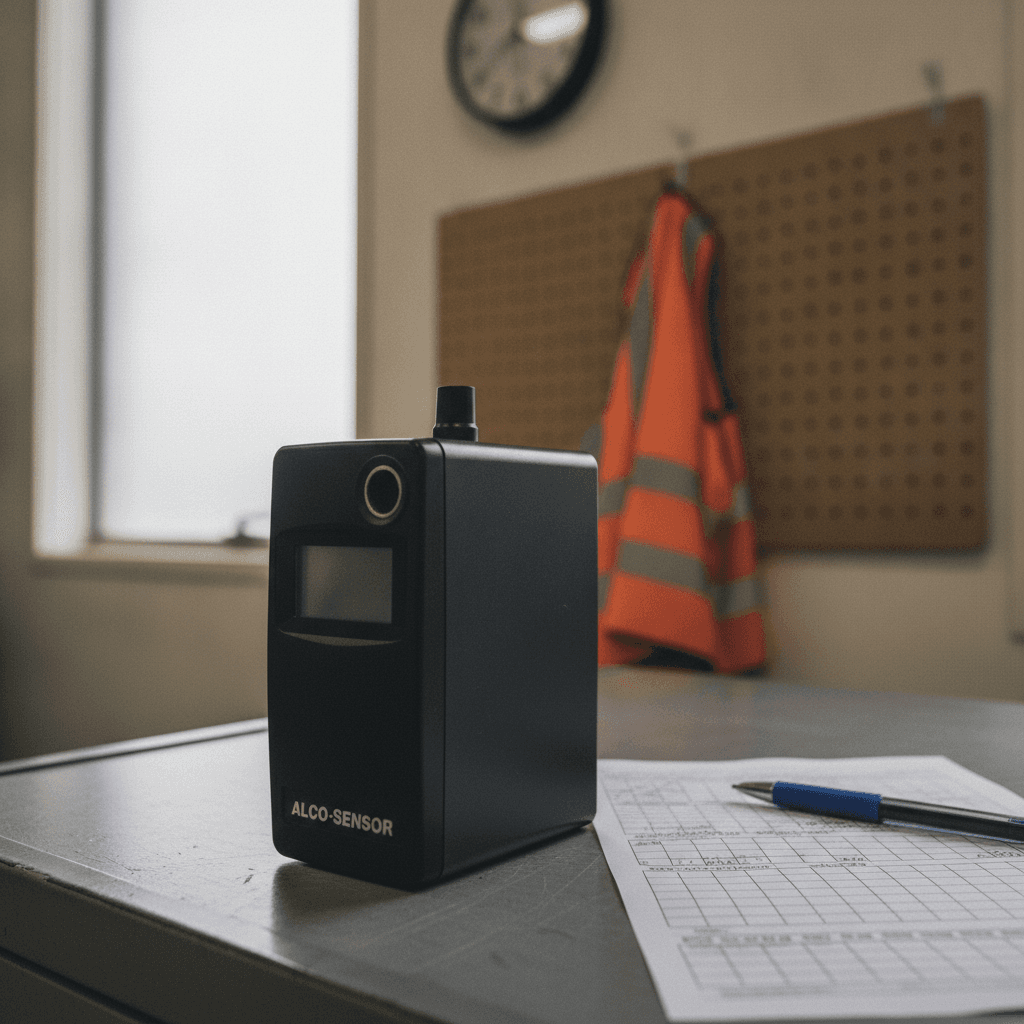
Even if you don't run a formal drug testing programme, a basic alcohol screening at the start of shift is practical, cheap, and defensible. Breathalysers for pre-shift checks cost under £100 each. The ones used by police forces for evidential testing are different — breathalysers for workplace use are indicative, not evidential — but a positive reading is grounds for a reasonable-suspicion conversation and can support a decision to stand a driver down.
If you do pre-shift breath checks, document them. A simple log — driver name, date, time, result — is enough. The record demonstrates that you're operating a system, not just hoping for the best. I've seen operators who do daily breath checks for every driver and keep the logs for 12 months. That's a reasonable response to the HSWA duty and it's something a DVSA auditor will note positively.
Prescription medication — the gap most policies miss
The drug conversation in fleet management usually focuses on recreational drugs. The prescription medication issue is less discussed and arguably more common in practice.
A driver prescribed opioid painkillers, strong sedatives, or certain antihistamines can be impaired by those medications even when taking them as directed. The Road Traffic Act applies to prescribed drugs as well as controlled substances — the defence is that the drug was taken as directed by a doctor and there was no accompanying warning against driving. But that defence requires the driver to know about the warning, to have checked with the prescriber, and for there to be no evidence of impairment.
Your policy should require drivers to notify management if they've been prescribed medication that could affect their ability to drive safely. Not to breach their medical privacy — but to allow an occupational health conversation about fitness for duty. A driver who discloses a prescription and is stood down for a shift while you get advice is in a very different position from a driver who says nothing, drives impaired, and is involved in an accident.
What a minimal compliant policy looks like
I rewrote ours after the 2021 audit. Two pages. Covers: the prohibition, what counts as a breach, when we test (post-incident and reasonable suspicion; no random programme), the process, prescription medication notification, consequences and support. Drivers sign it at induction and again if we make changes.
That's not the most sophisticated drug and alcohol programme in the industry. But it satisfies the HSWA duty, it gives the DVSA auditor something to read, and it means every driver on my fleet knows exactly what the rules are. Which is the point.
If you don't have one: write it this week. It doesn't need to be long. It needs to exist, to be signed, and to be on file. The DVSA auditor will ask for it eventually.