Driver CPC card expired: what operators must check immediately and how the driver gets back behind the wheel
My driver's DQC expired and he kept driving for two days before I caught it on a licence check. Here's what to check and how reinstatement works.
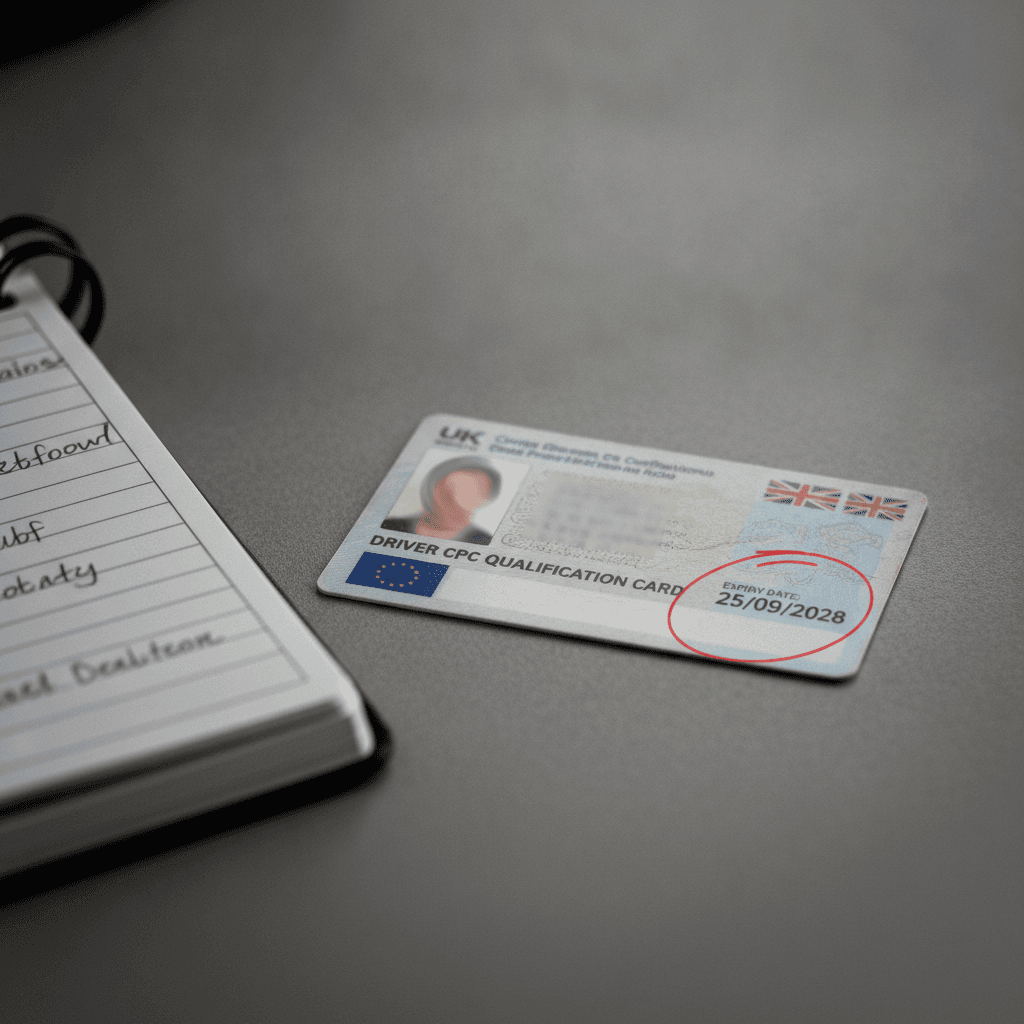
A driver called in sick on a Monday. I ran our standard licence check while sorting the rota cover — something I do every two weeks as a matter of habit. His DQC showed expired three weeks earlier. He'd been driving for us since the expiry date. Four shifts.
He hadn't told me. Possibly he didn't know — genuinely. His five-year training cycle had run out and the reminder letter from DVSA had gone to his old address. But the result was the same: four days of professional driving without a valid Driver CPC, each one carrying up to a £1,000 fine.
Here's how the DQC system works, what happens when a card lapses, and the operator check routine that catches it before DVSA do.
What the DQC is and when it expires
The Driver Qualification Card — the DQC, sometimes just called the "Driver CPC card" — is the physical card that confirms a driver holds a valid Driver Certificate of Professional Competence. To get one and keep one, professional HGV and bus drivers must complete thirty-five hours of approved periodic training every five years.
The card is issued by DVLA following confirmation from DVSA that the driver's training record is complete. It carries a photo and is specific to the holder. The driver must carry it while driving a lorry, bus or coach professionally — it's not enough to have completed the training; the card must be physically with the driver in the cab.
The card expires at the end of the five-year cycle. There's no grace period. The day after it expires, the driver cannot legally drive professionally. Not for a week. Not for a day. Not for a shift. Immediate.
Two separate penalties
The DQC system has two different penalty layers that operators sometimes conflate.
The first and more serious one: driving professionally without a valid Driver CPC qualification at all. This carries a fine of up to £1,000. This is the offence for a driver whose training cycle has lapsed and who hasn't completed their thirty-five hours for the new cycle.
The second: not carrying the physical DQC card while driving professionally, even if the qualification is current. This carries a fixed penalty of £50. If a driver has done their training, has a valid DQC issued, but doesn't have the card in the cab — that's the £50 offence, not the £1,000 one. Different amounts, different meaning.
Both matter. Both show up differently in enforcement data. Know which one you're dealing with.
Training done doesn't disappear when the deadline passes
One thing that confuses drivers and operators: if a driver misses their five-year deadline, the training they've already completed doesn't evaporate. GOV.UK is explicit about this: "Any training you've already done counts for 5 years from the date you took the course. You do not lose it because you've passed your deadline."
So a driver who completed twenty hours of training over the last five years, missed the deadline, and hasn't completed the remaining fifteen hours — they don't start from zero. They complete the remaining fifteen hours, get their record updated, and their DQC is reinstated. Their next five-year deadline runs from when they finished the training — not from when their old card expired.
If a driver has done zero training in the five-year cycle and missed the deadline, they need a full thirty-five hours before the DQC can be reinstated. Either way: no driving professionally until it's done.
How reinstatement works
To reinstate a lapsed DQC, the driver completes the remaining periodic training hours through DVSA-approved training providers. Training providers must be approved by DVSA; the approval covers both the provider (as a training centre) and the specific course content.
There is also a test-based route for reinstatement — the driver can take Driver CPC part 2 (case studies) and part 4 (practical demonstration) tests instead of completing training hours. But this option can only be used once; after reinstatement by test, future cycles must be completed through training. Book these tests by phone through DVSA on 0300 200 1122 — they can't be booked online.
Once training is complete, DVLA issues the new DQC. The card arrives in the post. The driver shouldn't drive professionally until they have the card in hand, even if their training record is updated. Remember: not carrying the card is a separate £50 offence from not having the qualification.
What operators must check and how often
Driver DQC expiry should be checked as part of your regular driver compliance monitoring. This isn't optional — under the undertakings of your O-licence, you're responsible for ensuring drivers meet the legal requirements for professional driving. A driver without a valid DQC is a driver you shouldn't be putting in a cab.
The DVLA Driver Enquiry Service allows operators to check licence status online with a driver's consent. DQC status is visible through the DVSA JAUPT portal and the driver's training record. Some licence-checking services include DQC status — confirm this with your provider if you use a managed checking service.
Check expiry dates for every driver, every month. Flag drivers whose DQC expires within ninety days. Chase them for confirmation their training is booked. Ninety days is enough time to complete a thirty-five-hour programme if the driver acts immediately — but it's not generous. And if the training has to be booked in specific slots around operational demands, sixty days isn't always enough.
Building the advance warning system
Spreadsheet, compliance software, calendar reminder — whatever your system is, it needs a DQC expiry column for every driver. Set alerts at ninety, sixty, and thirty days before expiry.
At ninety days: confirm with the driver that they know the deadline and have booked training.
At sixty days: confirm training dates are in the diary. Check against operational commitments.
At thirty days: confirm training is underway or complete. If it's not complete, take the driver off professional driving roles until the DQC is renewed. A month of light duties is far better than a £1,000 fine and an O-licence investigation.
Also: make sure your advance notice letters from DVSA reach the driver. DVSA sends renewal reminders, but they go to the driver's address registered with DVLA — which may not be current. If a driver moves and doesn't update DVLA, the reminder disappears. Your calendar check catches what postal reminders miss.
What happens if a driver drove on a lapsed DQC
If you discover a driver has been driving professionally after their DQC expired — whether four shifts or four months — you need to stop them driving immediately and then work backwards.
Document when you found out, how you found out, and what you did next. Brief the driver on the rule. Get them enrolled in training immediately. Keep a record of every step.
Whether to self-report to the Traffic Commissioner depends on the circumstances. For a short period — a few days, a genuine misunderstanding about the deadline — a solicitor or transport consultant is worth speaking to before you do anything. Self-reporting demonstrates good faith but also puts the issue on record. Get advice first.
The OCRS implications aren't automatic from a DQC lapse unless DVSA issue a notice or prohibition in connection with it. The risk is greatest if the driver is pulled at a roadside check during the lapse period — that creates an enforcement record that directly links to your operator licence.
Hiring new drivers: the DQC check on day one
Before any new driver puts a vehicle on the road for the first time, see their DQC. Not a photocopy. Not a photo on their phone. The actual card. Check the name matches the driver. Check the expiry date. Record the card number and expiry date in their file.
If a new driver says their DQC is "in the post" or "being renewed" — they don't drive commercially until it's in hand. No exceptions. The agency agreement doesn't protect you. The subcontract arrangement doesn't protect you. The vehicle is your O-licence and the driver operating it without a valid DQC is your problem.
The role of JAUPT in tracking training hours
Training hours are recorded centrally through the DVSA periodic training database. Training providers must record the hours a driver completed within five working days of the course ending. They access the system through Government Gateway.
This means the driver's training record is searchable by DVSA at any time. When a DVSA officer at a roadside stop checks a driver's DQC, they're checking the card. If they have cause to look deeper — or if they're doing a targeted compliance check — they can verify the underlying training record.
As an operator, you can't access the JAUPT training database directly for your drivers. But you can ask drivers for a printout or screenshot of their training record from the DVLA or JAUPT system, particularly when hiring. The DQC card confirms the card is valid; the training record confirms what's behind it.
Repeat training: DVSA can cancel hours
One thing worth briefing drivers on: DVSA can cancel hours if a driver repeatedly takes the same course without good reason. If a driver completes the same course on multiple occasions in the same five-year cycle — same subject, same content — DVSA have the power to disallow the repeated hours. Training that's been cancelled doesn't count toward the thirty-five-hour total.
The thirty-five hours must cover a range of subjects from the Driver CPC syllabus, not the same module repeated seven times. This isn't a widespread problem, but it does happen with drivers who find one local provider and book the same half-day course repeatedly. Check that your drivers' training plans have enough variety to cover the syllabus and survive scrutiny.
Self-employed drivers: a specific compliance risk
If you use self-employed drivers — owner-operators, or drivers who invoice you directly rather than being on payroll — the DQC obligation still applies. They cannot legally provide professional driving services to you without a valid DQC, regardless of their employment status.
The difference from an agency driver or an employee is that self-employed drivers typically manage their own compliance. They're not your employee, so your HR system may not track their DQC. But if they're driving your vehicles — or driving vehicles on your work — the O-licence implications are the same as for a direct employee.
For any driver you engage on a self-employed basis, see the DQC before the first shift. Record the expiry date. Ask them to notify you when they're within ninety days of their next renewal. This is a matter of good practice rather than just good faith — your licence depends on the drivers you put in your cabs meeting the requirements, regardless of how they're paid.
The annual driver documentation audit
Once a year, run a complete documentation check across all drivers on your fleet. Driving licence (Group 2 entitlement valid, medical current), DQC (expiry date checked, not within sixty days), and any other specialist qualifications — ADR certificate if applicable, DCPC for specific vehicle types.
This isn't the same as the monthly licence check routine — the monthly check focuses on endorsements and disqualifications. The annual audit is a broader review of everything a driver needs to drive legally in their role. It takes about thirty minutes per driver if your records are well organised. It's the check that catches the driver who quietly let something lapse and didn't tell anyone.
Date the audit, record what you found, file the results. If you find an issue — expired DQC, lapsed medical, licence restriction you didn't know about — you have a documented process showing you identified it and dealt with it. That record matters if the same issue comes up later in an enforcement context.