Mobile phones behind the wheel: the 6-point offence and what it means for your O-licence
A driver on my fleet got 6 points for using his phone at traffic lights. It wasn't just his problem. Here's what the operator's liability looks like and why the fine for a lorry driver can reach £2,500.
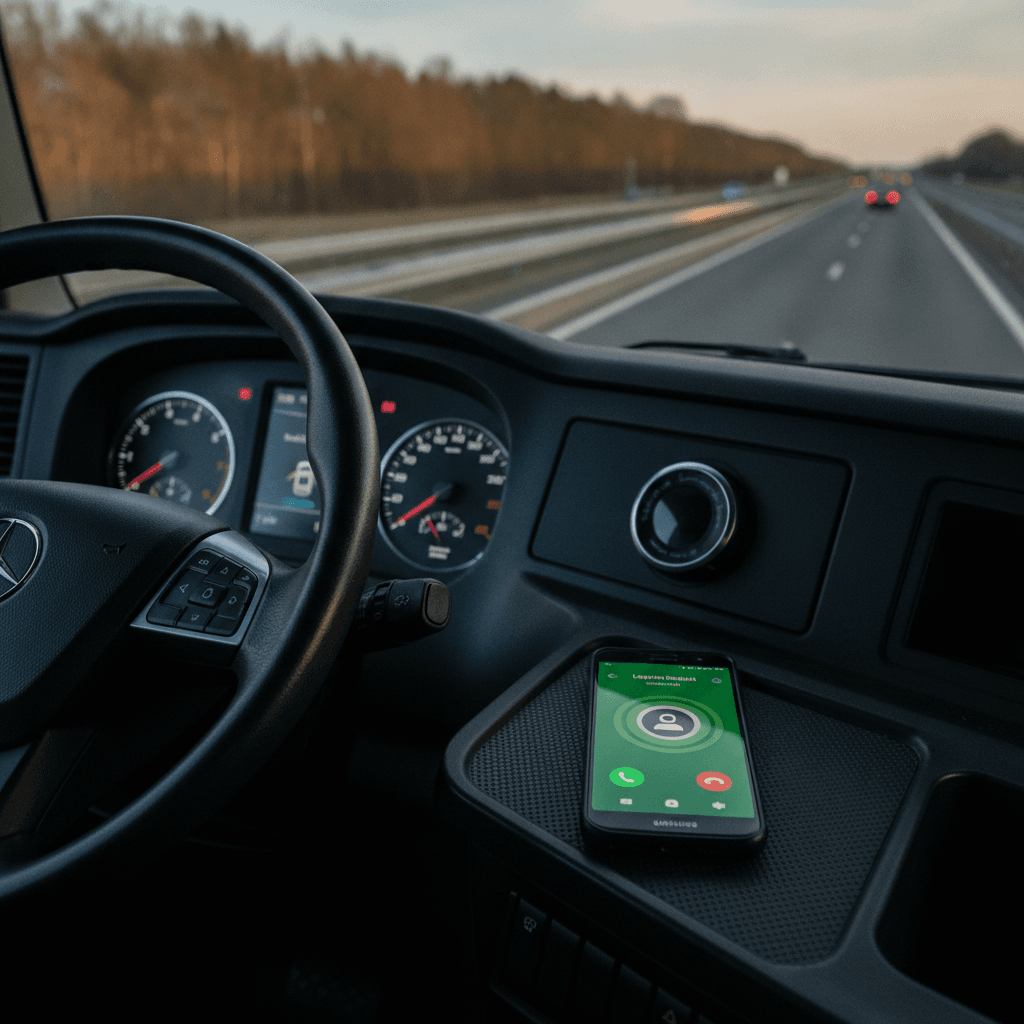
One of my drivers got six penalty points last autumn. Not on the motorway, not at speed — at a set of traffic lights in Coventry. He had his phone in his hand. Traffic officer spotted it through the side window.
Six points and a £200 fine for him. And then the conversation I had to have about his licence, his next renewal, and whether he could stay in the cab started.
What the law actually says
The rule has been tightened since the old days of 'just texting'. You can't hold and use any device capable of sending or receiving data while driving. That includes taking photos, browsing, using apps offline, filming — even if the device is on flight mode. The prohibition is on holding and using the device, not specifically on making calls.
And yes, sitting at traffic lights counts. So does being stationary in queuing traffic. The engine running and the vehicle in motion aren't the test — the test is whether you're driving, and legally you are until you've parked.
The fixed penalty for a standard offence is six points and a £200 fine. If the case goes to court — which happens when an officer decides to report rather than issue a fixed penalty, or when the driver contests it — the maximum fine for a lorry or bus driver is £2,500. Not £1,000 like a car driver. £2,500.
Why six points matters for HGV drivers specifically
Accumulate six points and you can still drive. But a professional driver approaching six points on their licence is in a different position to a car driver. A lot of lorry operators don't know this until it becomes relevant.
A new driver who passed their test within the last two years loses their licence automatically at six points, full stop. But for established HGV drivers, the concern is different. Courts and the DVLA take totting-up seriously for any driver who reaches 12 points. And six points from one phone offence puts you halfway there before you've accumulated anything else.
The driver on my fleet had two points from a speeding offence two years before the phone incident. After the traffic lights stop, he was at eight. We had a very direct conversation about how close that was to a totting-up hearing — and what would happen to his employment if his licence went.
What the operator can — and can't — do
Here's the part most fleet managers don't think about until they're in it. When a driver gets points on their licence, that affects their DVLA record. It doesn't automatically land on your OCRS. But if DVSA later pull that driver at the roadside and find an active fixed penalty or a pending licence endorsement, it can trigger questions about your driver management — specifically whether you knew, whether you checked, and what you did about it.
Your licence check process is the first line of defence. If you're running monthly licence checks through DVLA (which most operators should be doing by now), you'll pick up penalty points within a reasonable time of them being applied. If you're checking quarterly or less, or relying on drivers to self-declare points — you'll find out the same time DVSA does, which is too late.
As an operator, you're not responsible for a driver's individual driving offence. But you are responsible for knowing about it and acting on it appropriately. If a driver accumulates points and you've done nothing — no licence check, no conversation, no updated risk assessment — that's a gap in your driver management that a TC will notice.
The phone policy most operators think they have
Most operators have a mobile phone policy. It says something like 'drivers must not use handheld phones while driving.' Signed by the driver at induction. Filed away.
That's not enough on its own. If a driver gets a phone offence and you're asked what steps you took to prevent it, 'they signed a policy three years ago' won't carry much weight. What's your enforcement process? Do you monitor dashcam footage for phone use? Is it a disciplinary matter? Is it covered in driver briefings?
I started including phone use specifically in our quarterly driver debriefs after the incident in Coventry. Short conversation, five minutes: reminder of the policy, specific mention of the points and fine, and a note in the driver file that we'd discussed it. If that driver gets another phone offence, I have evidence I did something proactive.
Hands-free: what's legal and what's still risky
Hands-free calling through a Bluetooth headset or the vehicle's built-in system is legal. Dashboard-mounted phone holders used for navigation are legal. What isn't legal is picking the phone up from the holder while driving — even briefly — to change the sat-nav destination or accept a call. Holding equals using.
From a practical standpoint, I'd treat hands-free as a compliance baseline, not a green light. The distraction argument isn't going away — and some insurers have started asking whether drivers were on a call (hands-free or otherwise) when an incident occurred. The safer position is fewer calls in the cab, not just legal ones.
The hire and reward angle
One thing that often gets missed: if a driver commits a serious moving traffic offence — and a six-point phone offence counts — it can affect their Driver CPC periodic training record if it results in a conviction rather than a fixed penalty. Convictions of certain types can be relevant to a TC's assessment of a transport manager's professional competence and good repute as well. The connection between individual driver behaviour and the broader O-licence picture is tighter than most operators assume.
It's not a catastrophic link on a single offence. But it's a thread, and threads accumulate.