DVSA roadside check: what actually happens from the moment the examiner knocks on the cab
My Scania got pulled at Hilton Park services last April. Here's what the examiner asked for, in what order, and the one thing my driver nearly got wrong.
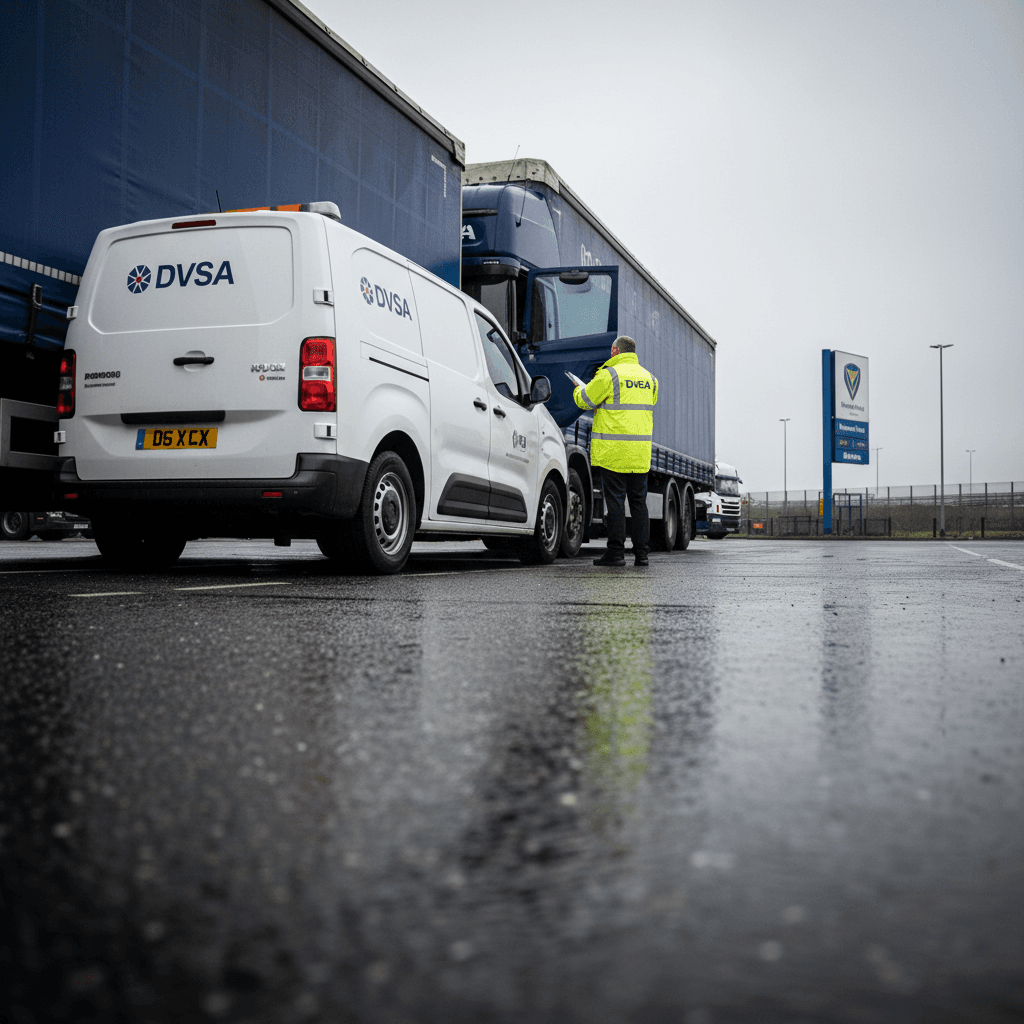
The blue lights aren't always police
A lot of newer drivers don't clock this. If you're directed into a check site off the A1 near Ferrybridge, or a DVSA car pulls in front of you on the M6 with FOLLOW ME lit up and leads you into Hilton Park services, or into a lay-by near Exeter — that's not a traffic stop. That's a roadside compliance check. Different rules. Different paperwork. And a different mindset from the person doing the checking.
I've had drivers pulled in twelve times over fifteen years across four different vehicles. Some went smoothly. One didn't. The difference, almost every time, came down to the first ninety seconds.
What happens when the DVSA examiner approaches the cab
They'll knock, or gesture for you to come down. Either way, your driver steps out.
The examiner introduces themselves, shows their authorisation card, and tells the driver they've been selected for a compliance check. Your driver has the right to see that card. They won't usually mind being asked.
In the first ninety seconds, the examiner is forming an opinion. About the driver's demeanour. About the vehicle condition. About how organised the cab is. That opinion shapes everything that follows.
A driver who's calm, has their documents ready, and engages professionally buys goodwill. Not immunity. But goodwill. A driver who's aggressive, can't find their card, or immediately starts explaining why they've been driving for six hours doesn't get the same experience. Simple as that.
The documents DVSA ask for first
Every driver on my fleet knows this list before they drive alone. Roughly in the order they'll be asked:
Driving licence — GB or third country. If it's a non-GB licence, know whether it requires an IDP for the journey.
Tachograph driver card. Inserted in slot 1. The examiner downloads and analyses it there and then using their OPTAC reader or equivalent. If the card shows infringements, that conversation starts immediately.
The tachograph unit printout for the current day — if the driver has changed vehicles or had a manual entry situation. On most digital vehicles this isn't needed; the unit holds the data. But if your driver used a different vehicle yesterday, or had a card reader fault, they need to explain that clearly and calmly.
Certificate of Professional Competence card — the DQC. If it's expired, that's a prohibition on driving commercially until renewed. No exceptions. I've seen drivers stopped, DQC checked, and sent back to the depot in a taxi. Not a good afternoon for anyone.
O-licence disc — displayed in the windscreen. The examiner checks expiry, the plate count, the operating centre. Make sure it matches the vehicle and hasn't been forgotten during a temp vehicle swap.
For international movements: CMR waybill, Community authorisation, and ADR documentation if applicable.
The vehicle inspection itself
After documents, the examiner does a physical inspection. It varies by examiner and by how the vehicle presents — a scruffy truck with a cracked mudguard gets more scrutiny than a clean Volvo FH with fresh tyres. That's not a rule. It's human nature.
Standard inspection points: lights (front and rear), tyres (condition, tread depth, pressure if they have a gauge), brakes, load security, bodywork, mirrors, wipers, exhaust, coupling gear on artics.
If they find a defect, they'll categorise it. S-marked prohibitions are for dangerous immediate defects — severely worn tyre, brake failure, cracked windscreen obscuring vision. Vehicle stops. Now. An ordinary PG9 covers defects that are unsafe but not immediately dangerous — you typically get to the end of the shift, but the vehicle can't be used again until the defect is cleared and the prohibition lifted.
Advisory notices — not prohibitions, but formal records that a defect was found — go on your OCRS record regardless. Don't assume advisory means nothing happened.
Tachograph analysis on the spot
This is what catches operators off-guard if they haven't thought about it.
The examiner has software. They download the driver card and within a few minutes can see infringements — missed breaks, reduced daily rest, excess driving, manual entries that don't add up. They see not just today's data but typically the last 28 days on the card.
A driver who's been managing their card badly — taking reduced rests every day, running the 4.5-hour driving limit to the minute, stacking compensatory rest incorrectly — that shows up as a pattern. Not just today's shift.
I had a driver once who'd been taking reduced rest four nights a week for six weeks. He'd told himself he was within the rules because technically each individual night was above the 9-hour minimum. But under the EU/assimilated rules, you can only take reduced rest three times between weekly rest periods. By week three he was consistently in breach. He didn't know. The examiner absolutely did.
What my drivers know to do — and not do
Don't volunteer problems. Answer questions directly and honestly, but don't start explaining things that haven't been asked about.
Know where your pre-trip walkaround is documented. Whether that's a paper defect form or a digital daily check, have it accessible. An examiner who asks "did you do a walkaround today?" wants to see evidence, not a verbal yes.
Don't argue about the tacho data. If the examiner shows the driver an infringement on screen, the right response is "I'll report that to my transport manager." Not "that's wrong" or "the machine made an error." Dispute it properly later through the formal process if needed.
Keep calm if the inspection takes a while. Check times run from ten minutes to three hours depending on what they find. A two-hour inspection doesn't mean something's badly wrong — it might mean the examiner is methodical. Stressing the driver out while they wait doesn't help anyone.
After the check: what comes back to me
After every roadside stop, I want three things from my driver before they continue the journey.
The outcome: prohibition (S-marked or ordinary), advisory, or no defects found. Not a verbal summary — the actual written notice if one was issued.
The tachograph analysis summary if the examiner printed one. Some don't. But if they did, I want it.
A brief account of what was checked and what was discussed. This isn't about catching drivers out — it's about knowing whether the check is likely to show up on my OCRS before the monthly data update does.
DVSA feeds roadside check results into OCRS within a few weeks. A prohibition goes on the record. An S-marked prohibition carries significantly more weight. A clean check where nothing was found goes on too — and those are actually useful, because clean checks improve your OCRS score.
What happens if the vehicle fails badly
An S-marked immediate prohibition means the vehicle cannot move under its own power. You need to arrange recovery or repair at the scene. If the load is time-critical or the driver is stranded somewhere inconvenient — that's your problem to solve.
I keep a roadside emergency procedure card in every cab. Recovery company contact, my mobile number, the depot number, and the instruction to call me before calling anyone else. It means I can authorise spend and start the paperwork before a flustered driver starts making decisions they shouldn't.
S-mark prohibitions stay on OCRS for five years. Two in 12 months and I'd be very surprised if you didn't receive a formal letter from your regional Traffic Commissioner.
A note on fixed penalty notices
Some offences at roadside result in a fixed penalty in addition to, or instead of, a prohibition. Common ones: expired DQC card (driver pays), tachograph offences (driver and potentially operator), overloading (operator liability).
Fixed penalty notices issued to drivers at roadside don't automatically become your liability as the operator. But they do become your problem — a driver who's been hit with a roadside FPN may not be reliable at self-reporting it. Find out what happened before DVSA's enforcement team does.
The one thing most operators don't brief their drivers on
The examiner's card. It's a physical authorisation. DVSA vehicle examiners have specific statutory powers — they can stop and inspect, issue prohibitions, and require documents. They don't have the same powers as a police officer. Their powers relate specifically to the vehicle's roadworthiness and the driver's documentation.
Knowing this helps a driver understand what the examiner can and can't do. It reduces the instinct to panic. And a driver who understands what's happening is a driver who doesn't make it worse by accident.