DVSA walkaround checks: the 6 defects that got my drivers pulled in at Hilton Park
My drivers have been pulled at Hilton Park twice in 18 months. Both times it was the same class of defect the walkaround should have caught. Here's the list I hand new starters.
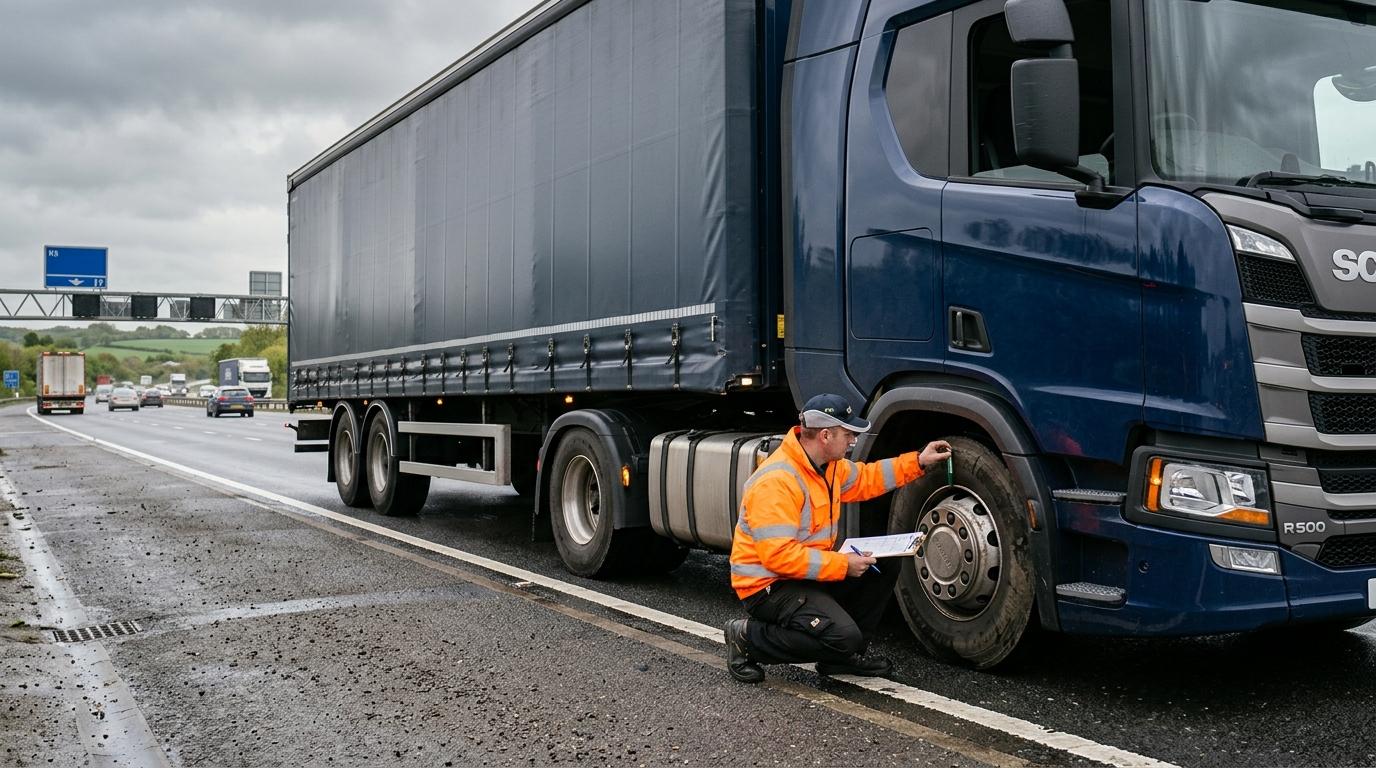
The first time I watched a DVSA officer do a walkaround on one of our trucks at the side of the A14, I thought we were fine. The driver had ticked the box that morning. The defect book was up to date. The trailer was clean. Then the officer found a brake light hanging by its wire on the trailer rear, and a tyre on the second axle showing cord at the inner edge.
That cost us a PG9 prohibition and a delayed delivery. The driver swore he had checked it. I believed him. He had walked around the vehicle. He had not, in any meaningful sense, checked it.
This is the gap I want to talk about: between the walkaround that drivers think they are doing and the walkaround that DVSA expects. They are not the same thing, and the cost of confusing them is real money.
What the walkaround check is actually supposed to be
The Driver and Vehicle Standards Agency publishes the Guide to Maintaining Roadworthiness, which is the document inspectors are working from when they pull you in at the side of the road. It lists the items that should be checked before a vehicle goes on the road, every single time. Not weekly. Not when you remember. Every shift, by the driver who is about to drive the vehicle.
Some of those items are obvious: tyres, lights, mirrors, indicators, washers, horn, wipers. Some are less obvious and get skipped almost universally: brake lines, body security, ABS warning lamp behaviour, trailer landing legs, spray suppression flaps, load security on the kingpin and twist locks if you are running containers.
The full list is in section 4 of the Guide, and it is worth reading not because you will memorise it, but because reading it once changes how you watch a driver do a check. You start noticing what they are not looking at.
The five things most drivers skip
I have watched a lot of walkarounds over the years, on a lot of yards, with drivers I trust. These are the items that get missed almost every time, regardless of the driver:
- The trailer brake lines. Drivers connect the susies. They very rarely check them for chafing, perished rubber, or that the suzie itself is not splitting at the connector. A failed brake line on a tip is the kind of thing that ends careers.
- The number plate lamp. Sounds trivial. It is. It also gets you a PG9 prohibition if it is out at the wrong moment, because the lamp is required by law and the absence of one is technically an offence. Easy fix, but only if you noticed.
- Inner sidewalls of tyres. The outer sidewall is fine, drivers see that. The inner sidewall on a twin-tyre setup is invisible without crouching down and angling a torch. Most drivers walk past it. Inspectors do not.
- Reflectors and side markers. These get knocked off by hedges and yard equipment and nobody notices because they are not lights. They are still mandatory and DVSA will absolutely write them up.
- The condition of load straps when running flatbeds. Frayed webbing, ratchets that do not lock, hooks that are bent open. Drivers rarely inspect these as part of the walkaround because the load is always already on. That is exactly why DVSA does, and that is what triggers PG9s for insecure loads under section 40A of the Road Traffic Act.
What gets you a prohibition vs a verbal warning
This is the part most fleet managers do not understand until it happens to them. A walkaround defect is not automatically a prohibition. DVSA grades defects by severity, and they have a fair amount of officer discretion at the roadside. The grading roughly works like this:
Inspection notice (no prohibition): something is wrong but the vehicle is safe to continue. You get told to fix it inside a stated period and provide proof. An indicator bulb out on a non-essential side light, for example. Annoying, but not a stoppage.
Delayed prohibition: the defect is serious enough that it must be repaired, but the vehicle can continue to a place of repair under specific conditions. You have a clock running. This is where most worn brake pads and exhaust leaks land.
Immediate prohibition (PG9): the vehicle is not going anywhere on a road until it is fixed. Bald tyre, broken steering component, brake imbalance over the legal threshold, dangerous load. The truck stays where it is or goes on a recovery. This is the one that costs you a delivery, fuel for a recovery vehicle, and an entry on your O-licence file. DVSA also tracks the rate of these against your O-licence, and if they pile up, the Traffic Commissioner gets interested. That is where it starts costing you the licence itself, not just an afternoon.
How to do a walkaround check that actually works
The honest truth is that a proper walkaround check on a tractor unit and trailer should take about 12 minutes if you are doing it properly. Most drivers do it in 4. The reason is not laziness. The reason is that the system most fleets use rewards speed and punishes nothing.
If a driver ticks every box on a paper sheet in 4 minutes and nothing happens, they will tick every box in 4 minutes again tomorrow. The check has become a ritual, not an inspection. The only thing that breaks this loop is a system that makes the check actually visible to someone who cares.
What works in practice, in the order that has worked for me:
Make the check itemised, not free-form. A clipboard with "walkaround complete: yes/no" is functionally useless. The driver needs to confirm each item one at a time. If you are still on paper, this means a longer form. If you are using software, it means a checklist that requires each item to be marked individually before submission.
Photograph the defects. A defect with no photograph is half a defect. The transport manager has no way to assess severity, the workshop has no head start when the truck rolls in, and there is no audit trail if DVSA later asks why a defect took three days to fix. A photo costs four seconds and removes all of that ambiguity. This is the single biggest improvement most fleets can make to a paper-based system.
Review the checks daily, not weekly. If your transport manager only looks at walkaround records when DVSA asks, you have a paperwork problem disguised as a compliance system. The checks should be visible the moment they are submitted, and someone whose job depends on it should read them.
Stop confusing the daily walkaround with the safety inspection. The safety inspection is the periodic one done by a fitter or workshop, on the schedule on your O-licence, usually every 6 to 8 weeks for an HGV doing serious mileage. The walkaround is the daily one done by the driver. They are different things and DVSA will check that you understand the difference. If your records muddle them, that itself is a compliance failure.
Why paper and spreadsheets quietly fail
I am not going to pretend nobody does this on paper anymore. Plenty of fleets still do, and most of them are not getting roadsided enough to feel the cost. The problem with paper is not that it cannot work in principle. It is that it cannot scale, and it cannot provide an audit trail in any reasonable time.
When DVSA opens an investigation, they will ask for walkaround records for a specific date range. If those records are in a binder in the cab of a truck that is currently in Glasgow, you have a problem. If they are in a binder that the driver lost a fortnight ago, you have a bigger problem. If they are in a spreadsheet that the office admin updates weekly from photographs of paper sheets, you have invented work that adds nothing and breaks under audit.
This is the part where I should mention that we built FleetPad's vehicle check feature specifically because we got tired of watching this exact failure mode happen to fleets that thought they were compliant. The full vehicle list ties checks to specific vehicles so a transport manager can pull a defect history in seconds. But honestly, even if you do not use FleetPad, you should be using something digital. Anything that takes the records out of the cab and puts them in front of the person responsible.
Frequently asked questions
How long should a walkaround check take?
Around 10 to 12 minutes for a tractor and trailer if you are checking every item on the DVSA list. Less if you are running a rigid with no trailer. I have timed my own checks against drivers I trust, and 10 minutes is the floor for actually doing it. Anything under 5 minutes means at least one item is being skipped, and usually more than one.
Can a driver refuse to drive a vehicle that has failed the walkaround?
Yes, and they should, and the law backs them up. If a driver identifies a defect that makes the vehicle unsafe, they cannot legally take it on a road, and a fleet that pressures them to do it anyway is in serious trouble if the case ever reaches the Traffic Commissioner. Document the refusal. The driver should write down what they found and what they were told to do. That paperwork protects everyone, including the driver.
What is the difference between a daily walkaround and a first-use check?
The first-use check is done on a vehicle the first time it is used in a shift, and it is what most people mean when they say walkaround. If a vehicle changes drivers mid-shift, the new driver should also do their own check before taking it out. This is the part that gets missed in agency-driver setups, where a vehicle might pass through three drivers in a day and only get one walkaround documented.
Does DVSA inspect walkaround records during an audit?
Always. An O-licence audit will ask for at least 90 days of walkaround records, sometimes more, and they will read them. Patterns matter as much as individual entries. If the records are too clean, that itself is a flag. Real fleets find defects. A fleet that records zero defects across 90 days is either not doing the checks or not recording them honestly, and DVSA knows both options well.
What happens if a defect is found and not fixed before the next shift?
It depends on severity. A minor defect can be deferred with a written note, but the deferral itself needs documenting and a date for repair. An urgent defect cannot be deferred at all and the vehicle should not move until it is repaired. The mistake fleets make is treating to be fixed as the same as fixed. It is not, and DVSA will read those notes carefully if they ever see them.
If you take one thing from this: the walkaround check is the compliance ritual that catches more fleets out than any other, and the way most fleets do it is wrong. Not because the drivers are lazy, but because the system around them rewards speed and ignores the records until it is too late. Fix the system and the rest follows.