Fleet telematics and tachograph integration: what actually syncs, what doesn't
Four times I've sat through a 'telematics integration' pitch. Not once did it mention that GPS data can't replace a tachograph download. Here's the gap.
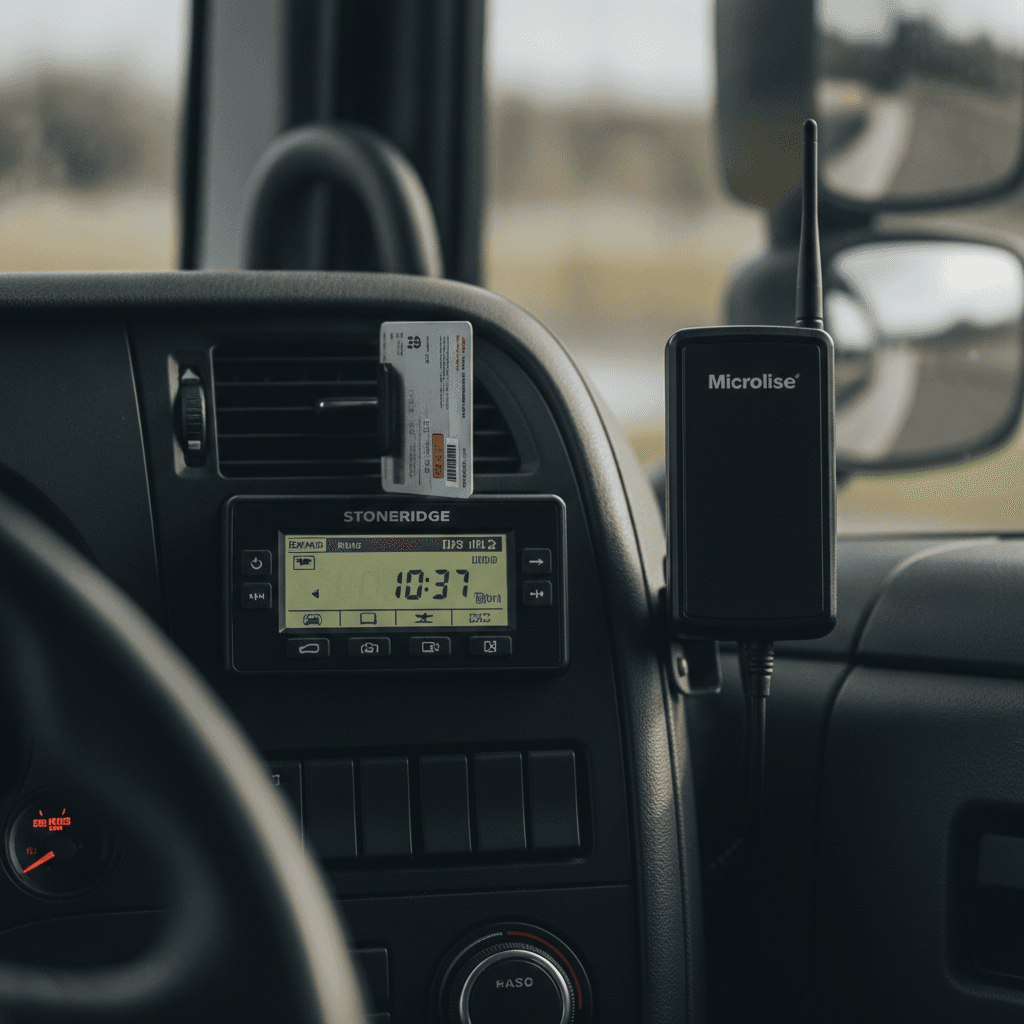
The sales pitch goes something like this: "Our telematics system integrates with your tachograph, so you'll have full compliance data in one place." I've sat through that presentation four times over the years. Every time, I've had to ask the same question afterwards: but what does that actually mean?
Because "integration" covers a lot of ground. And if you're running under an O-licence and betting your compliance on a telematics dashboard, you need to understand exactly where the legal obligation sits — and whether your telematics system is meeting it, or just performing the appearance of meeting it.
Two completely different systems
Start with the basics. A tachograph records specific things under specific legal requirements. Your telematics system records something else entirely. These are not the same thing dressed differently.
A digital or smart tachograph records: driver activity (drive, rest, work, availability), card events and faults, vehicle speed stored in the Vehicle Unit for roughly the last 24 hours, daily start and end locations, and — for smart tachographs — GPS positions at defined intervals. That data lives in the Vehicle Unit in encrypted .ddd or .v1b files. The format is prescribed by regulation.
Your fleet telematics system records: GPS location at whatever intervals your supplier configures, CAN bus data (speed, revs, fuel, sometimes braking events), possibly driver ID via a card reader or PIN, and behaviour scores derived from accelerometers or CAN signals. Different data. Different format. Different legal status.
The download obligation your telematics cannot touch
Under assimilated Regulation (EU) 165/2014, operators must download data from the Vehicle Unit at least every 90 calendar days, and from each driver card at least every 28 days. That's the legal minimum. The data must then be stored securely for a minimum of 12 months — 24 months if it's your only working time directive record.
No GPS trail from a telematics platform satisfies this requirement. Not even close. The regulation specifies the actual stored files from the VU and the card, in the native tachograph file format. DVSA examiners asking to see downloaded tachograph data will not accept a telematics export in its place.
I've watched operators trip over this. A fleet of 18 vehicles, telematics system sending live GPS and CAN data into a clean dashboard, transport manager genuinely believing they had "real-time tachograph compliance." They didn't. The VU data was months old. One DVSA premises visit later, that became a very uncomfortable conversation with the traffic examiner — and a referral to the Traffic Commissioner.
What smart tachographs actually record
Smart tachographs — mandatory on new HGVs registered from June 2019 and on subsequent vehicle generations — do record GPS positions. But the recording intervals are fixed by Article 8 of assimilated Regulation (EU) 165/2014, not by you or your telematics supplier:
- At the start of the daily working period
- Every 3 hours of accumulated driving time
- At the end of the daily working period
- When the vehicle crosses a national border
- When loading or unloading activities occur
Five trigger points. Not continuous. Not every few minutes. The smart tachograph gives you timestamps and coordinates at those specific events, embedded in the VU data. For real-time tracking, you still need separate telematics hardware. The two systems run alongside each other, not in place of each other.
Older first-generation digital tachographs record no GPS at all. None. When a telematics supplier talks about "smart tachograph integration" for a mixed-age fleet, ask which specific vehicles they mean and how many of them actually have smart units fitted.
Where integration genuinely works
The piece that does work — and has genuinely transformed compliance admin for a lot of fleets — is remote tachograph download. An on-board unit, either a telematics device with a secondary tachograph connection or a dedicated download device, pulls the actual .ddd or .v1b files from the VU over the air, automatically, on a schedule you set.
Providers offering remote tachograph download in the UK include Microlise, Novadata, Geotab (via marketplace partners), Samsara, and others. What they deliver is the real tachograph files — the same files a USB stick would pull in your depot — pushed directly into your tachograph analysis software.
The integration with your main telematics dashboard is a presentation layer on top of that. The underlying compliance process — actual file download, infringement analysis, archiving — still has to happen against the legal timescales. The remote download automates the first step; the analysis and retention are still your responsibility.
One note on DVSA Earned Recognition: if you're in the scheme or aiming for it, the ER thresholds are stricter than the legal minimum. Under ER, driver cards must be downloaded at least every 14 days (not 28), and VUs at least every 42 days (not 90). A remote download scheduler set to the legal minimum won't qualify for ER without reconfiguring it.
Driver card readers in telematics units
Some telematics units include a driver card reader slot. The driver inserts their tachograph card when they start the vehicle; the telematics system logs "Driver X in Vehicle Y." Useful for driver ID and vehicle allocation. What it does not do is download the driver card tachograph data.
The activity records, infringements, card events — they remain on the card until it goes into an approved analysis reader or a remote download system that specifically handles driver cards. Inserting a card into a telematics unit does not update your download records. It does not reset your 28-day window. I know it feels like it should. It doesn't.
What to check before you sign anything
If you're buying a combined telematics and tachograph compliance package, ask these questions:
Does the system produce actual .ddd or .v1b files — the native tachograph format — or does it produce reports derived from that data? DVSA will ask for the files. Reports are not a substitute.
Can you evidence individual download timestamps? You need to show each VU was downloaded within 90 days and each card within 28 days, vehicle by vehicle, driver by driver. A supplier who talks about "continuous data" but can't give you a timestamped download audit trail is not covering your compliance obligation.
Does the analysis flag infringements under Regulation (EC) 561/2006 — the EU drivers' hours regulation retained in UK law — or does it produce general driving-style reports? Those are different things, and one does not satisfy the obligations of the other.
The practical test
Run this check right now. Pull your last three months of tachograph download records. Can you show, for every vehicle in your fleet, that the VU was downloaded within 90 days of the previous download — with specific dates and file receipts? Can you show the same for every driver card, within 28 days?
If yes, your setup is working and your telematics investment is serving its compliance purpose. If you can't produce that evidence, you have a gap — and no integration pitch, however well-designed the dashboard, changes that.
Find the gap before DVSA does. The timing makes a considerable difference to what happens next.
Tachograph analysis: the part remote download doesn't automate
Remote download gets the files off the vehicle and into your system. What it doesn't do is review those files and flag infringements. Tachograph analysis — looking at driver activity against Regulation (EC) 561/2006 requirements, identifying missed rest breaks, excessive driving, incorrect mode entries — still requires analysis software and, crucially, a human being reviewing the outputs and following up on what they find.
Under the operator licence undertakings, you commit to analyse tachograph data and take action on infringements. DVSA traffic examiners will ask to see both the download records and the analysis records. A fleet with remote download that can demonstrate files are coming in on schedule but can't demonstrate that infringements have been reviewed, logged, and actioned is only half-compliant. The download is a means to an end; the analysis is the obligation.
What to do when analysis throws up persistent infringements
If your tachograph analysis consistently shows the same infringement pattern from the same driver — missed daily rest, incorrect activity recording, regular short breaks — there are two possible explanations. Either the driver is genuinely non-compliant and needs retraining or formal action. Or the tachograph is malfunctioning or being operated incorrectly.
Don't jump straight to disciplinary action until you've ruled out a technical fault. A tachograph that consistently logs a driver as "driving" during periods the driver says they were on a break may have a fault in how the motion sensor is reporting, or the driver may not be manually entering rest periods correctly. Both are fixable. Neither gets fixed if you treat every infringement as automatically the driver's personal failure.
Investigate the pattern. Pull the records. Speak to the driver. Check the tachograph's calibration date. A pattern that appears across multiple drivers in the same vehicle but not in other vehicles is almost certainly a hardware issue. A pattern that follows one driver across multiple vehicles is almost certainly a training issue. Treat them accordingly.
When telematics data IS useful for compliance purposes
This hasn't been a piece about why telematics is bad. It isn't. The GPS trail from your telematics system is genuinely useful in a compliance context — just in a different way from tachograph data.
If a driver is involved in an accident and there's a question about where the vehicle was and how fast it was travelling, telematics data provides independent corroboration or challenge to the tachograph record. If a driver claims they were in a specific location at a specific time (or wasn't), the GPS record is evidence. For insurance purposes, for incident investigation, and for driver coaching, the detailed location and behaviour data from telematics is often more useful than the tachograph.
The point is that each system has its own legitimate purpose, and they complement each other rather than substitute for each other. Your tachograph data proves compliance with drivers' hours law and is what DVSA enforcement is calibrated against. Your telematics data serves a broader operational and risk management function. Both are worth having. Neither replaces the other. Buy them for what they actually do.
One final point on the practical reality. I know operators who've bought expensive telematics packages partly on the promise of "integrated tachograph compliance" and then discovered six months in that their VU download records show gaps of four and five months. The telematics dashboard looked fine; the compliance record was a problem. The gap between the two is exactly what this post is about. Before you trust the dashboard, audit what's actually being downloaded, filed, and analysed. The technology works when it's set up and maintained correctly. That setup and maintenance is your responsibility, not the supplier's.
Tachograph compliance and telematics compliance are both real things, and both worth investing in. But they cover different legal obligations and serve different evidential purposes. The telematics system answers questions about where the vehicle was, how it was driven, and who was operating it. The tachograph system answers questions about whether the driver was rested, whether the hours rules were observed, and whether the operator is downloading and analysing their fleet data as required. Each supports the other. Neither substitutes for the other. Get both working properly and you have a complete compliance picture. Rely on one to cover the other and you have a gap that will show up eventually.