Fuel card fraud on fleets: the patterns I've caught and what stopped them
I've caught five fuel fraud patterns in three years on my own fleet, and another four while helping other TMs. Here's what the audit trail actually looks like, and the stuff that works.
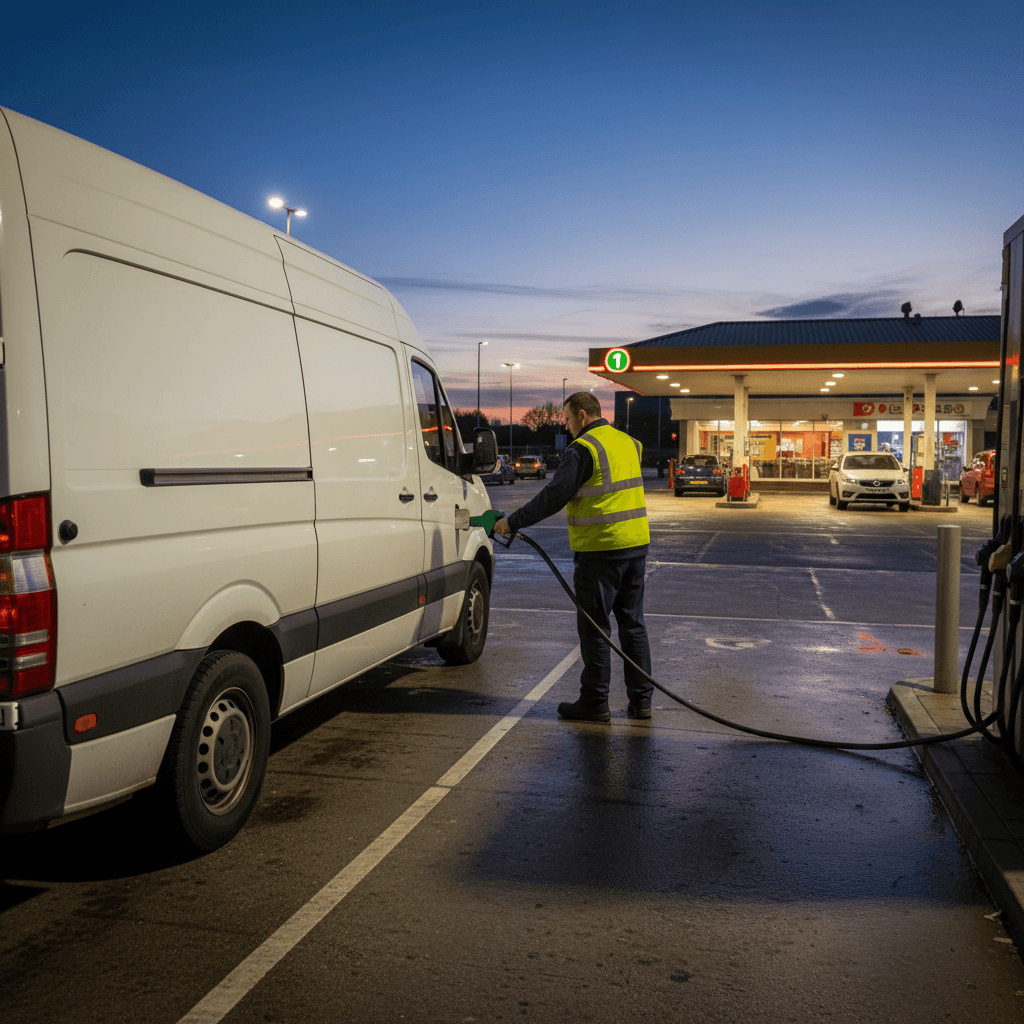
Fuel is the second-biggest cost on a fleet, after drivers.
It's also the cost where fraud hides best. A bent invoice from your workshop is obvious – someone has to have forged it, and it stands out against twelve months of proper invoices. A bent fuel transaction buries itself in a sea of real ones. The right thief can take a few hundred pounds a month out of a fleet of ten vans and nobody notices, ever, unless the operator actively goes looking.
I've been on the wrong end of this. Three years ago I lost what I reckon was around fourteen thousand pounds over eighteen months before I worked out what was happening. The thief was a driver I'd hired out of a good company who'd been running a quiet scam at his previous job and brought it with him. Nothing dramatic. Just a slow, steady leak on the fuel card.
Here's what I now look for, and what stopped him.
The five patterns I've seen
Pattern one: double-dipping at the pump. Driver fuels the company van, then fuels his own car, puts both on the company card, keeps the receipt for the smaller transaction as 'his' to cover a query if anyone asks. On a van that takes 70 litres and a small car that takes 35, the total is 105 litres on the transaction but the van is only getting 70 into the tank. The tell is mpg drift – sudden, sustained, inexplicable mpg drop on a specific van.
Pattern two: pump-swap. Driver turns up at a filling station with a friend. Both fuel at the same time, same forecourt, company card pays for both, split the cost afterwards in cash. Nobody looks at a single transaction for fuel – they're all the same shape. But the second pump's fuel isn't going into your van.
Pattern three: the helpful favour. Driver's mate has a leaky fuel tank, or a holiday to pay for. Driver puts a top-up on the company card. Nothing huge. Twenty quid here, thirty there. It hides in the noise. I caught this one because a driver's mpg went up beyond what was physically possible for the van – he was filling up after the previous stint had ended, then topping up his own vehicle just enough to move the needle.
Pattern four: phantom fuelling. Driver has a deal with a forecourt cashier. Card is swiped, transaction goes through as if fuel was dispensed, no fuel is actually put in. Split the proceeds. Rare, because it needs a bent cashier, but not unheard of. The tell here is the location – always the same forecourt, usually an independent, usually at quiet times.
Pattern five: cross-vehicle card use. Nothing sinister on the surface. Driver A uses Driver B's card because Driver A 'forgot his'. Happens in yards where the cards are held centrally and handed out by a planner. Eventually you get a card that's being used for multiple vehicles and the audit trail is a mess, which is cover for lots of things.
What stopped them
Five things.
Number one: one card per vehicle, locked to the vehicle's registration on the card profile. If the forecourt system allows for reg-capture – and most do on fleet cards – the driver has to type the reg in at the pump, and the card provider compares it to the approved reg on file. Mismatch flags on the weekly report. This alone ended Pattern Five for me.
Number two: odometer entry at every transaction. It's an extra keypress for the driver. Takes four seconds. The audit report flags transactions where the odometer is lower than last time (impossible), higher than expected (suspicious), or identical for two transactions in a row (somebody's making it up). My card provider runs an automated alert on any of these. Ended Patterns One and Three within a month of turning it on.
Number three: mpg tracking per vehicle, rolling 8-week average, with a band either side. On a 3.5-tonne Transit I'd expect 30 mpg give or take three. If the rolling average drops to 24 and stays there without a mechanical explanation, I want to know why. The rolling window matters – a single bad tank on a driver who loaded heavy one week is nothing. A 25 per cent drop sustained for two months is a sign.
Number four: forecourt-level reporting. Where is each driver fuelling? A driver on a Birmingham-to-Newcastle run who fuels at Watford Gap every week makes sense. A driver on a west-Midlands patch who's suddenly fuelling in Wolverhampton every Thursday morning – at a specific independent – doesn't. I look at these reports once a month, no more. Takes fifteen minutes. Flags two or three things a year.
Number five: the awkward conversation. When the data says something is wrong, I have the conversation early. Not accusatory. 'Your mpg on the Sprinter has been dropping for six weeks – anything going on with the van, or with the way the route's being driven?' Nine times out of ten there's a real explanation. Cold weather. A driver who's been towing a work trailer. A clutch on its way out. Once out of ten, there's a pause, and the driver looks at me differently, and I know something's up.
The one I almost missed
The fourteen-grand one. In retrospect it was obvious. The driver's mpg was fine – nothing suspicious there – but the frequency of his fuelling was high. He was filling his tank every 350 miles on a van that had been doing 450 miles between fills for the other three drivers who used it. Same van. Same route. Different driver. Different fuelling frequency.
He was topping up his wife's car from cans. Never put the car on the company card directly. Never had a mismatched reg or an odometer error. Just drove to the forecourt with a ten-litre jerry, filled the can, filled the tank, drove home, emptied the can into the Nissan.
I caught it because I started tracking fill frequency as well as mpg. Fuel cost per mile rolled up across a rolling four weeks. His was about 9 per cent higher than it should've been, sustained, for six months. Not headline-grabbing. Enough, once you have the data, that I put a tracker on it.
The conversation was short. He resigned. No police involvement – I didn't have the appetite for the prosecution work, and the evidence would've needed to be tightened up. Lesson learned. I'm more rigorous now.
The data setup that actually works
You don't need fancy software. You need four fields per transaction, tracked consistently:
- Date and time
- Forecourt / location
- Odometer
- Litres dispensed
From those four you derive everything: mpg between fills, miles between fills, cost per mile, location patterns. Most fleet fuel card providers give you all four if you configure them to.
If you're running ten or fewer vehicles, a spreadsheet will do it. Transactions down the rows, calculations in adjacent columns, monthly refresh. Takes me about twenty minutes a month to keep current.
If you're running more than ten, a fleet management platform will pull it together automatically. The platform doesn't catch the fraud for you – it just puts the numbers in front of you in a way that makes the anomaly visible. The catching is still a human judgement.
Supplier-side things to ask for
When you set up or renegotiate fuel cards, ask for these specifically:
Reg number validation at the pump. If your driver types in ABC123 and the card's linked to XYZ456, it should reject. Some providers bolt this on as a default, some as an option. Turn it on.
Anomaly alerts. Unusual transaction types, out-of-hours fuelling, transactions in unfamiliar geographies. Email or SMS to the operator, real time.
A 'maximum per transaction' cap. If your biggest tank is 80 litres, don't allow transactions over – say – 95 litres. A pump swap into two tanks at once would trip this, if the attacker is greedy. Also blocks the very occasional runaway pump.
Monthly reporting down to the transaction level. Not summary dashboards. The raw transactions. Let your operational people look at the data, not a PowerPoint.
The people side
Fuel fraud is always a people problem pretending to be a process problem.
Most drivers – in my experience, the overwhelming majority – are honest and bored by the paperwork. The systems you put in place to catch fraud are not aimed at them. They're aimed at the very small number who'll try it if they think they can. The systems also protect the honest drivers from being wrongly suspected when a number looks odd and turns out to be a mechanical fault on the van.
I say all this at induction. 'We check fuel data every month. If your numbers ever look wrong, we'll ask you. It's almost always a van problem, not a person problem. But the audit is the audit.' That sets expectations.
Drivers who are planning to nick fuel often flinch a bit when they hear that. Drivers who aren't, don't. It's not a scientific test but it's a useful one.
What to do if you catch someone
Depends on the size of the loss and your appetite.
Small, early catch – £50, £100 – have the conversation, get them to repay, make clear what you've noticed, document it, keep watching. If it stops, it stops. If it doesn't, you've got a pattern and a paper trail.
Larger, sustained catch – thousands – get HR, get a solicitor, run disciplinary process, consider Action Fraud referral. This is messy and time-consuming. Don't commit unless the numbers are big enough to justify it.
In every case, tighten the controls that let it happen. A fraud you catch is a gift – because it's told you exactly where your system has a gap. Plug that gap. Not with more rules. With better data.
That's how I've run it for six years since the expensive lesson. Hasn't happened since. Which doesn't mean it won't. Just that the next one will have to work harder.