Fuel card VAT reclaim: HMRC's three options for fleets and what private use actually requires
HMRC queried our fuel card input tax claims. We ran driver-home vans and claimed everything. Here is how VAT Notice 700/64 three options work for fleet operators, and what business use only actually requires you to prove.
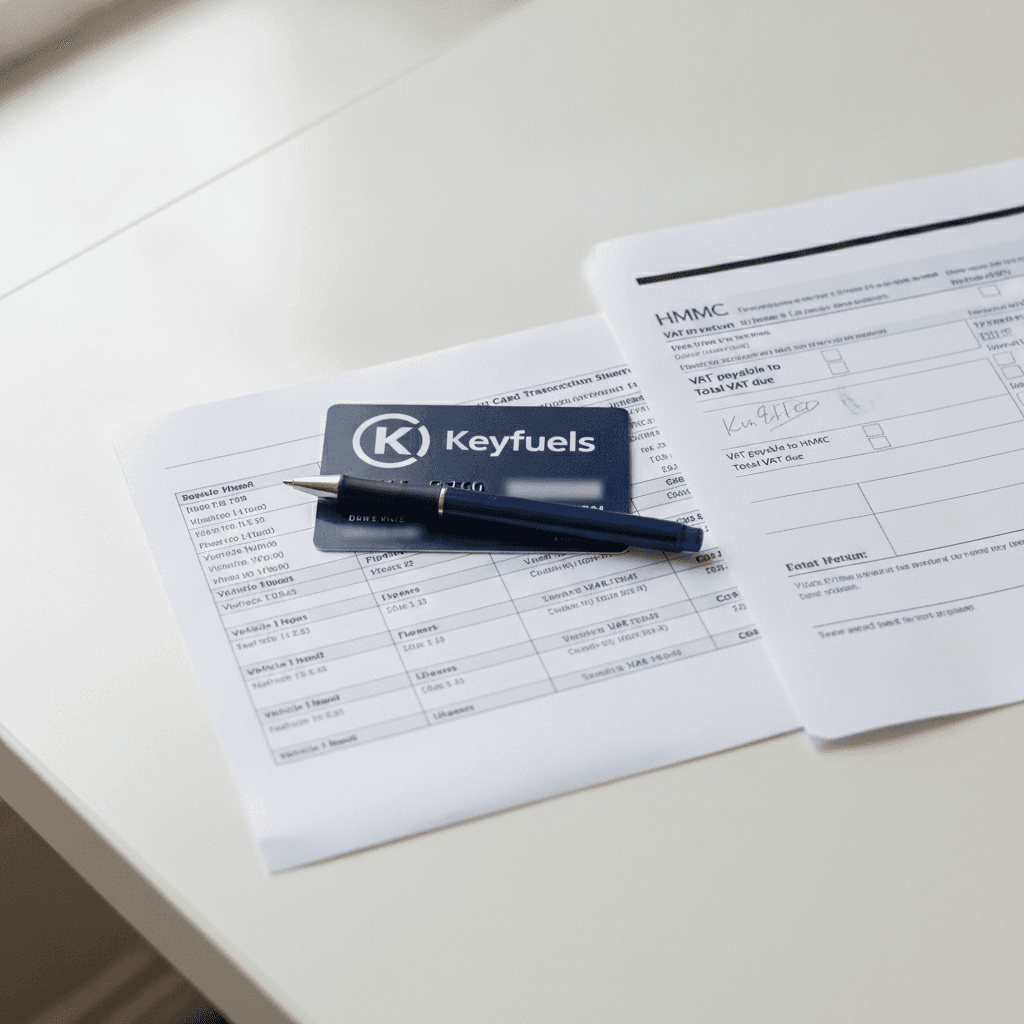
The fuel card VAT question most fleet operators get wrong
Three years ago my accountant flagged a VAT audit query on our fuel card spend. HMRC had looked at our input tax claims on road fuel and wanted to understand how we were treating private use. I hadn't thought carefully about this. We ran a mix of vehicles — some driven home by drivers, some yard-kept. The fuel card covered all of them. The VAT claim covered all the fuel. That's not how HMRC's rules work, and the conversation that followed was not short.
Here's the thing about fuel card VAT reclaim: most operators either claim everything without thinking about it, or don't claim anything because they're worried. Both approaches can leave you significantly worse off. Understanding how HMRC's rules actually work lets you claim correctly — neither over-claiming nor under-claiming.
The three options HMRC gives you
HMRC VAT Notice 700/64 (Motoring Expenses) sets out three ways a VAT-registered business can deal with road fuel where there may be private use:
Option 1: Claim all the input VAT and apply the fuel scale charge. You reclaim VAT in full on all road fuel purchased through the business. At the same time, you account for output tax using HMRC's published fuel scale charge, which is a flat-rate mechanism designed to cover the output tax on private use. The scale charge rate is based on the vehicle's CO2 emissions band. Include the scale charge on your VAT return as output tax each period.
Option 2: Claim VAT only on the business mileage share. You keep mileage records sufficient to identify what proportion of fuel was used for business journeys. You reclaim input VAT only on the business proportion of your total fuel spend. No scale charge applies because you're not claiming VAT on the private fuel.
Option 3: Claim no input VAT on fuel at all. If you choose this, you pay no output tax on private use either. For fleets with very low private mileage or where the scale charge would exceed the VAT recoverable, this can occasionally be the most practical option.
The key point: you must pick one approach and apply it consistently. You cannot use Option 1 for some vehicles and Option 2 for others.
The scale charge and commercial vehicles
Here's where fleet operators need to be careful. The fuel scale charge as described in VAT Notice 700/64 is specifically a car-based mechanism — it's calculated by reference to the car's CO2 emissions band. It's designed for company cars, not for vans, HGVs or other commercial vehicles.
For commercial vehicles — vans, tractor units, HGVs — the position on private use is different. HMRC treats the fuel scale charge as applying to cars. For commercial vehicles, if you're reclaiming input VAT on fuel and there's genuinely no private use (vehicles don't go home with drivers, fuel is used strictly for commercial purposes), you can claim the full input VAT with no scale charge applicable.
But if drivers do take commercial vehicles home, or if fuel cards are used for personal journeys in commercial vehicles, that creates a private use issue — and it's not covered by the scale charge mechanism. You'd need to apportion between business and private use using mileage records, or disallow the VAT on private-use fuel entirely.
I've seen operators apply the company car fuel scale charge to their entire HGV fleet on the basis that "fuel is fuel." It isn't, for these purposes. Get this wrong and you're either over-claiming input tax or unnecessarily paying a scale charge that doesn't apply.
Van benefit charge is a separate issue
The van fuel benefit charge under income tax rules is separate from the fuel scale charge under VAT. They're different rules, different calculations, different reporting obligations. The van fuel benefit is reported via P11D for employees who use vans for private journeys where the employer pays for the private fuel. As of 2026/27, the van fuel benefit charge is £757 (flat rate, not CO2-based like the company car figure).
If you've been treating your vans as "no private use" for P11D purposes, check whether that's actually true. Drivers who take vans home and use them at weekends — even occasionally — trigger the benefit in kind. The amount is the same regardless of how much private fuel is used: £757 applies whether a driver fills up twice on private journeys or twelve times.
What "business use only" actually requires you to prove
If you're claiming that fuel card spend is 100% business use — and therefore claiming full input VAT with no apportionment — HMRC can ask you to demonstrate this. "Business use only" means exactly that: no fuel purchased on the card is used for private journeys, no vehicle covered by the card is used for private mileage.
For a yard-kept fleet where vehicles never go home with drivers and the depot is locked outside hours, this is credible and straightforward to evidence. For a fleet where drivers take vehicles home, or where fuel cards cover drivers' personal cars as well as company vehicles (yes, this happens), "business only" is a harder position to sustain under scrutiny.
The evidence HMRC looks for:
A clear policy on private use of vehicles and fuel cards — in writing, with driver acknowledgement. A blanket prohibition on private use is not the same as a blanket prohibition being followed.
Mileage records showing start and end points for all journeys covered by fuel card spend. If the journeys are all commercial routes or depot-to-delivery, that's consistent with business-only use. If the records show a Tuesday evening run from work to a driver's home address, less so.
Fuel card transaction records showing where fuel was purchased. Cards used at motorway services during working hours on commercial routes are consistent with business use. Cards used at local petrol stations at 7pm on a Sunday are less so.
What HMRC looks at in a fuel card audit
The trigger for fuel card scrutiny is usually a VAT control visit or a specific query. HMRC will ask to see: the fuel card transaction records for the period under review, the VAT claims made on those records, and evidence of how you've treated private use (either no private use with evidence, or a scale charge calculation, or mileage-based apportionment).
Mismatches between the total fuel card spend and the reasonable fuel consumption of the vehicle fleet at the distances driven are a red flag. If your cards show 40,000 litres for a period when your mileage records suggest you drove distances requiring 28,000 litres, that 12,000-litre gap prompts questions.
Controls that demonstrate you're on top of this: monthly fuel card reconciliations against vehicle mileage data, exception reports for transactions that don't match a vehicle's usual location or time pattern, and a clear written policy that drivers have signed.
Before your next VAT return
If you haven't reviewed your fuel card VAT treatment recently — particularly if your fleet has changed, if the mix of yard-kept and driver-home vehicles has shifted, or if you've added card users who weren't there when you set up the original policy — it's worth going back to basics. Check whether your current treatment aligns with one of the three HMRC options. Check whether the scale charge you're applying (if any) is on the right vehicle types. And check whether your private use position is one you can actually evidence if asked.
Getting this right doesn't require complex systems. It requires knowing which option you're using, applying it consistently, and keeping the records that support it. An hour with your accountant now is considerably cheaper than a VAT investigation later.
When the fuel card is used for drivers' own cars — the employer-provided fuel situation
Some fleet operators allow drivers to use company fuel cards for their own cars — a common benefit, especially for sales teams or managers. This is a completely separate situation from commercial vehicle fuel, and it triggers the full company car fuel benefit rules under income tax, plus the fuel scale charge under VAT (because these are cars).
If you provide this benefit and aren't running the appropriate P11D entries and fuel scale charges, that's an HMRC exposure. The value of employer-provided private fuel for a company car is chargeable as a benefit in kind, calculated using the fuel benefit charge multiplied by the car's emissions band percentage. It's calculated separately from the car benefit charge.
The safest approach for fuel cards that cover a mix of HGVs, vans and cars is to segregate them — different card programmes for different vehicle types, with clear policies on what each card covers. Trying to run one card type across every vehicle and then work out apportionment post-hoc is how things get missed.
Mileage reimbursement instead of fuel cards — the HMRC approved mileage rate
Some operators move away from fuel cards for grey fleet (employee's own car used for business) in favour of the HMRC Approved Mileage Allowance Payment (AMAP) scheme. Under AMAP, payments up to the HMRC approved rates — 45p per mile for the first 10,000 business miles, 25p per mile thereafter for cars — are free from income tax and National Insurance for the employee. The employer cannot recover VAT on these payments.
For commercial vehicles where drivers use their own vans or trucks for business work, the approved rate is 25p per mile regardless of mileage level. Payments above the approved rates are taxable income for the driver.
If you're paying drivers mileage at rates above AMAP (many operators pay 50p or 55p per mile for grey fleet), the excess is taxable. If this hasn't been going through PAYE, the back-tax position can be significant. A payroll review before an HMRC visit is considerably more comfortable than one conducted during one.
The fuel card fraud connection
One consequence of lax fuel card VAT records is that they also tend to indicate lax fuel card controls generally. If you're not reconciling fuel card transactions against vehicle mileage data — which you'd need to do for Option 2 VAT treatment — you're also less likely to catch fuel card fraud.
The reconciliation that keeps HMRC satisfied on VAT also keeps you on top of whether cards are being used for personal fills, whether transaction volumes match expected consumption, and whether any card has been used at locations inconsistent with your vehicle movements. HMRC compliance and fraud prevention overlap here. Running good records for one serves both purposes.