HGV axle group weights: load distribution planning to pass the weighbridge clean
My driver was 1,400kg over on the drive axle with a total weight that was legal. Wrong load position, not wrong load. Here's how axle group planning actually works.
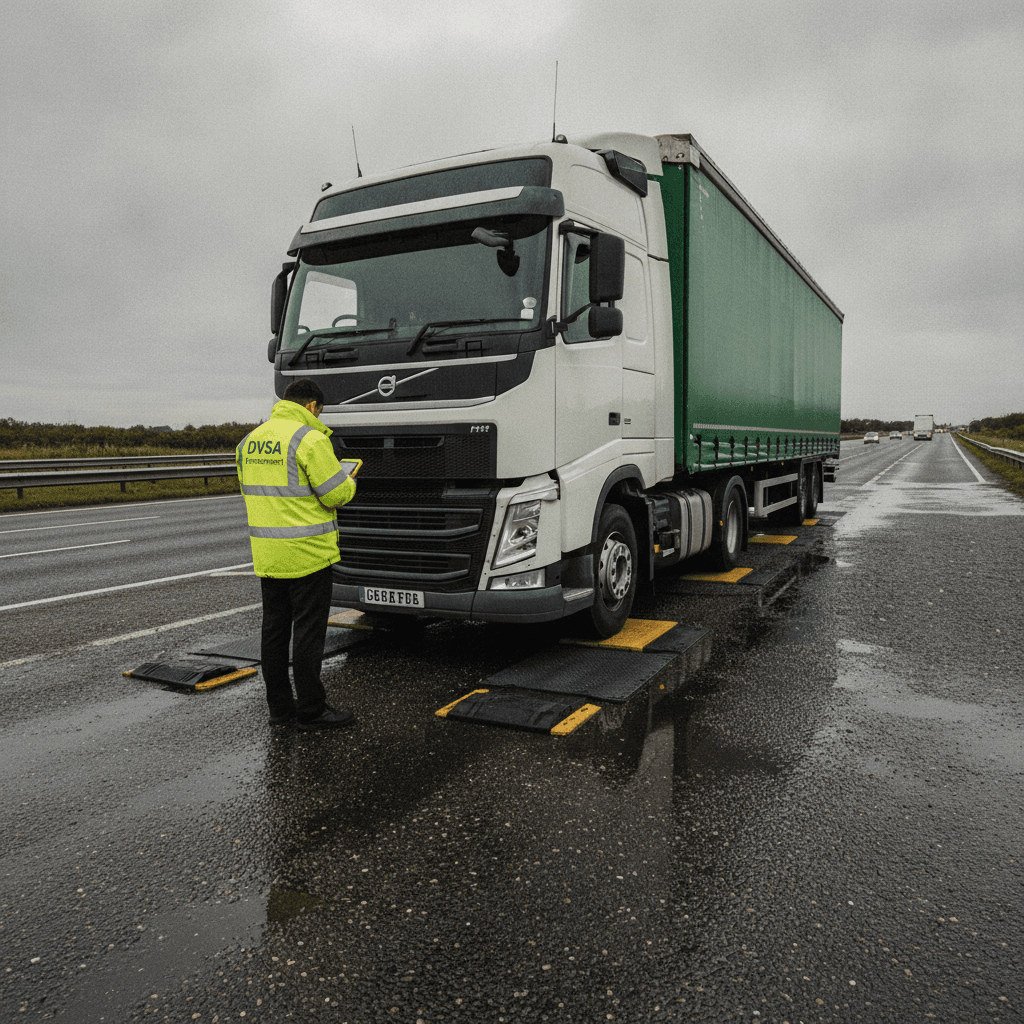
Total weight legal. Drive axle overloaded. DVSA said that's an overloading offence regardless.
September 2020. A driver of mine loaded at a cash-and-carry outside Coventry — mixed pallets, nothing dramatic. Total weight checked at the outbound weighbridge: fine. Got stopped at a DVSA enforcement site at Catthorpe interchange an hour later. The portable axle pads showed the drive axle was 1,400kg over its individual axle limit, even though the gross train weight was below 44 tonnes.
The load had been concentrated too far back on the trailer. The trailer tandem wasn't taking enough of it, the tractor drive axle was taking too much, and the steer axle was correspondingly light. Three problems, not one.
The fixed penalty was £300 plus OCRS implications. More importantly: I had never properly briefed my drivers or my loading bay on how axle group limits interact with load position. That was the real problem.
How axle limits work alongside gross weight
Most operators think of weight in terms of GVW or GTW — gross vehicle weight or gross train weight. A standard 44-tonne articulated outfit has a maximum gross train weight of 44 tonnes. But that's not the only limit.
Each axle — and each axle group — has its own maximum weight limit set by the Road Vehicles (Construction and Use) Regulations 1986. For a typical 6x2 tractor unit pulling a tri-axle trailer, the limits work roughly as follows: the steer axle has a lower limit than the drive axle, the drive axle or bogie has its own limit, and the trailer axle group has its own. The exact figures depend on the axle configuration, spacing, and tyre specification — they're on the Ministry plate (or the manufacturer's plate for vehicles not subject to Type Approval plating) and vary by vehicle.
The critical point: you can be legal on total weight and still overload an individual axle. Load distribution determines whether each axle is within limits, and that distribution depends on where on the trailer the load is positioned.
The centre of gravity problem
When you load a trailer, the weight doesn't distribute evenly across all axles. It distributes based on where the load sits relative to the axles and the fifth wheel coupling point. Heavy load concentrated towards the rear of the trailer puts more weight on the trailer axles and less on the tractor. Heavy load concentrated towards the front of the trailer transfers more weight onto the tractor's drive axle through the fifth wheel.
The ideal loading position — in terms of axle distribution — varies by trailer length, axle configuration, and the weight of the tractor unit itself. For most standard curtainsider configurations, loading evenly or very slightly forward of centre tends to produce the best axle distribution. But 'tends to' isn't good enough when the penalty for getting it wrong is a fixed penalty notice and an OCRS hit.
What to calculate before loading
If your operation loads mixed cargo onto curtainsiders or flatbeds, building in a basic axle weight check is not complex. You need: the tare weight of the tractor and trailer (from the plating certificates), the maximum individual axle limits (from the Ministry plate), and the approximate centre of gravity position of your load.
For bulk or uniform loads — 33 pallets of the same product — the calculation is straightforward. The load weight times the fraction positioned over each axle group, plus the tare contribution, gives an estimate of the running axle weights. Many weighing software systems and loading tools do this automatically.
For mixed loads — which is most of what my fleet carries — the planning is less precise, which is why having a practice of checking axle weights at departure matters. Not just a total weight check. An axle-by-axle check, with a portable axle pad set if your site doesn't have a weighbridge with individual axle readings.
The landing leg and bogie slide
A semi-trailer's bogie — the rear axle group — can usually be slid forward and back on a sliding bogie rail. Moving the bogie rearward transfers weight from the tractor drive axle to the trailer tandem; moving it forward does the opposite. This is one of the primary tools for adjusting axle distribution without changing the load.
But bogie slide only helps within limits. It changes the load distribution, but it doesn't change the total weight on the trailer. If the load is genuinely too heavy for the trailer's maximum axle group weight, no bogie position will make it legal.
Brief your drivers on bogie adjustment: when it's appropriate, how far the bogie can travel (marked on the bogie rail), and the fact that adjusting the bogie changes the overall combination length — which has its own limits under Regulation 7 of the Construction and Use Regulations. A long wheelbase combination may not be legal with the bogie slid fully rearward, even if the axle weights are then fine.
The steer axle: why being under the limit isn't always safe
A lightly loaded steer axle — typically caused by excessive weight forward on the trailer, reducing the leverage effect on the tractor front — reduces steering response and, at higher speeds, steering feel. It's a handling hazard even if all axle weights are technically within limits.
DVSA enforcement focuses on overloading, not underloading, but the DVSA examiner who stopped my driver at Catthorpe noted the steer axle reading in their report as an additional concern. The tractor's manufacturer typically specifies a minimum front axle loading — check this against the plating certificate for your specific units.
Weighbridge use: what to do when the numbers are wrong
If your site has an axle weighbridge — or if you use a public weighbridge before departure on heavy loads — and a reading shows an axle overloaded: don't drive away. Pull the vehicle to a safe area and adjust the load before you move onto the public road.
Once the vehicle is on the public road and is weighed by DVSA, the overloading is an offence. The penalty for a goods vehicle axle overload starts at around £100 for a minor excess and scales based on the degree of overloading, under the graduated penalty system. Individual driver and operator liability can both apply, and the OCRS implications of an overloading check outcome are separate from the fixed penalty.
Brief drivers that leaving the site with a known axle overloading issue — even if they only know because a colleague mentioned it rather than a formal check — is not something to proceed with. The 'I didn't know' defence doesn't survive well when a colleague did know. And if there's a vehicle weighbridge at the premises, there's an expectation that you use it.
Payload calculations for new vehicle purchases
If you're buying or speccing new vehicles, axle group limits are part of the spec decision, not something you work out afterwards. The combination of tractor unit kerb weight, fifth wheel height, and trailer kerb weight determines how much actual payload you can carry within the legal limits on all axles simultaneously.
A vehicle that's legal at 44 tonnes gross but whose tractor unit weights and trailer weights leave only 22 tonnes of payload before axle limits are hit is a limited vehicle. Check the manufacturer's axle weight data sheets before ordering, not after delivery.
Keeping records
DVSA doesn't require operators to keep weighbridge records in the same way they require maintenance records. But if your fleet regularly carries loads close to the maximum, keeping departure weight records — gross and per axle where available — is good practice and provides evidence of due diligence if an overloading offence is challenged.
The Catthorpe stop in 2020 cost my driver a fixed penalty and put a mark on the OCRS. Both could have been avoided with a pre-departure axle check. The calculation isn't complicated. The discipline of doing it is.