HGV axle weight limits: how DVSA weighs vehicles at roadside, and what the graduated fines mean in practice
I've watched three operators get weighed at Catthorpe interchange in one afternoon. Two drove away clean. One didn't. The overloading wasn't cargo weight — it was load distribution. Here's how the weighing works.
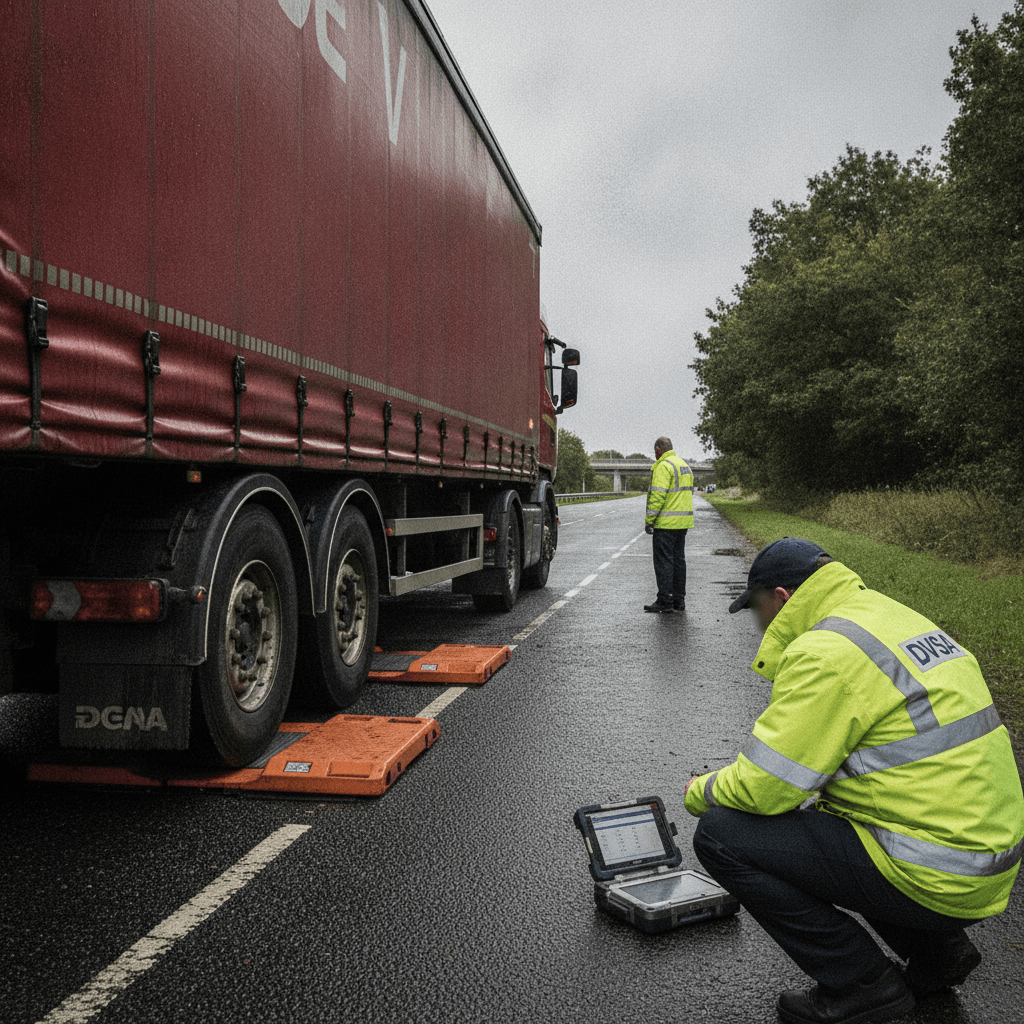
Catthorpe interchange, on the M1/M6 junction, has a DVSA weighing site that gets regular use. I've watched three vehicles from my previous employer get pulled in over the years — twice on random selection, once targeted. Two of them drove away clean. The third didn't.
The load on the third vehicle was within the gross vehicle weight. The total weight was fine. The problem was how the load was distributed — pallet positions had shifted the centre of gravity forward, putting the steer axle about 300kg over its individual axle limit while the drive axle was under. Technically legal gross weight. Actually illegal axle weight. The driver hadn't weighed at departure. He hadn't driven over a weigh bridge. He'd looked at the total weight on the consignment note and assumed that was all that mattered.
It's not.
Gross vehicle weight versus axle weight: two different limits
Every HGV has two sets of weight limits that apply simultaneously. The gross vehicle weight (GVW) or train weight (for artic combinations) is the total maximum weight of the vehicle and load together. The axle weights are individual limits that apply to each axle — steer axle, drive axle(s), and trailer axles separately.
A standard two-axle rigid, for example, might have a GVW of 18,000kg, a front (steer) axle limit of 7,500kg, and a rear (drive) axle limit of 11,500kg. Hitting the GVW without exceeding either axle weight is fine. Hitting one axle limit while remaining under the GVW is still a breach. You can fail the axle weight check while passing the GVW check, and vice versa.
For articulated combinations, the limits multiply. Each axle on the tractor unit has its own limit. Each axle group on the trailer has its own limit. The combined train weight has a limit. And for road-friendly suspension systems, lifted-axle configurations, and multi-axle trailers, there are additional rules about which axles count toward which group limits.
The specific limits are set out in the Road Vehicles (Construction and Use) Regulations 1986, Schedule 1. These are the legally binding limits. The plated weights shown on the vehicle's plate are the maximum the vehicle is constructed to carry — in some cases lower than the legal maximum for that axle type, in which case the plate limit applies.
How DVSA weighs at roadside
DVSA uses portable weigh pads at most roadside sites. Each pad sits under one wheel of an axle and measures the load on that wheel. For a two-wheel axle, you get two readings that are added together for the total axle weight. For a twin-wheel drive axle, each set of twins reads as one unit. The pads are calibrated equipment — DVSA officers have to maintain certification records for them.
The vehicle is driven slowly over the pads — typically at a walking pace, sometimes in a stop position for each axle. The officer records each axle weight and the total. This takes three to five minutes for a standard artic. For a multi-axle combination or a specialist vehicle, longer.
Some sites have static weigh bridges — a full platform you drive onto that weighs the whole vehicle at once. These give a GVW reading quickly but don't individually measure axle weights. DVSA sometimes uses these for initial triage and then moves vehicles to pad weighing if there's any concern about the GVW.
The graduated penalty structure
Overloading penalties in England and Wales use a graduated fixed penalty system based on how much the vehicle exceeds its legal weight limit — expressed as a percentage above the limit rather than a flat amount.
The graduated bands, as set under the relevant Road Traffic legislation, step up as the overloading percentage increases. Minor overloads — typically up to around 5% over the axle or GVW limit — attract the lower end of the penalty range, while significant overloads attract higher fixed penalties or may result in the vehicle being directed to a weighbridge for formal weighing and a potential prosecution rather than a fixed penalty.
Fixed penalties are issued to the driver at the roadside. Prosecution can follow for the operator if the circumstances suggest the operator caused or permitted the overloading — which can mean a significantly larger financial penalty and, in serious cases, OCRS implications. A driver who overloads because the operator's loading system produced an overloaded vehicle is a different enforcement outcome than a driver who overloaded independently of any operator instruction.
For very significant overloads — typically more than 30% above the relevant limit — DVSA has the power to prohibit the vehicle from moving until the excess load is removed or redistributed. That means the vehicle sits at the roadside or weighbridge until it's compliant, which means unloading at the roadside, calling for a second vehicle, or redistributing pallets in a layby with no loading equipment. All of which costs significantly more than the fine.
The distribution problem: why correct gross weight isn't enough
The case I described at Catthorpe — within GVW, over steer axle — is more common than operators realise. Load distribution is a planning problem as much as a weight problem. Where pallets are positioned in the trailer affects how the load sits across the axles. A 26,000kg load on a 44-tonne artic should be fine — but if 14,000kg of it is in the front third of the trailer, the steer axle will likely be over its limit regardless of what the GVW says.
Drivers loading their own trailers should be working from a load plan that specifies pallet positions. Collection drivers picking up third-party loads should check the load summary against the axle weights — not just the gross. If the consignment note shows a heavy front-heavy load pattern, that's a warning sign.
The practical check many experienced drivers use is the 'feel' of the steering on departure — a heavily laden steer axle changes the steering response noticeably on most HGVs. That's not a reliable compliance tool, but it's a driver instinct worth taking seriously. If the steering feels heavier than usual for the stated load weight, something about the distribution may be off.
Weigh bridges: when and why to use them
Many distribution depots and quarry sites have on-site weigh bridges. If you're loading from a site with a weigh bridge, using it before departure is the simplest overloading prevention measure available. Record the weigh bridge ticket — it's contemporaneous evidence of the weight at departure if DVSA subsequently questions the load.
For trunking operations collecting pre-loaded trailers from third parties, you don't always have access to a weigh bridge. The consignment documentation becomes more important in that case. If the paperwork describes a load that the vehicle's configuration can't carry legally, the driver has the right — and arguably the obligation — to refuse to move it until the issue is resolved. A driver who knows they're overloaded and drives anyway is taking personal legal risk. An operator who instructs a driver to move a load they've both identified as overloaded is creating an additional layer of exposure.
International trips and axle weight differences
One footnote for operators running any international work: axle weight limits vary by country. The UK's limits are set domestically under domestic legislation. German autobahn axle limits, French péage infrastructure limits, and Spanish road weight regulations are all different — and in some cases stricter on specific axle types. A vehicle that's within UK domestic limits for its drive axle configuration may exceed the permitted load on that axle in France.
For operators whose vehicles are primarily UK domestic, this isn't a daily concern. For operators with vehicles running to Europe — even occasionally — it's worth having your European axle weight limits documented alongside your UK ones, and worth briefing drivers who cross the Channel on what changes.
OCRS and the record of overloading
An overloading fixed penalty issued to the driver is a road traffic enforcement event that, depending on its categorisation, may appear in the OCRS calculation for the operator. Vehicle roadworthiness and loading compliance are both tracked under OCRS. A single overloading FPN may not shift an operator's band significantly. Multiple overloading incidents, or an overloading incident combined with other vehicle condition issues, can produce a OCRS deterioration that increases the frequency of DVSA roadside checks on your fleet.
That's the multiplier effect that makes overloading management worth taking seriously even for operators who've never been caught. Higher check frequency means more exposure to other vehicle condition and driver hours issues. OCRS deteriaration is self-reinforcing in the short term.
Having a load checking procedure — documented, trained, followed — is the baseline defence. If DVSA or the Traffic Commissioner ever asks what steps you took to prevent overloading, a written load checking procedure with evidence of driver training is the answer. The absence of a procedure is the absence of a defence.