HGV rear underrun guard: Regulation 49, the 550mm rule and what DVSA checks at the back of your trailer
A cracked mounting bracket put a trailer off the road on the A14. The defect had been there for months — nobody's PMI sheet caught it because it had one checkbox. Here is what Regulation 49 actually requires.
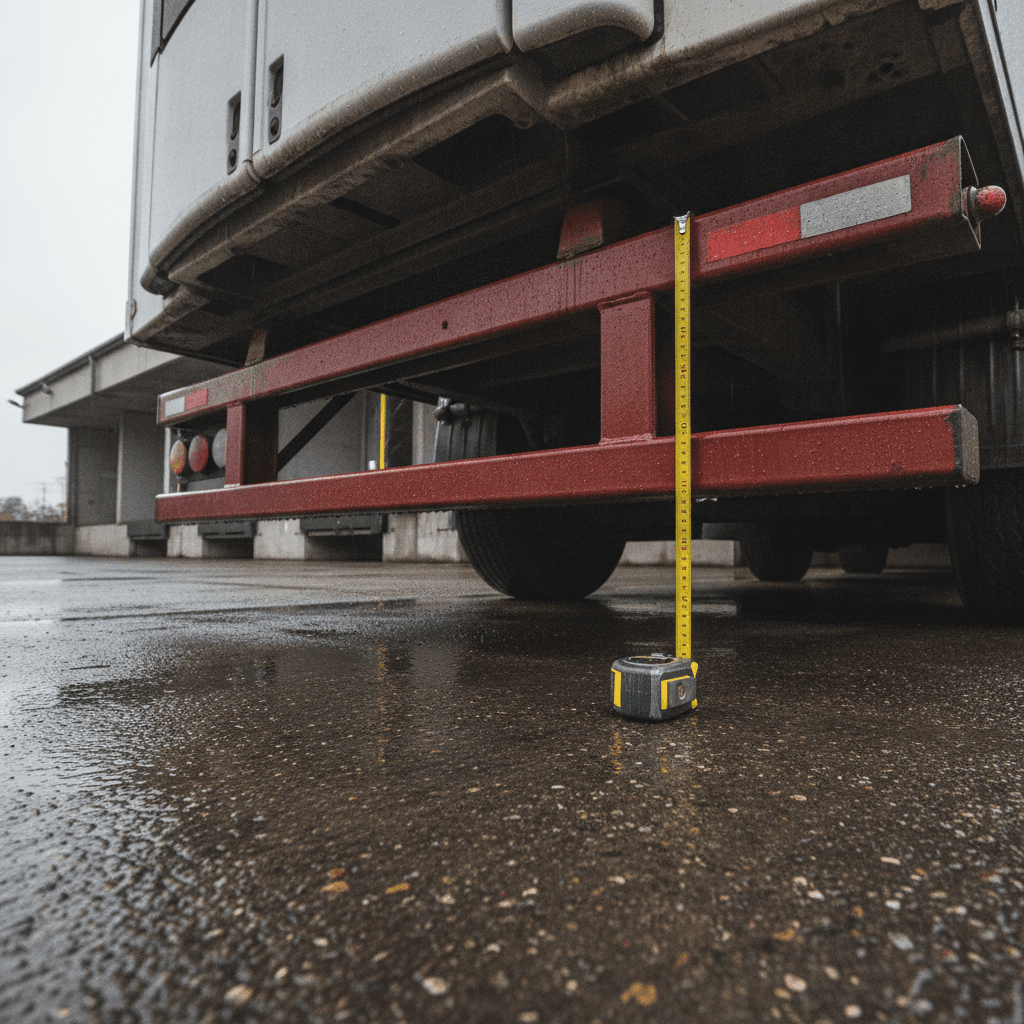
The component most drivers have never been asked about at a walkaround
Three years ago I watched a DVSA vehicle examiner crouch down at the back of a curtainsider during a roadside stop on the A14, spend about forty seconds looking at the rear underrun guard, stand up and write a prohibition notice. The driver didn't know what the examiner had checked. The operator didn't know they were supposed to be checking it at PMI. And the defect — a cracked mounting bracket — had probably been there for months.
The rear underrun guard (formally called a Rear Underrun Protective Device, or RUPD) is one of the most consistently under-checked items on HGV walkaround lists. It's buried on most PMI sheets as a single checkbox. Drivers pass it every day without looking at it properly. And when it fails, the consequences range from a PG9 to a fatality — because the entire point of the thing is to stop cars going under the back of your trailer in a collision.
What the regulation actually requires
The legal requirement sits in Regulation 49 of The Road Vehicles (Construction and Use) Regulations 1986 (SI 1986/1078). It applies to motor vehicles with a maximum gross weight over 3,500kg first used on or after 1 April 1984, and to trailers manufactured on or after 1 May 1983 with an unladen weight over 1,020kg. The technical dimensional and strength requirements come from Directive 79/490/EEC, incorporated by reference into Regulation 49.
The core requirements for a properly fitted rear underrun guard on a goods vehicle over 3,500kg GVW are:
The rearmost part of the guard must be positioned no more than 400mm forward of the rearmost point of the vehicle. In practice this means the guard must extend right to the back of the trailer, within 400mm of the trailer's rear face.
The guard must be no more than 550mm from the ground at its lowest point when the vehicle is unladen. That's the critical measurement — unladen, without any load. The idea is that if the vehicle is legal unladen, it's even lower and better protected when loaded. Worn mounting hardware, bent crossmembers or impact damage can push a guard above 550mm without it being visually obvious.
Width: the guard must extend across the full width of the vehicle, with no more than 100mm gap between the end of the guard and the outer edge of the rear axle tyres. This is the measurement most often missed in walkaround checks.
Strength: the guard's crossmember must have a minimum section height of 100mm. Under the load test required by Directive 79/490, the guard must withstand a horizontal force of up to 100,000N (100kN) applied at two central test points, without deflecting more than 400mm rearward from the vehicle's rear extremity. That's the type-approval test — you can't replicate it at PMI — but cracked welds, bent crossmember sections and corroded fixings are visible indicators that structural integrity has been compromised.
Exemptions — and why they don't apply to most trailers
Some vehicle configurations are exempt from the requirement. Off-road vehicles (certain combinations with off-road capability), vehicles where the bodywork already provides equivalent protection, agricultural trailers, and some specialist equipment carriers. For standard curtainsiders, flatbeds, boxes and refrigerated trailers — the ones that make up the bulk of most fleets — the exemptions don't apply.
I've seen operators assume their flatbed is exempt because the subframe structure provides "some" protection at the rear. It doesn't, unless it's been type-approved as equivalent. If DVSA examines the vehicle and the dedicated RUPD doesn't meet the spec, the subframe doesn't save you.
What DVSA examiners look for at a roadside stop
From the stops I've been present at and the conversations I've had with traffic examiners, the checks on the rear underrun guard are fairly consistent:
Height from ground. They'll often get down and look — or use a measuring implement. A guard that's visibly sitting higher than it should, because of a damaged mounting bracket or bent section, is an immediate flag.
Width coverage. They walk behind the vehicle and check whether the guard extends to within 100mm of the outer tyre edges. A guard that's been damaged and pushed inwards, or one that was never fitted correctly for a wider trailer body, fails this.
Mounting integrity. The brackets and fixings attaching the guard to the trailer chassis. Cracked welds, loose bolts, corroded mounting points. This is the one that caught my trailer — not the guard itself, but where it was attached. A guard that wobbles when pushed is not providing the protection it's supposed to.
Deformation. A guard that's been nudged in a yard manoeuvre and hasn't been straightened out. Even minor bending can take the ground clearance outside the 550mm limit at one point while leaving it legal-looking everywhere else.
Where the PMI sheet falls short
Every PMI sheet I've seen lists the rear underrun guard. The problem is how it's listed. Usually it's a single tick box: "Rear underrun — satisfactory / unsatisfactory." That doesn't tell the examiner, or you, what was actually checked.
After the Knutsford incident, I rebuilt our trailer inspection sheets to break it out into four separate checks: height from ground (recorded in mm), width coverage (gap to tyre edge, left and right), mounting bracket condition (weld integrity, bolt condition), guard deformation or damage. Four separate boxes that have to be individually assessed. It takes about ninety extra seconds per trailer at PMI. What it catches pays for itself.
More importantly, when DVSA looks at your PMI records at an operator compliance visit, "tick box: satisfactory" tells them nothing about whether the item was genuinely checked. Four individual assessment entries, with measurements, tells them someone actually looked.
Trailers are different from tractor units
One thing worth being clear about: the rear underrun guard requirement applies to the trailer, not the tractor unit. Most tractor units have a rear underrun bar fitted as standard (and a type-approved one at that), but it's the trailer that needs the compliant RUPD for the combination to be legal.
This matters for operators who run hired or leased trailers. When you take on a trailer — even short-term — the compliance obligations sit with you as the operator for the duration you're using it. A hired trailer with a substandard rear guard is your problem, not the hire company's, when DVSA pulls you on the A14.
Before a trailer goes on your O-licence, check the RUPD. Take measurements. Record them. If the guard is defective, fix it or decline the hire. That sounds obvious. I've seen it done wrong more times than I can count.
After a collision — what happens to the guard
Any rear-impact collision, even a minor yard nudge, should trigger an immediate check of the rear underrun guard before the vehicle goes back out. Impact damage to the guard is often not visible from a distance — bent mounting brackets, cracked welds, guard deformed inward at one point — but the structural integrity has gone even if it looks serviceable.
Your post-incident procedure should include a specific rear underrun guard check as a mandatory step before the vehicle is cleared for use. I added this to our VOR procedure after a driver backed into a loading bay bollard and the trailer went out three hours later with a guard that was 680mm from the ground on the left side.
The connection to your OCRS
A PG9 immediate prohibition for a defective rear underrun guard goes into your OCRS like any other prohibition. If it's your first in a while and your overall score is good, it might not move the needle dramatically. But prohibitions for structural/safety-critical items — and the rear underrun guard is safety-critical, in the most literal sense — are weighted more heavily in DVSA's targeting system than, say, a minor documentation issue.
Get pulled twice for rear underrun guard defects within eighteen months and you're building a pattern DVSA notices. Get pulled once and it shows up on your OCRS without a corresponding record of PMI checks that covered the item properly, and the Traffic Commissioner's examiner will be asking questions about your maintenance system.
The fix takes less time than you think
Add the RUPD to your pre-trip driver check and walkaround card. Four items: height looks correct, extends full width, no visible damage, mounting brackets secure. Thirty seconds. Brief drivers on what they're looking for — show them a photo of a compliant guard versus a damaged one. At PMI, update the sheet to require individual checks with recorded measurements rather than a single tick.
Most of the defective rear underrun guards I've encountered weren't defective from new. They got that way gradually — a nudge here, a crack in a weld there — and nobody caught it because nobody was looking properly. That's fixable. It just requires making the look deliberate.
The exemptions in full — and why few trailers qualify
Regulation 49(2) lists the vehicle types exempt from the rear underrun requirement. Most of them are narrow categories that don't apply to standard fleet vehicles. It's worth knowing them, because occasionally an operator will try to argue an exemption that doesn't actually apply to their configuration.
Vehicles with a maximum speed not exceeding 15 mph are exempt. Practically, this means slow construction equipment and agricultural tractors. If it can do 30 mph, the exemption doesn't apply.
Articulated tractor units — the tractor part of an artic combination — are exempt because the semi-trailer provides its own rear end protection. But the trailer itself still needs a compliant RUPD. The combination as a whole must still meet the requirement at the rear.
Agricultural trailers and trailed appliances are exempt. So are engineering plant, fire engines, and vehicles fitted with road-spreading apparatus at the rear.
Vehicles where the body structure provides the equivalent protection — and here's where I see the most misapplication. The exemption says the vehicle must be specially designed (not merely adapted) for the purpose. A flatbed platform that happens to have a structural rear crossmember doesn't qualify as "specially designed" to carry other vehicles loaded from the rear. You'd need engineering documentation to support that claim, and you'd need to be confident it would hold up if examined at roadside.
Tail lift platforms get an exemption — but only where the platform, when in the stowed position, provides at least one metre of floor length parallel to the vehicle's longitudinal axis. A taillift with a short platform that stows vertically doesn't meet this. A taillift where the platform lies flat and forms a one-metre section of the vehicle floor might. The measurement matters.
If you're unsure whether a specific vehicle configuration qualifies for an exemption, don't assume it does. Get written confirmation from the manufacturer or a competent engineer. Running without a RUPD on a vehicle that doesn't qualify for an exemption is a Construction and Use offence regardless of whether you thought the exemption applied.
Buying or hiring a trailer — the check before it goes on your O-licence
The RUPD check should be one of the first things you do when a trailer arrives on your fleet — whether purchased, hired or leased. I add it to the pre-purchase inspection alongside ministry plate verification, brake system check, and lights.
The checks take about four minutes per trailer. You're looking for height, width coverage, mounting bracket condition, and guard integrity (no cracks, no bends that have pushed the guard out of position). Measure the height from the ground. Measure the gap between the guard end and the outer tyre edge. Take photographs and record the results.
If the trailer arrives from a hire company and the guard doesn't meet spec, return it or refuse it. Don't accept the trailer intending to "sort it later." The vehicle goes on your O-licence, and the compliance obligation goes with it, from the moment it leaves the hire company's yard.