HGV tyre sidewall inspection at PMI: the check that single-tick inspection sheets miss
A sidewall separation on the M6 at speed. Tread depth was fine, the tyre had passed three PMIs. The bulge that caused it had been developing for months. Here is what your PMI sheet needs to record for tyres.
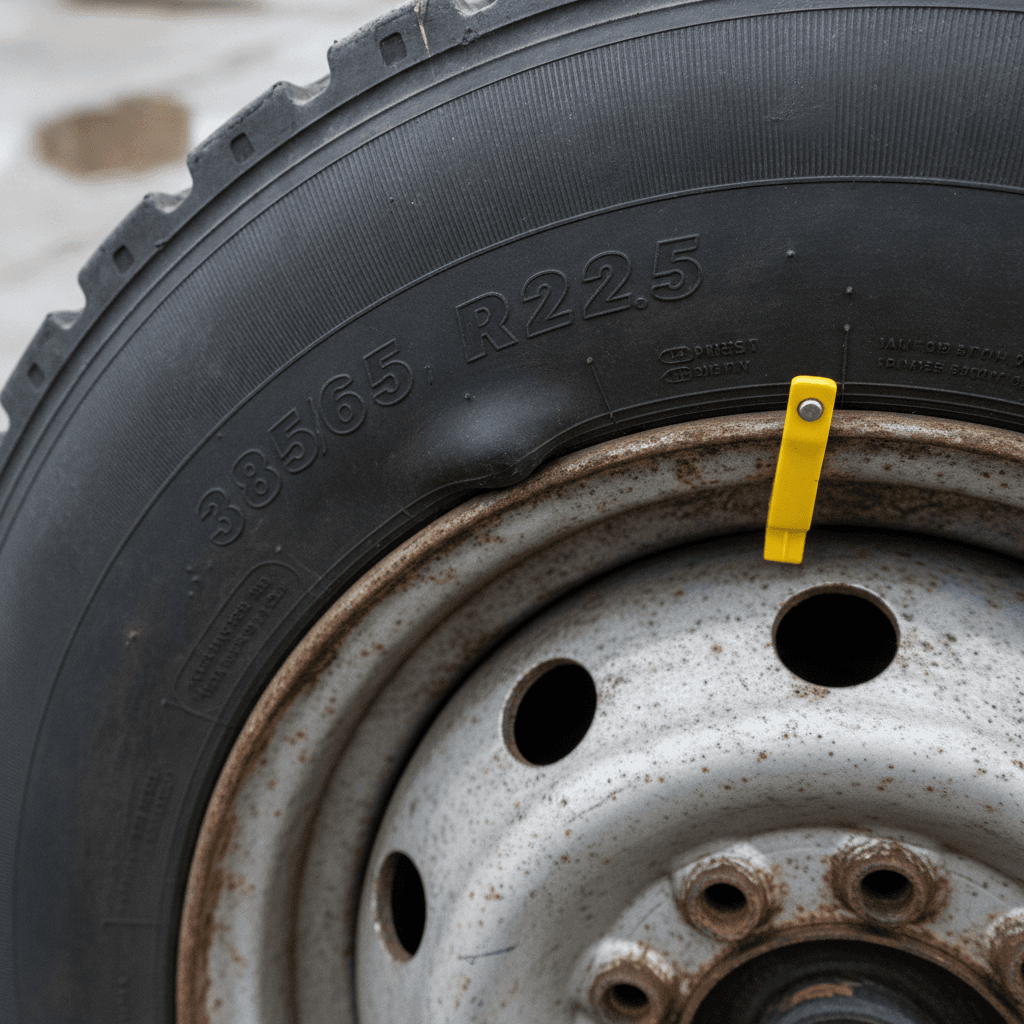
The tyre check that PMI sheets do badly
Four years ago I had a tyre fail at motorway speed on the M6. Not a blowout — a sidewall separation. The tread depth was fine, the pressure was fine, the tyre had passed three PMIs in the previous year. What nobody had written down, what nobody had been systematically checking, was the sidewall condition. There was a bulge on that tyre that had probably been developing for two or three months. It should have been caught. It wasn't, because our PMI sheet had one checkbox for "tyres" with no breakdown of what you were actually checking.
Tyre checks at PMI are broader than most operators realise, and the recording standard DVSA expects is higher than most inspection sheets deliver. Here's what your PMI sheet needs to capture for tyres, and why each element matters.
What the law requires
Tyre condition and maintenance requirements sit in Regulation 27 of The Road Vehicles (Construction and Use) Regulations 1986. The regulation sets minimum tread depth requirements (for commercial goods vehicles: 1mm across the central three-quarters of the tread breadth for the full circumference), prohibits the use of tyres that are not fit for use, and sets requirements on tyre condition including freedom from cuts, lumps, bulges and tears.
DVSA's Guide to Maintaining Roadworthiness expands on this for operators. It specifies that the formal safety inspection (PMI) must examine tyres comprehensively and that the inspection record must demonstrate what was checked, not just record a pass or fail outcome.
The four elements your PMI sheet needs for tyres
1. Tread depth — with measured values
Minimum legal depth is 1mm across the central three-quarters of the tread breadth for the full circumference. But the DVSA Guide to Maintaining Roadworthiness recommends operators set their own minimum threshold higher than the legal minimum — typically 3mm for steer tyres and 2mm for drive tyres — to avoid vehicles going out of service mid-cycle or failing at annual test.
Your PMI sheet should record actual tread depths for each tyre position, not just "OK" or "pass." If the depth recorded on a tyre today is 2.5mm and you're using a 2mm action threshold, you know that tyre needs replacing at the next PMI or sooner. Without the measurement, you lose this early-warning function entirely.
Record position (nearside steer, offside drive, nearside drive trailer axle 1 left, etc.) and the depth reading. It takes about forty extra seconds per tyre. The information is worth considerably more than that when a tyre goes at 56mph.
2. Sidewall condition — the one that gets missed
Sidewalls need a separate, explicit check. Not just a general glance — a close inspection of the whole sidewall surface on both sides of each tyre, looking for:
Bulges or lumps. These indicate internal structural damage, often from an impact (kerbing, pothole). A bulge is a failing tyre. Remove from service immediately. Don't wait for the next PMI.
Cuts and gashes. Any cut that penetrates to the cords is a fail. Superficial surface cuts that don't reach the cord structure are monitored and checked at every subsequent walkaround.
Cracks. Fine weather-cracking in the sidewall rubber is normal ageing. Deep cracks that propagate across the sidewall, or cracking around the sidewall near the bead, indicate deterioration that's approaching the point of failure.
Delamination or separation. Visible separation of the sidewall layers, or the beginnings of tread separation, means the tyre is at end of life.
Your PMI sheet should have a specific box for sidewall condition that requires a description, not just a tick. "Sidewall: no defects noted" tells DVSA that someone looked. "Sidewall: OS/S — minor surface cracking, no cords visible, monitored" tells them exactly what was found and what the response was.
3. Tyre specification — matching plating certificate
This is the one that catches operators after a tyre change or a secondhand vehicle purchase. Every tyre on the vehicle must match the specification listed on the plating certificate or be an approved equivalent. The wrong load rating or speed rating for the axle position is a Construction and Use offence.
Your PMI sheet should record the tyre size and load index for each position. Not "correct" or "not correct" — the actual size (e.g. 385/65 R22.5 160K). When a tyre is changed between PMIs and the fitter puts on a different spec without flagging it, this is how you catch it.
I've seen this missed more often on trailer axles than tractor units, partly because operators pay more attention to steer and drive tyres and treat trailer tyres as less critical. They're not. An underrated trailer tyre on an overloaded axle is a serious safety risk.
4. Wheel fixings — torque record
This is technically a separate check from tyre condition, but it sits naturally in the tyre section of the PMI sheet. Wheel fixings — studs, nuts, locking rings for tubeless tyres — must be checked for correct torque and for any visible sign of loosening (witness marks displaced, rust tracks from movement).
Record the torque values applied and the reference value for the vehicle. This isn't just a safety record — if a wheel loss incident occurs and you can't show that torque was checked and recorded at the last PMI, your liability position is considerably weaker than if you can.
The driver walkaround and the PMI — different checks
The daily walkaround check is not a substitute for the PMI tyre inspection. The driver is checking for obvious visible defects — a flat tyre, a clearly visible bulge, a cut they can spot at a glance. They're not measuring tread depths and they're not doing a close sidewall inspection.
The PMI tyre check is the systematic, measured, recorded inspection. Both are required. A driver who flags a tyre defect on the walkaround before PMI is doing exactly what the system is designed for — catching the thing the PMI might have missed for another few weeks. Your process for how walkaround defects feed into the PMI record (and vice versa) matters.
Post-incident tyre checks
After any incident that might have caused tyre damage — kerbing, pothole impact, collision, hitting a loading bay stop — tyres should be inspected before the vehicle returns to service. Not at the next scheduled PMI. Before the next journey.
Document the post-incident inspection separately and link it to the incident record. If DVSA later asks whether the vehicle was inspected after an event that occurred before a subsequent tyre failure, you need to be able to show that it was checked and cleared.
What DVSA checks at a roadside stop
At a DVSA roadside check, the examiner will typically walk around the vehicle and look at each tyre. They're checking for obvious defects — sidewall damage, visible wear, tyre condition — using the naked eye and, occasionally, a gauge. They can issue a PG9 immediate prohibition for a tyre that's unsafe to drive on.
What they're checking is simpler than what the PMI requires — they're looking for failures, not measuring margins. But a vehicle that arrives at a roadside check with a bulging sidewall, an underinflated tyre, or a tyre with obvious sidewall cracking has failed your PMI process as much as it's failed the DVSA check. The roadside stop is where your PMI either validates itself or doesn't.
Spare tyre — the forgotten item on most PMI sheets
If your vehicles carry a spare tyre — not all do, but many do — it should be on the PMI sheet. A spare tyre that's twenty years old, cracked across the sidewall and deflated to 15psi isn't going to help anyone at the side of the M1 at 2am. More to the point, a spare that doesn't meet the specification for the vehicle it's fitted to (wrong size, wrong load rating) isn't legally usable as a replacement in service.
Check the spare at every PMI. Record its condition and pressure. If it's not fit for service, replace it or remove it. A spare you can't use is taking up space and creating a false expectation for the driver.
Re-grooved tyres — what's legal and what isn't
Re-grooved tyres are permitted on commercial vehicles under certain conditions, governed by Regulation 27 of the Construction and Use Regulations. The tyre must have been manufactured with re-grooving in mind (marked "regroovable" on the sidewall), and the groove must not be cut below the depth of the original moulded design.
A re-grooved tyre that's had the groove cut deeper than the manufacturer's specification — even if tread depth is within legal limits — is a Construction and Use offence. At PMI, if you're running re-grooved tyres, confirm they're marked as regroovable and that the groove depth is within specification. Record the confirmation.
I've seen workshops re-groove tyres as a cost-saving measure without checking whether the specific tyre was designed for it. The cost saving evaporates rapidly if DVSA finds a non-regroovable tyre that's been re-grooved. And the liability position in the event of a tyre failure on a re-grooved tyre that wasn't designed for re-grooving is not somewhere you want to be.
The annual test tyre check
Annual test failures on tyres are more common than operators expect. The items that catch most operators out at test:
Tread depth below minimum, found during test inspection when it passed the pre-test PMI — usually because the PMI tread depth reading was close to the action threshold and the tyre wore down further before test date.
Sidewall damage not caught at PMI — usually a cut or bulge that developed between the last inspection and the test date, or that was present but not identified during the PMI inspection.
Tyre not matching plating certificate specification — discovered at test because the examiner checks the specification against the plate, and a substituted tyre from a previous repair doesn't match.
Mismatched tyres on the same axle — different sizes or load ratings on opposite sides of the same axle. This can affect handling and is a Construction and Use issue.
A pre-test inspection run specifically to check tyres — not just relying on the most recent PMI — saves annual test failures and the re-test fee. I run one on every vehicle two weeks before test date: tread depths checked and recorded, sidewalls inspected, specification verified against the plate. Any issues get fixed before test, not discovered by the DVSA examiner.