Load securing on HGVs: Regulation 100 and the DVSA Code of Practice that most operators haven't read
I found a 400kg pallet three inches from the tailgate on Tuesday. Regulation 100 doesn't care about driver excuses — it's your O-licence on the line.
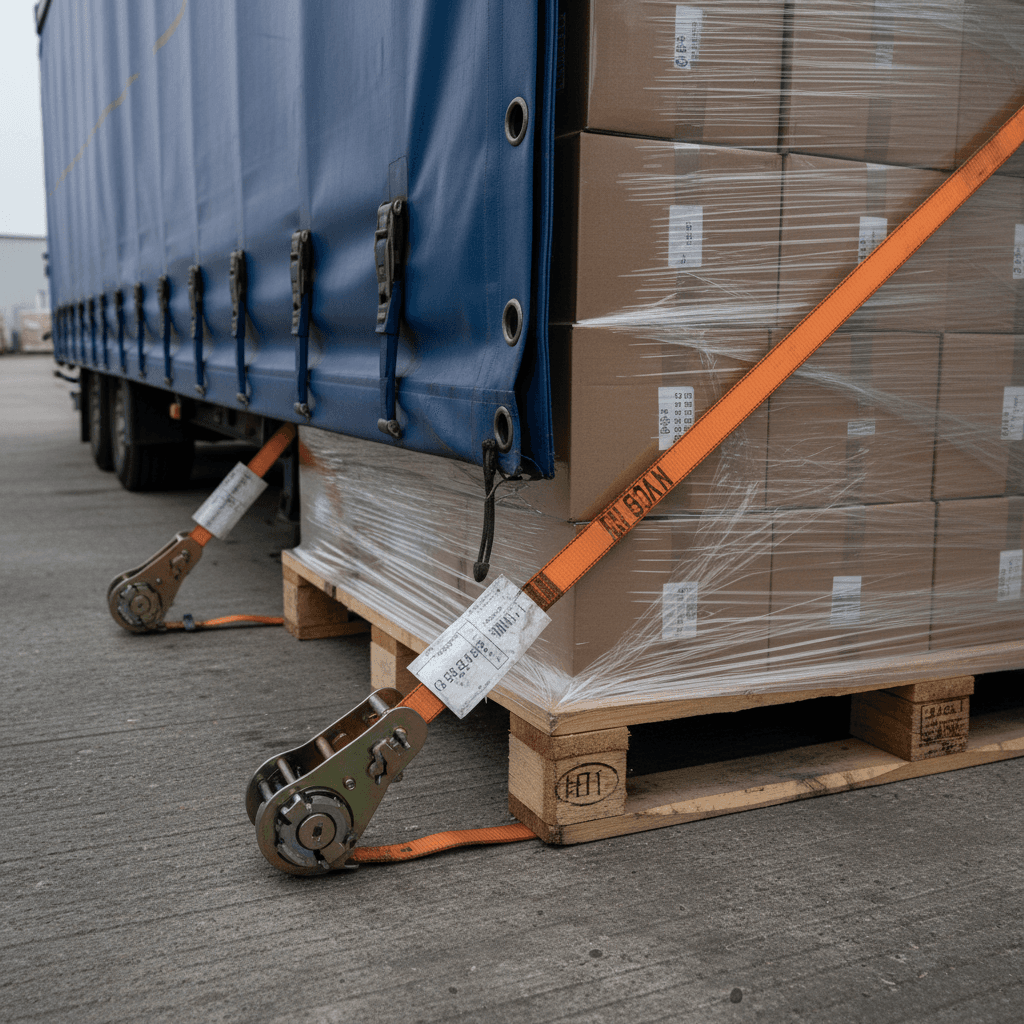
Found on a Tuesday morning: a pallet that had walked three inches towards the tailgate
It was a freezer delivery run. The driver had pulled into the service yard, and before he'd even climbed down I could see it through the windscreen — a 400kg pallet of dairy on a curtainsider, sitting unsecured against the tailgate bars. Not falling. Not fallen. Just waiting.
Nobody was hurt. Nothing was lost. But I spent the next two hours going through the paperwork and realising that if a DVSA officer had seen that load at the wrong moment, I'd have been looking at an immediate prohibition, an OCRS mark, and a letter from the Traffic Commissioner. All from one unsecured pallet my driver apparently hadn't thought needed a strap.
Load securing gets treated like box-ticking on most fleets. It's not. Here's what the law actually says, and what DVSA looks for when they pull you in.
Regulation 100: the bit of law most operators misquote
The starting point is Regulation 100(2) of The Road Vehicles (Construction and Use) Regulations 1986. It says — and I'm quoting directly — that the load must be secured "so that neither danger nor nuisance is likely to be caused to any person or property by reason of the load or any part thereof falling or being blown from the vehicle or by reason of any other movement of the load."
That's it. No specific lashing forces. No mandated strap grades. Just: if it moves, that's on you.
The vagueness is deliberate. It's a duty-of-care standard. But the detail people miss is the phrase "or any other movement." Not just falling off. Shifting. Rolling. Tipping. Any movement that could cause danger. Which means your curtainsider sheets don't count as restraint. They never did.
The DVSA Code of Practice: what it actually covers
On top of Reg 100, DVSA publishes a Code of Practice on Load Securing. It's not legislation — but breach it in front of an examiner and you'll find out very quickly that it carries significant weight in an enforcement context.
The Code cross-references EN 12195, the European standard for lashing. EN 12195-1 sets out the calculation method for required lashing force. EN 12195-2 covers webbing lashings. EN 12195-3 is for chains. EN 12195-4 covers wire ropes.
Most fleet operators I've spoken to have heard of EN 12195. Almost none of them know which part applies to their loads or can explain how the force calculation works. That's a problem — because an examiner absolutely can.
The lashing force calculation in plain English
You don't need a physics degree to get this right. But you do need to understand the basic principle.
The required lashing force depends on the weight of the load and the coefficient of friction between the load and the deck. For a standard metal stillage on a plywood floor, you're looking at a friction coefficient of around 0.3. For rubber-footed equipment on aluminium decking, it might be 0.5 or higher.
The Code says total lashing force must be sufficient to prevent movement in any direction under normal driving conditions — and "normal" includes emergency braking. Forward lashing typically needs to withstand 0.8g of force. Sideways: 0.5g. Rearward: 0.5g.
On a 400kg pallet, that's forward lashing capable of restraining 320kg of force. One standard EN 12195-2 webbing strap typically has a lashing capacity of 250daN — but that's at the strap's rated load, not what you actually achieve with a ratchet tensioned by a tired driver at the end of a long shift.
That's why two straps is minimum for anything over 200kg on a flatbed. One strap, poorly tensioned, fails the calculation even before DVSA looks at it.
What examiners actually check at roadside
Here's what my drivers tell me happens at a Hilton Park or Ferrybridge stop when load securing is the focus.
First, the examiner looks at the body. On a curtainsider, they'll look for bulging, unusual contour, and whether the sheets are doing work they shouldn't. If a sheet is tight against a load rather than hanging close to it, that's a flag. Sheets keep rain out. They're not restraints.
Second, they want to see inside. They're looking for movement evidence — scuff marks on the deck, pallets that have shifted, visible gaps between loads that should be butted. Tight-packed loads are good. A 100mm gap between a stillage and the bulkhead is a potential issue.
Third: the lashings themselves. Strap condition, rated capacity markings, tension. A strap with a frayed edge or a missing rating tag fails immediately. They'll physically check the ratchet mechanism. And they count the straps against the load weight — if the numbers don't work, it doesn't matter how neat the paperwork is.
The immediate prohibition and what it costs
A load securing failure at roadside typically results in a GV3 prohibition notice. Depending on severity, that can be immediate or delayed. An immediate prohibition means the vehicle doesn't move until the defect is rectified. A delayed one gives you to the end of the working day.
Either way, it goes on your OCRS record. One prohibition isn't the end of the world. Two in a rolling 12 months changes your DVSA risk band. And a pattern of load-related prohibitions attracts the kind of attention that ends with a letter from the Traffic Commissioner.
I've seen operators receive a Section 9(2) Direction — a formal warning from the TC — off the back of three load-related prohibitions in 18 months. No public inquiry. Just a letter making very clear the TC is watching. Uncomfortable reading on a Friday afternoon.
Five things I changed on my fleet after that Tuesday morning
One. I added a load securing checklist to the daily pre-departure walkaround. Five questions, takes ninety seconds. Did you strap it? Did you tension it? Did you check the strap rating matches the load? Did the curtains close cleanly? Did anything shift during loading?
Two. I bought a torque tester for our ratchet straps. Costs about £45. Every driver checks tension before departure and logs it.
Three. I replaced six straps that had damaged or missing EN 12195 rating tags. Non-negotiable. If the tag's gone, the strap goes.
Four. I had a supplier briefing on stillage weights. I'd been assuming a standard 400kg for all Clipper Logistics stillages. Two of them were running at 520kg. That changes the calculation.
Five. I reviewed our curtainsider specification. Our trailers had Michelin-rated curtains — but the body manufacturer's paperwork didn't specify whether those curtains met EN 12642 Code XL. They didn't. For loads above 2,500kg, that matters. We've since spec'd two XL trailers for the heavy runs.
The document most operators don't have ready
If an examiner asks you to demonstrate your load securing system meets Regulation 100, you need a load security plan. Not a generic one. A plan showing, for each load type you carry, the strap configuration, minimum lashing capacity, and friction coefficient assumption used.
Most operators don't have this. They strap loads the way they were taught by someone who was taught by someone else. No documentation, no calculation, no reference to EN 12195.
That doesn't mean you automatically fail at roadside — load securing is usually assessed visually. But if you end up in a TC's office justifying your operations, a load security plan is the kind of evidence that says "we take this seriously." The absence of one says the opposite.
A quick word on abnormal loads
If you're running anything over 5,000kg on a flatbed, or anything with unusual dimensions or shape, the standard Code of Practice may not be sufficient. The DfT's guidance for abnormal loads, and for ADR operators, intersects here. And if you're crossing into Europe, requirements can differ by country.
For unusual loads, the standard EN 12195-1 calculation may need to be augmented with manufacturer-specific guidance or a specialist transport consultant's assessment. Standard rules cover standard loads. Your job is knowing when you're outside the standard.
Bottom line
Regulation 100 isn't complicated. Keep the load from moving so it doesn't hurt anyone. But the devil is in the calculation — specifically, whether your straps are sufficient, whether they're correctly rated, and whether your drivers are tensioning them properly rather than just threading them through and calling it done.
That pallet on a Tuesday morning woke me up. I'd been running loads the same way for three years without a problem. But "no problem yet" isn't a load securing policy.
Get the Code of Practice. Check your strap ratings. Build a load plan for your main load types. And for anything heavy or awkward, do the EN 12195-1 calculation before the examiner does it for you.