Maintenance contracts with external workshops: what DVSA expects to find on file
My workshop sent records when they remembered. Which was most of the time. DVSA's guide says that's not good enough — here's what the contract must say and what you must be able to produce.
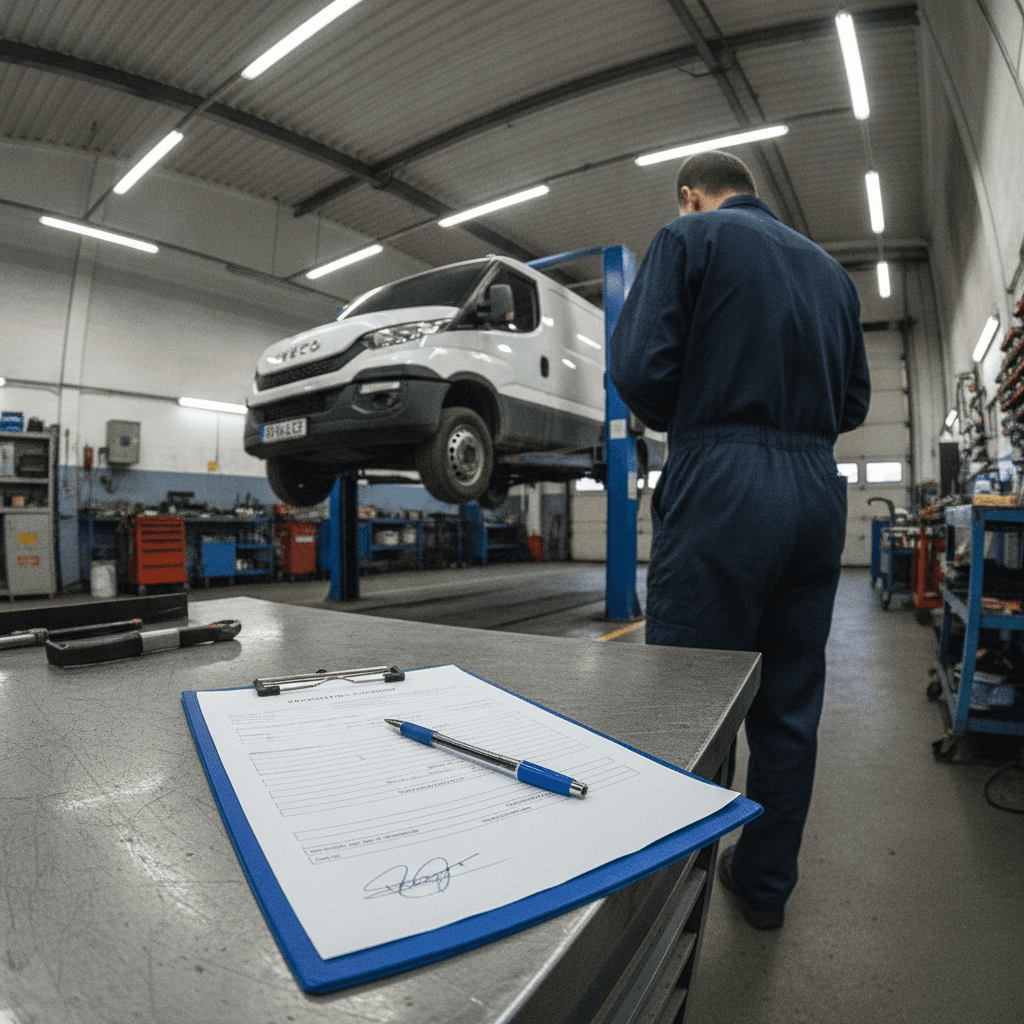
My first external workshop arrangement was basically a handshake. Local garage, knew the owner, vehicles went in for PMIs every six weeks. Records would come across when they remembered, which was most of the time. That arrangement lasted four years before I sat in an MIV and discovered 'most of the time' wasn't good enough.
The DVSA Guide to Maintaining Roadworthiness is clear on this: operators who have contracted out their safety inspections must draw up a formal written contract with the inspection agency or garage. That contract must be retained on file. Not as a courtesy — as a legal requirement on any operator who doesn't do their own maintenance in-house.
Why the contract matters
When something goes wrong — a vehicle gets a PG9 at the roadside, a driver notices a defect that should have been caught at the last inspection, or a prohibition is issued after an MIV — the Traffic Commissioner's starting question is: what arrangement did you have with the person responsible for maintaining this vehicle?
If the answer is 'a verbal agreement and a phone call when we need a booking', that's a problem. Not because the verbal arrangement was necessarily bad — but because you can't prove what was agreed, and you can't demonstrate that you were monitoring the quality of work being done.
The guide specifically requires that operators who use external workshops must be able to view inspection records and have a means of regularly monitoring the quality of work produced for them. That monitoring responsibility doesn't transfer to the garage when you hand over the keys.
What the contract needs to cover
The DVSA guide includes an example maintenance contract template as Annex 5. It's worth reading even if you have an existing agreement — most operators find gaps when they compare. The key elements a contract needs to address:
Inspection frequency. The contract must specify how often vehicles will be inspected. That frequency needs to be consistent with your maintenance planner and appropriate for the type of work the vehicle does. A general haulage vehicle should be on a 6-to-10-week inspection cycle; arduous operations bring that down to 4-to-6 weeks.
Record provision. The contract must say how and when inspection records will be provided to you. My preferred arrangement now is within 24 hours of each inspection, sent digitally. The records need to be in a format you can retain — email with a PDF, upload to your compliance system, whatever — not just sitting in the workshop's own files.
Defect rectification procedure. The contract should be clear about what happens when defects are found. Are they rectified immediately before the vehicle leaves? Is a prohibitable defect notified to you directly before the vehicle goes back into service? Who authorises repair work above a certain cost?
Driver defect reports. If your drivers submit defect reports electronically or on paper, how do those get to the workshop? And how does confirmation of repair get back to you? The paper trail linking a driver's defect report to the repair invoice and back to the PMI record — that's what DVSA is looking for.
Workshop accreditation: what to ask for
You don't have to use an accredited workshop. But if you're choosing an external contractor, the DVSA guide highlights two schemes worth knowing about.
The IRTE National Workshop Accreditation scheme — run by the Society of Operations Engineers — assesses workshops against specific standards for vehicle maintenance. A workshop with IRTE accreditation has been externally assessed. That's a meaningful quality marker.
The Maintenance Provision Rating Scheme (MPRS) is another option, specifically designed for the road transport industry. Not every good workshop has one of these accreditations — smaller local garages often don't bother with the paperwork — but the absence of any accreditation means you need to do more of the quality monitoring yourself.
When I moved to a new external workshop after the MIV, I asked three questions before signing anything: What qualifications do your technicians hold? Are any of your mechanics IRTEC-accredited? And can I see a sample inspection record from a recent job? The answers told me more than any sales pitch.
Monitoring: the bit most operators skip
A written contract is step one. Regular monitoring is step two, and it's the part that falls away first when you're busy.
Monitoring the quality of a workshop's work doesn't mean visiting every six weeks and watching inspections. It means reviewing the inspection records when they come in. Are they complete? Are defects being noted and repaired? Are the inspection intervals matching what's in your maintenance planner? Is the technician's signature there?
I started keeping a simple spreadsheet — vehicle, last inspection date, next due date, defects found, action taken. Takes fifteen minutes a fortnight. If an inspection record comes in that's vague, unsigned, or doesn't match what I'd expect for that vehicle, I'm on the phone to the workshop the same day.
That paper trail of monitoring — I reviewed records on these dates, I queried these items, I received these responses — is exactly what a Traffic Commissioner wants to see if the quality of maintenance ever becomes an issue. It's also what protects you from a workshop that cuts corners and expects you to carry the consequences.
One more thing
The contract stays on file for the duration of the arrangement and — like the maintenance records themselves — for a reasonable period after. If your workshop changes, keep the old contract. If you can't locate a contract and DVSA ask for it, 'we had an arrangement but didn't write it down' is not where you want to be standing when they ask what happened to the vehicle that got a PG9 last March.