PG9 immediate prohibition: the clearance process after the examiner walks away and what operators get wrong
The examiner put an immediate PG9 on my Scania at Knutsford. Vehicle off the road, driver looking at me. Getting it back on the road took three days — and I got the process wrong twice.
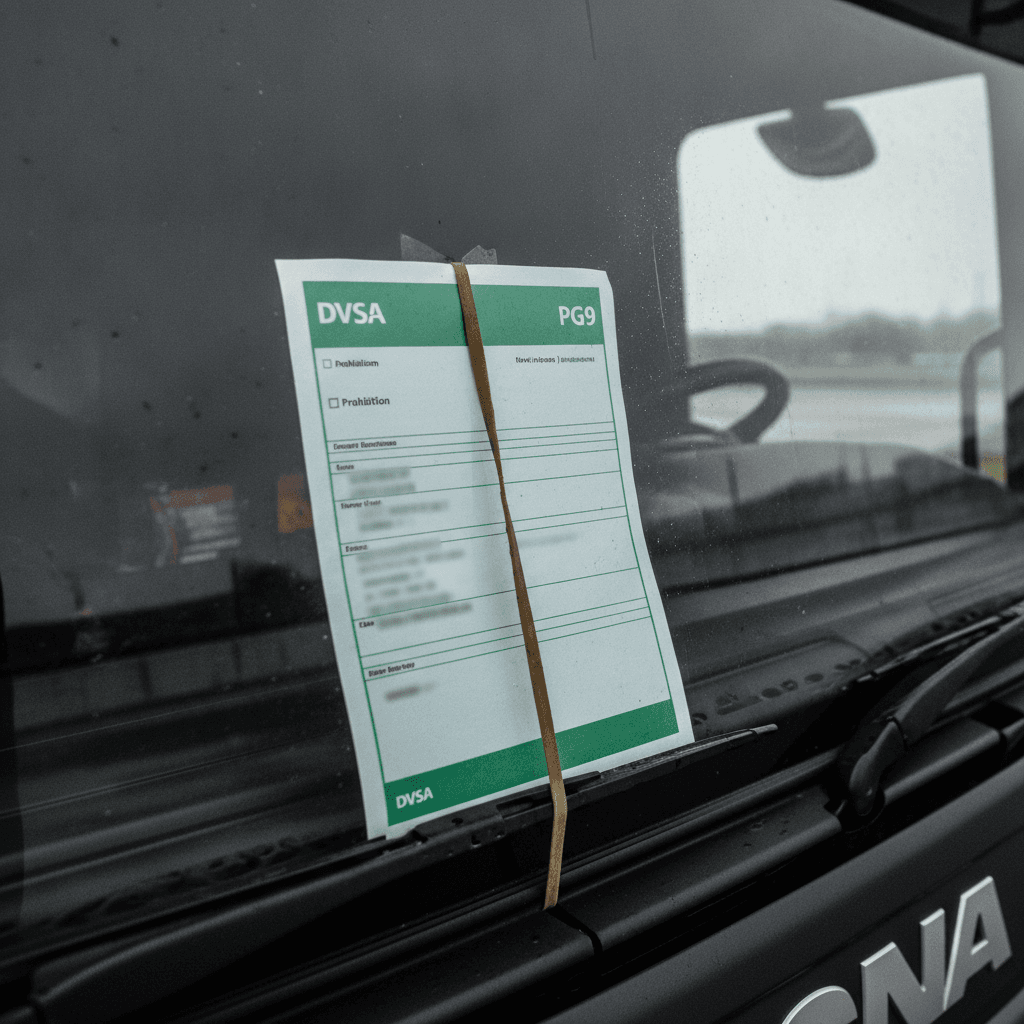
A PG9 immediate prohibition is a formal notice that says the vehicle must not move until the defect is fixed and the prohibition is cleared. Not 'fix it when you can.' Not 'drive carefully to your workshop.' The vehicle stays where it is.
What happens next is where most operators — especially those who haven't been through it before — make mistakes. The process for getting a prohibition cleared isn't complicated, but it's specific. And getting it wrong means the vehicle stays off the road longer than it needs to.
What a PG9 prohibition actually is
PG9 is the form reference. The formal title is a notice under Section 69 of the Road Traffic Act 1988. An immediate prohibition means the vehicle must not move except to a place of repair. A delayed prohibition — sometimes called a 'clear by end of day' or a specific date — means the driver can complete the current journey or run until the specified time, after which the same rules apply.
The defect that triggers it is recorded on the PG9 form. There are categories: 'S' marked means the examiner considers the defect poses a serious and immediate danger to road safety — that's an S-marked prohibition, which has additional consequences for your OCRS and triggers a notification to the Traffic Commissioner. A non-S-marked immediate PG9 is serious enough, but it doesn't carry that additional TC notification burden.
This article focuses on the non-S-marked immediate PG9. The S-marked process has additional steps beyond what's described here.
The moment the notice is issued
The examiner hands you the PG9 form. They leave. The vehicle is now prohibited. What most operators do at this point: call the workshop, arrange recovery, and assume the workshop will sort everything from there.
That's not quite right. The workshop needs to know they're dealing with a prohibited vehicle — because the process for clearing the prohibition requires a specific inspection by a qualified inspector and the right paperwork, not just a repair job card and a road test.
Contact the workshop before the vehicle moves. Tell them it's a PG9 immediate prohibition, tell them what the defect is (it's on the form), and confirm that they're going to handle the clearance inspection as well as the repair. Not all workshops are set up to do this — or remember to do it in the right order.
Recovery: moving the vehicle
An immediate PG9 allows the vehicle to be moved to a place of repair. In practice that means it can be driven — very carefully, with the prohibition in hand — to an appropriate repair facility, or recovered by a breakdown recovery company. If the defect makes driving genuinely dangerous, recovery on a transporter is the right call. If it's something like a failed brake chamber on one axle where the vehicle can be moved slowly and safely, driving to the nearest suitable workshop is more practical.
The prohibition notice should travel with the vehicle. The driver, or whoever is recovering it, needs to be able to produce it at a roadside check on the way to the workshop — because without it, the vehicle has no legal justification for being on the road.
The repair
Fix the defect described on the PG9 form. This sounds obvious. But the workshop needs to understand that the repair must address the specific fault recorded on the notice — not just the most visible problem with the vehicle. If the PG9 says 'nearside front brake chamber failed, insufficient service brake efficiency,' the repair is the brake chamber, a test of the brake performance after repair, and documentation of both. Not a general service and a road test.
The repair record needs to show: what was found, what was replaced or repaired, parts used (with manufacturer references where relevant), and the result of any post-repair test. A roller brake test printout is the standard evidence of brake performance after a brake system repair. If the prohibition was for a brake defect and there's no RBT printout in the file, the clearance inspection is going to have questions.
The clearance inspection: who does it
After repair, the vehicle needs to be inspected to confirm the defect has been fixed before the prohibition can be lifted. That inspection must be carried out by a DVSA examiner or, in most cases, by an Authorised Testing Facility (ATF).
In practice, most operators use an ATF for clearance — it's faster to arrange and doesn't require waiting for a DVSA examiner to be available. ATFs are approved vehicle testing stations, usually run by workshops, HGV test centres, or large operators. Your maintenance workshop may be an ATF; if not, they'll usually know where the nearest one is.
Book the clearance inspection before the repair is complete if you can. ATF slots aren't always immediately available. A vehicle sitting repaired but uncleared is still prohibited and still off the road. Every day waiting for a clearance slot is a day of lost revenue.
The clearance form: GV79
The form used to request clearance of a prohibition is the GV79 — 'Application for the removal of a vehicle prohibition.' This form needs to be completed and taken to the clearance inspection. The inspector will check the vehicle, confirm the defect has been rectified, and either stamp the form to confirm clearance or decline it if the repair isn't satisfactory.
If the prohibition is cleared: the inspector signs and stamps the GV79, the vehicle is legal to operate again, and you have your documentation. Keep the cleared PG9 and the completed GV79 in the vehicle maintenance file. DVSA can ask for them at a later audit, and showing that a prohibition was properly cleared — with the inspection record — is important for your OCRS.
If the clearance inspection fails: the vehicle stays prohibited. The inspector will note what's wrong. Go back to the workshop, fix it, rebook the inspection. This is where the cost of a PG9 really accumulates.
Fees
Clearance inspections at an ATF or through DVSA aren't free. The exact fee depends on the type of inspection and the testing station. It's typically in the range of £40-£80 for a clearance inspection — check with your ATF before booking. Some operators try to avoid paying by arranging a 'passing inspection' as part of a scheduled annual test booking instead; this is only appropriate if the annual test is genuinely due, and the test centre will still need to clear the prohibition as part of the process.
The two mistakes operators most commonly make
Mistake 1: treating it like a normal repair. The workshop fixes the defect, test drives the vehicle, and sends it back on the road — without arranging a formal clearance inspection and getting the GV79 stamped. The prohibition is technically still in force. The vehicle is back on the road without legal clearance. If it gets stopped again, the driver has a prohibited vehicle that's been used in breach of the notice — and that's a significantly more serious outcome than the original PG9.
I've seen operators do this genuinely not realising there was a formal clearance step. The workshop finished the job, the driver picked the vehicle up, and nobody thought to check whether the prohibition itself had been lifted. It hadn't.
Mistake 2: filing the PG9 without assessing the wider picture. A PG9 prohibition goes on your OCRS — it's recorded against the vehicle and the operator. An immediate prohibition for a defect that should have been caught at the last PMI is going to raise questions at your next DVSA encounter about whether your maintenance system is working.
After any prohibition, do a brief root cause review: was the defect present at the last PMI? If yes, why wasn't it caught? If it developed between PMIs, is the PMI interval appropriate for this vehicle and its usage? The clearance is the legal step that gets the vehicle back on the road. The review is the compliance step that stops it happening again.
The OCRS impact and how to mitigate it
A PG9 immediate prohibition is a 'roadworthiness' event in your OCRS record. It scores against you. There's no way to prevent that. But DVSA's assessment of your overall compliance takes into account whether prohibitions are isolated events or part of a pattern, and whether you have systems that should have prevented them.
After the clearance, document what you did: the root cause review, any changes to your PMI process or inspection schedule, any driver briefing about defect reporting. If the TC or a DVSA examiner later asks about the prohibition, you can show not just that you cleared it, but that you analysed it and acted on it. That's the difference between an operator who's compliant and one who's just managing paperwork.