Tachograph record retention: the 12-month floor, when you need 24, and the WTD gap most operators run straight past
Most operators keep tachograph records for 12 months. There's one situation where you need 24, and most operators don't know they're in it.
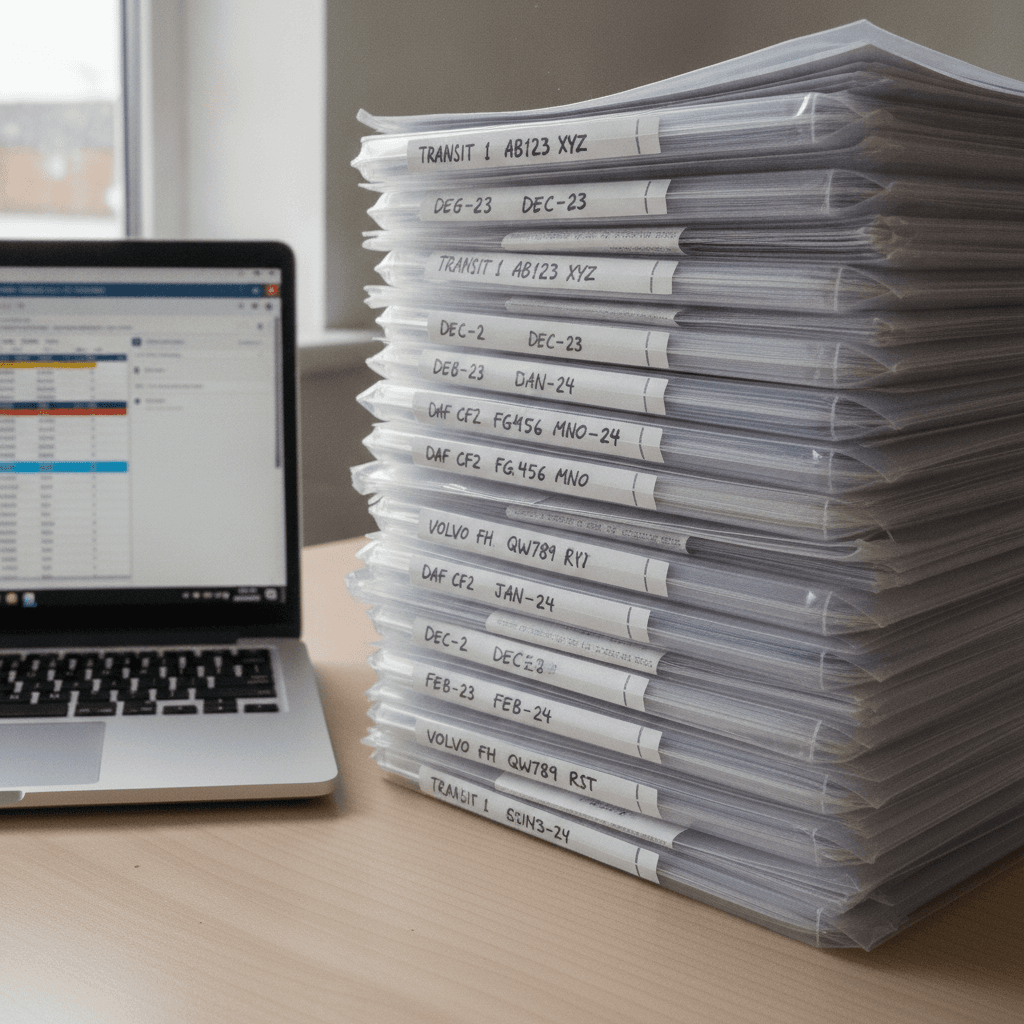
A DVSA officer arrived at our yard for a targeted maintenance investigation in April 2023. He wanted tachograph records. Not for the last month — for the last eighteen months. I had twelve months of records. Meticulous twelve months. The previous six had been archived on an old system and the export had failed.
We weren't prosecuted. But that visit sharpened my understanding of the difference between the basic retention rule and the rule that applies once WTD obligations enter the picture. Here's how the retention periods actually work — and where most operators discover they've been keeping records for the wrong amount of time.
The twelve-month baseline
Under the EC 561/2006 rules — the assimilated Regulation still applicable in the UK — operators must be able to produce tachograph records on demand for the previous twelve months. That applies to both vehicle unit (VU) downloads and driver card downloads.
Twelve months. Not three years. Not two years as a standard. Twelve months is the legal floor under the assimilated tachograph regulation. Gov.uk is explicit: "Be able to produce records to enforcement officers for 12 months."
Some operators keep three years because someone told them to, or because their software defaulted to that. That's not a compliance requirement under EC 561. It may be good practice for other reasons, but you're not legally required to keep tachograph records for more than twelve months to satisfy the tachograph rules.
Where the twenty-four months comes in
The Working Time (Road Transport) Regulations 2005 require employers to keep WTD records for two years after the period in question. Two years. Twenty-four months.
If you have separate WTD records — time sheets, HR records, roster records that demonstrate hours worked, breaks taken, and weekly rest — then those records need to be kept for twenty-four months, and your tachograph records need to be kept for twelve months. Two separate archives, two different retention periods.
But here's the situation most operators are in without knowing it: their tachograph data IS their WTD record. There's no separate timesheet. There's no HR system capturing weekly working time. The tachograph download is the only evidence that the driver complied with WTD obligations. In that case, the tachograph data needs to be kept for two years — because it's serving dual purpose as both tachograph record and WTD record.
If DVSA or an employment tribunal asks for WTD compliance evidence going back twenty months, and your only record is the tachograph data, and you've deleted it after twelve months — you've got nothing. That's the gap.
How to know which situation you're in
Look at your HR or payroll system. Is there any record of driver working hours outside of the tachograph analysis system? If your payroll software records hours worked based on something other than tacho data — manual input, signed timesheets, an HR system where managers log hours — then you have a separate WTD record and you can keep tachograph data for twelve months.
If the answer is "we use the tachograph data as proof of hours worked" — or more likely "we've never thought about it" — then your tachograph records are your WTD records and you need twenty-four months.
Most small fleet operators are in the second camp. The tachograph download is the record of what the driver did. It's used for drivers' hours analysis. It's the only evidence of rest periods, working time, driving time. Without it, there's no WTD compliance trail. Keep it for two years.
Download frequency — separate from retention
The download frequency rules are separate from the retention rules. Don't confuse the two.
You must download the vehicle unit at least every ninety calendar days. You must download each driver card at least every twenty-eight calendar days — or before the driver leaves your employment, whichever comes first.
These are the intervals at which data must be collected. How long you keep it is a separate question. You download the VU every ninety days and keep the downloads for twelve months (or twenty-four months if it's your WTD record). You download the driver card every twenty-eight days and keep those downloads for the same period.
If your download cycle slips — VU not downloaded for a hundred days, or driver card not downloaded for thirty-five days — you've already committed an offence before the retention question arises. Get the download right first, then worry about retention.
Certificates of undownloadability
Sometimes a vehicle unit or driver card can't be downloaded. Card reader failure. Unit malfunction. Defective card. In those cases you need a certificate of undownloadability — a record that you attempted to download, failed, and the reason why.
These certificates must be kept for at least twelve months. They're part of the tachograph record. If DVSA ask why a specific window in your VU download history is missing, the certificate is your explanation. Without one, the gap looks like you didn't bother — not that you couldn't.
Keep certificates of undownloadability in the same archive as your regular download records. Index them by date and vehicle registration. When a VU or card is sent for repair after a download failure, note the outcome — repaired, replaced, data recovered, data lost.
Archive formats: what "keeping records" actually means
The regulation doesn't prescribe a specific archive format. Digital archives are fine — and they're what most operators use. Cloud storage, network drives, analysis software archives, third-party tachograph analysis services. All of these are acceptable provided the data can be produced on demand in a usable form.
Usable form means: a DVSA officer can read it. Not "we have the data somewhere in a proprietary format that requires the software vendor to extract." Operators have been caught out by this — analysis system cancelled, data locked, records technically present but not producible. Keep a format-independent copy of critical records, particularly for older data approaching the retention boundary.
For paper records — analogue tachograph charts, printouts — keep them flat, in order, indexed, and in a location where they won't be damaged. Paper records are still legally valid and still subject to the same retention requirements. A box of damp, torn tachograph charts in a corner of the yard doesn't satisfy the obligation.
What enforcement looks like in practice
At a DVSA targeted maintenance investigation — a formal visit to your premises — the officer will ask for tachograph records for specific vehicles and drivers, usually covering the previous six to twelve months at minimum. They may ask for records going back to the start of a licence period or the start of employment for a specific driver.
If you can't produce records that should exist — because your retention period was too short, or the archive failed, or the data was never downloaded correctly — that becomes part of the investigation. It's not automatically a prosecution, but it's a significant adverse finding that the TC will see.
The clean position: clear download records for every vehicle and every driver, covering the full retention period, indexed and retrievable within minutes. Not in three weeks when someone gets back to you. On the day, within the hour.
Practical system for getting this right
Set a calendar reminder for both download intervals. VU every eighty-five days — five days before the ninety-day limit. Driver card every twenty-five days — three days before the twenty-eight day limit. The buffer gives you time to deal with any download failure before the deadline passes.
Archive downloads by vehicle and by driver, separately. Use a clear naming convention — registration, date, download type — so you can find any specific file in thirty seconds. If you use an analysis service, confirm with them in writing what retention period they archive data for, and download your own copy separately. Don't rely on a third party's retention policy to satisfy your legal obligation.
And once a year, run a simple audit: pick three vehicles at random, ask your system for the last two years of VU downloads, and check that they're all there, complete, and readable. Gaps you find yourself are fixable. Gaps DVSA find aren't.
The interaction with analogue tachograph records
If any of your vehicles still run on analogue tachographs — older vehicles on certain operations — the record-keeping obligation applies to the paper charts. Analogue charts must be kept by the driver for the current day and the previous twenty-eight days in the cab. Beyond that, they're returned to the operator and archived for the same retention periods: twelve months minimum, twenty-four months if they constitute your WTD record.
Paper analogue charts are more vulnerable than digital records. They get damaged, lost, folded, exposed to coffee. A chart that can't be read — faded, torn, ink smeared — is as useless as a missing chart for audit purposes. Store analogue charts flat, in boxes, indexed by driver and date. The fifteen-year-old filing system that's been "working fine" may not actually be producible in the form DVSA need.
Agency drivers: whose records are whose?
When you use agency drivers, the tachograph records are your responsibility for the period those drivers operated your vehicles. The driver card belongs to the driver personally. You need to download those cards within the twenty-eight-day window that applies during your engagement — you can't hand that obligation back to the agency.
This creates a practical problem with short-term agency engagements. Driver comes in on Monday, drives Wednesday and Thursday, back to the agency on Friday. Have you downloaded their card before they leave? If not, and they take the card with them, you've potentially missed the download window for the vehicle activity during their time with you. The vehicle unit download will show their driving activity, but the driver card data may not be accessible once they've left.
Build card download into the offboarding checklist for any agency driver. Download the card before they leave the site on their last day. File the data. Then they can take the card with them.
Defending a gap in your records
If you have a gap in your archive — a period where records are missing — the question is whether you can explain it convincingly. Equipment failure with a certificate of undownloadability is an explanation. System migration that corrupted files, if you can document it, is an explanation. "We deleted them because we thought we only needed twelve months" is not an explanation if you needed twenty-four months.
Before a planned system change — new analysis software, new archive solution, data migration — confirm that all existing records will transfer correctly. Run a post-migration check. Don't assume the migration worked until you've verified you can retrieve records from both the old and new system.
If you discover a gap today, document it: what's missing, why it's missing, when you discovered it. Then fill in what you can from other sources — vehicle unit data if you have it, driver card data if the card is still in your possession, any paper printouts that exist. A partial record plus a clear explanation of the gap is better than silence.