Trailer PMI intervals: when the 6-week rule isn't enough and what DVSA says triggers a shorter schedule
My trailers ran on 6-week PMIs for years. Then DVSA pointed out two of them were covering 15,000 miles between inspections. The interval is about usage, not a calendar.
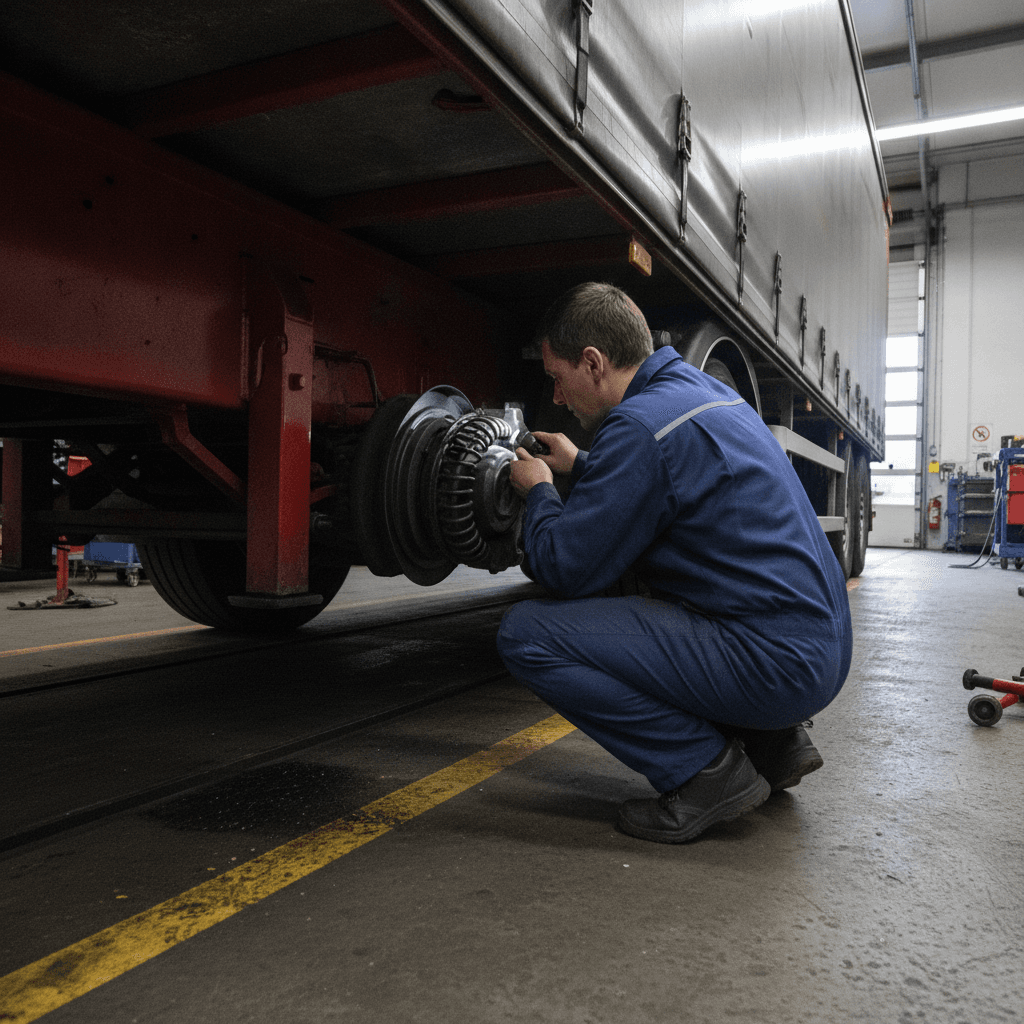
Six weeks is the maximum. It's not the target.
I made this mistake for a long time. I had a maintenance planner that said 'trailer A: 6 weeks, trailer B: 6 weeks, trailer C: 6 weeks' and I thought that was a properly managed schedule. It wasn't.
One of those trailers was doing two shuttle runs a week from Leeds to Immingham and back. The other spent most of its time parked at a depot in Bradford, going out maybe once a fortnight. Treating them identically was not only poor maintenance practice — it was the kind of thing a DVSA traffic examiner points to when assessing whether an operator's maintenance system is fit for purpose.
The DVSA Guide to Maintaining Roadworthiness is the starting point. Not the endpoint. And it's clear that the interval has to reflect operational use, not just a maximum calendar period.
What the Guide actually says
The DVSA guide sets out that safety inspections should be carried out at regular intervals but states explicitly that the frequency should be based on factors including the type of vehicle, its age, the type of work it does, the mileage it covers, and the operator's own experience of the defects that commonly arise.
Six weeks is the outer limit for most goods vehicles and trailers used regularly. But 'most' is doing a lot of work there. High-mileage vehicles, vehicles operating in arduous conditions — construction sites, quarries, coastal salt environments — and vehicles covering more than roughly 12,000 to 15,000 miles between six-week windows are candidates for shorter intervals.
DVSA's guidance notes that operators should review their inspection frequency if experience shows that vehicles are commonly found in a defective condition between inspections. That's not a passive suggestion — at a documentary audit, an examiner can look at your PMI records and ask whether your interval is justified by the defect history. If tyres are consistently under-inflated, if brake adjustments are regularly needed, if the same brake shoe keeps wearing — that's evidence that the interval is too long.
Trailers versus tractor units
Trailers tend to get less attention than tractor units in maintenance planning, which is backwards given how much load stress they take. A curtainsider trailer carrying 25 tonnes of consolidated freight, swapped between multiple tractor units and rarely seen at the home depot, can accumulate serious mileage and take significant structural stress in ways that don't show up on a standard walkaround.
Specifically with trailers: landing legs, fifth wheel coupling receiver points, brake chambers, slack adjusters, and suspension components need attention at PMI. The coupling inspection has to include both the trailer king pin receiver and the tractor's fifth wheel. If your trailers run on multiple tractor units, the fifth wheel inspection isn't always done at trailer PMI — it happens at tractor PMI. Make sure someone is tracking that intersection.
What triggers an earlier inspection
Three things should automatically bring a trailer in sooner than the scheduled date.
A defect report. If a driver returns a trailer with a marked defect — any defect recorded on the daily check sheet — that defect must be assessed and rectified before the trailer goes out again. But a complex defect, or one that suggests a broader mechanical issue, should prompt an earlier full safety inspection rather than just a repair sign-off. A cracked chassis member found in a defect report is not a job for a one-line repair record — it calls for a full inspection of the frame.
A change in use. If a trailer that normally runs sealed temperature-controlled work starts doing flatbed construction material deliveries, the PMI interval needs a rethink. Not because the regulation has changed, but because the wear pattern has.
A prohibition or roadside check finding. Any vehicle or trailer that receives a PG9 prohibition should be inspected fully before returning to service. That's not optional — it's a condition of the prohibition clearance. But beyond the clearance inspection, review whether the finding indicates a pattern. A brake imbalance that only showed up at a DVSA roller brake test might not have been visible at the previous PMI. That tells you the inspection process needs tightening, not just the defect.
Seasonal adjustments
October through March is harder on trailer equipment than the rest of the year. Salt corrosion on brake chambers, landing leg mechanisms, coupling assemblies, and electrical connections accelerates. Tyre pressures drop with temperature. Brakes that were fine in September can behave differently in January.
I don't have a different PMI interval for winter — my trailers run at five weeks from November to February, then back to six from March. That's a decision based on what I see in the records: we pick up more defects in winter, and five weeks gives me one more inspection window before things become serious.
That's the kind of operational logic DVSA expects to see behind an interval. Not 'six weeks because that's what everyone does' but 'five to six weeks depending on season, reviewed against our own defect history.'
Documentation: what the records need to show
Every safety inspection needs to be on a proper inspection report, signed by the inspector and by someone in authority — typically the transport manager. The record needs to show: vehicle/trailer registration, date, mileage where applicable, items checked, items found defective, items rectified, and who signed it off.
For trailers, note the tractor unit coupling inspection separately if it's being checked at the same time. Keep the records for at least 15 months. If a trailer goes off-fleet or is sold, retain the records for the same period from the date of sale.
One thing I've seen catch operators out: a trailer that was off-fleet for three months while under repair, then returned to service. The clock for the next inspection doesn't restart from the repair date automatically — or rather, it shouldn't. Review the inspection record from before it went off-fleet and schedule the next one accordingly. If it's been three months sitting in a bodyshop, a safety inspection before it returns to active service is the right call regardless of where it sits in the schedule.
When your workshop doesn't flag the interval
If your maintenance is contracted to an external workshop, it's your responsibility — not the workshop's — to set the inspection intervals and chase overdue inspections. The DVSA Guide to Maintaining Roadworthiness says that clearly. The workshop can advise, but the operator is responsible for deciding the frequency.
Get this in writing in your maintenance contract. The contract should specify the inspection interval for each vehicle and trailer, the basis for that interval, and the process for the workshop to flag if a vehicle comes in with defects that suggest the interval should be reviewed. A workshop that just signs everything off without flagging patterns isn't serving your compliance interests.
Review it once a year, at minimum
Look at your defect history for the last twelve months. Are any trailers consistently showing brake adjustment needed? Tyre under-inflation on the same axle? Electrical faults on the same circuit? Pattern defects are evidence that the inspection is catching things, which is good, but if the same thing is being caught every time, either the interval is too long or there's an underlying issue the inspection hasn't resolved.
A maintenance plan that hasn't been reviewed in two years is a liability in front of a DVSA examiner. Not because the regulation specifies annual reviews, but because good fleet management practice means your inspection frequency reflects your current operation — not the operation you had when you first filled in the maintenance planner.
Six weeks was never meant to be the answer. It was meant to be the ceiling. There's a difference, and DVSA knows it.