One of your vehicles is in a road accident: the operator's first three hours
A driver called me at 7am from the hard shoulder of the M1. Vehicle and trailer were driveable but a car had gone under the trailer's rear overhang. Here's what I did, in order, and what I should have had ready.
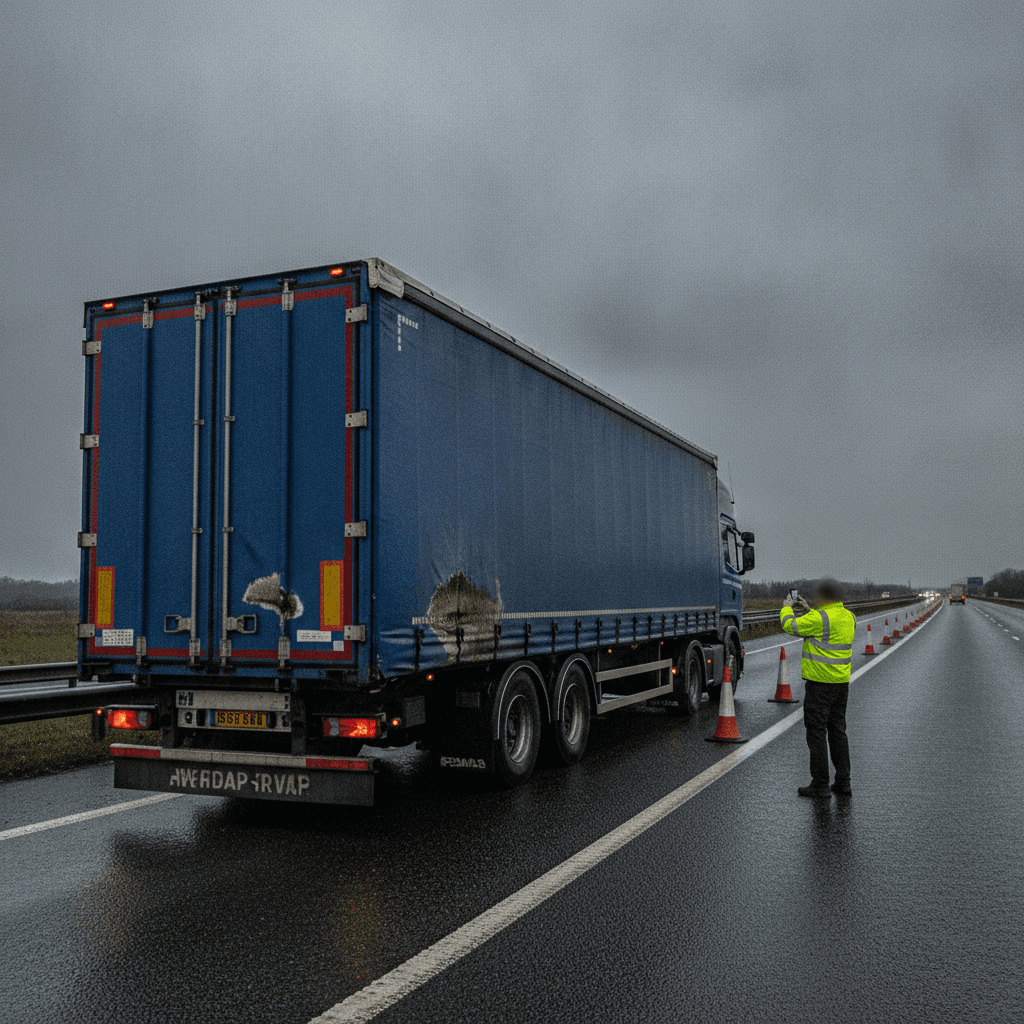
A driver called me at 7am from the hard shoulder of the M1. His curtainsider was driveable, no serious injuries, but a car had gone under the rear overhang of his trailer at a lane change on a contraflow. Minor injuries to the car driver, police on scene, nobody taken to hospital. The call lasted 45 seconds before I said 'stay there, don't move the vehicle, I'll call you back in ten minutes.'
Then I stood in my kitchen trying to remember what I was supposed to do next.
That was eight years ago. I've had the post-incident process written down and practised since then. Here's what it actually covers.
In the first hour: driver side
The driver's immediate obligations under the Road Traffic Act 1988 are: stop, remain at the scene, and exchange name and address with anyone involved. If injury is involved and those details aren't exchanged at the scene — or if the driver left the scene before police arrived — they must report the accident to a police station as soon as reasonably practicable and no later than 24 hours afterwards.
In most accidents involving a commercial vehicle, police will attend. So the driver's job in the immediate aftermath is: stay put, give their details, don't discuss fault, and call you.
Your instruction to the driver should be simple and pre-agreed: don't move the vehicle until you've told them to, take photos of the scene (all vehicles involved, road markings, damage, any road debris, weather/lighting conditions), get the other party's details, and don't make any admission of liability. That last one matters for the insurer as much as anything else.
In the first hour: operator side
Call your insurer. Commercial fleet policies typically require notification within 24 hours of an incident — some specify sooner. Check your policy wording before an incident happens, not during one. Most large fleet insurers have a 24-hour incident line. Use it even if the incident seems minor; damage estimates are often higher than they look at the roadside.
The other call to consider is your solicitor or transport lawyer if you have one on retainer. This applies particularly if there are injuries — even minor ones. Early legal advice on what you should and shouldn't be recording can prevent problems later.
Preserving the tachograph data
This is the one most operators know about in theory and forget about in practice. The driver card and vehicle unit both contain data relevant to the incident — the driving pattern in the hours before the accident, the point at which the vehicle stopped, speed data from the vehicle unit (approximately the last 24 hours of detailed data on most digital units).
Download the driver card as soon as the driver returns. Download the vehicle unit if you can access it — or arrange for it to be downloaded at a DVSA-approved workshop before the vehicle goes back into service or goes for repair. Data can be overwritten as the vehicle continues to be used, and once it's gone, it's gone.
The same applies to any dashcam footage. Most dashcams loop and overwrite continuously. Get the SD card or download the footage the same day. If the incident time is known, the footage window you need is roughly 30 minutes either side.
The vehicle: before it moves
If the vehicle is driveable, the instinct is to get it back on the road quickly. Resist that. Before the vehicle moves:
- Photograph all damage, all four sides of the vehicle and trailer
- Note the tyre condition and pressures if accessible
- If there's any possibility of mechanical failure contributing to the incident — brake failure, steering issue, a tyre blowout — the vehicle needs a formal examination before it goes back into service, not just a visual once-over
If a PG9 prohibition is issued at the roadside following the incident, the vehicle cannot be moved until the defect is rectified and the prohibition is cleared. That's a DVSA officer's call to make, not yours.
Getting a driver statement
A written statement from the driver — taken the same day, before any formal interviews or insurance conversations — is one of the most useful things you can have. It captures their account while it's fresh: what they were doing, where they were going, what they saw, what happened. It doesn't need to be long. It needs to be accurate and dated.
Don't use the statement process to coach the driver on what to say. The statement's value is that it's contemporaneous — taken on the day, in the driver's words. If there's ever a legal process months later, a statement written the same day as the incident carries far more weight than one reconstructed from memory.
In the days after: what goes on your OCRS
If DVSA were involved at the scene and issued a prohibition, that prohibition goes on your OCRS record. Traffic enforcement data — fixed penalties, improvement notices — also feeds through to OCRS in time. A single serious incident with a prohibition doesn't automatically crater your risk score, but it's a marker that DVSA will look at in context with your broader compliance record.
If the incident involved a serious injury and a police investigation follows, DVSA may be notified by the police. In that scenario, you might receive a DVSA letter requesting information about the vehicle's maintenance history and the driver's hours records. Have those records organised and available — specifically the last six weeks of PMI records for the vehicle and the driver's tachograph data for the relevant period.
The thing that saves you at 7am
Post-incident procedures only work if the driver knows them before the incident. I laminated a single-page 'what to do if you're in an accident' card — the phone numbers, the steps, the key don't-do-this reminders — and it lives in every cab. New starters get it at induction and we talk through it.
The difference between a well-managed incident and a badly managed one is mostly preparation. The incident itself is outside your control. What you do in the three hours after it isn't.