VOR procedure for HGVs: taking a truck off the road without messing up your O-licence
VOR is simple on paper and a paperwork disaster in the real yard. I've seen operators fined more for sloppy VOR records than for the original defect that put the truck off road.
Vehicles break. That's the job.
What's less obvious, when you start running a fleet, is that a broken vehicle sitting harmlessly in the corner of the yard is an active compliance event. It's not just a thing waiting to be fixed. It's a thing that appears in your records, that the Traffic Commissioner can ask about, and that – if you've handled it badly – can cost you more than the repair did.
VOR means Vehicle Off Road. In practice it's the status a vehicle enters when it can't legally or safely be used, and is being kept off the public highway until the issue is resolved. The rules around it aren't complicated. The way it interacts with your safety inspection schedule, your fleet records, your O-licence and your insurance is where operators get themselves in trouble.
The two flavours of VOR
There's planned VOR and unplanned VOR. They're different animals.
Planned VOR is the one you put a vehicle into deliberately. Maybe you're selling it. Maybe it's in a major refurbishment project that'll take weeks. Maybe seasonal demand has tailed off and you don't need it running until spring. You've got time to prepare the paperwork and think about things properly.
Unplanned VOR is the middle-of-the-afternoon one. A driver calls in from the depot with an ABS fault that the fitter can't fix today. Or a compliance officer during a PMI finds something that's prohibition-level. Or an MOT fails and you can't book a re-test until Thursday. The vehicle stops. You've got to VOR it now, with whatever systems you've built for exactly this moment.
What must happen on day one
Three things, in any order.
First, stop the vehicle from going on the road. This isn't metaphorical. Take the keys off the board. Block the vehicle in if you can. Tell anyone who might move it – drivers, fitters, agency staff, the yard manager – that this motor doesn't move outside the yard until further notice. I've had agency drivers just take a set of keys and drive a VOR'd unit onto the street 'to move it out of the way'. That's a disaster in the making. Put a physical lockout on it. Remove the keys to a locked box.
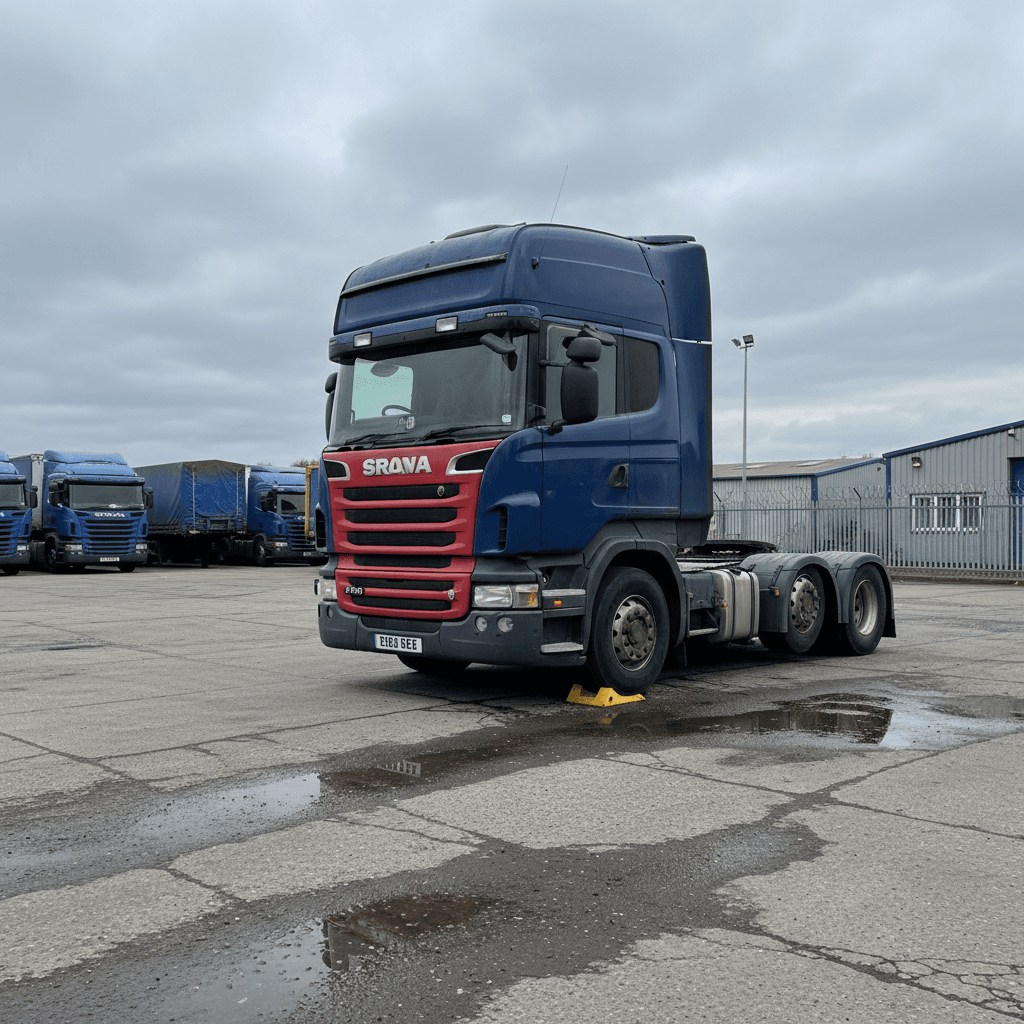
Second, mark the vehicle. A bright laminated A4 in the windscreen saying 'VOR – do not use'. A chock under the wheel. Something that says, at a glance, this one isn't in service. Shift changes happen. Memories fade. A sign prevents sincere mistakes.
Third, log the event. VOR status, reason, date, time, who declared it, planned or unplanned, expected duration, and the person responsible for follow-up. This goes on the vehicle file and on the workshop diary. It goes on your tachograph fleet system too – you don't want missed download reminders firing off for a truck that's been parked for three months.
The safety-inspection clock
This is the bit most people don't understand clearly.
A vehicle that's in genuine VOR – not being used on the road – doesn't need active PMIs during the VOR period. The six-week rhythm pauses. What you need is a clean entry in the log: 'Vehicle VOR from [date]. Reason: [reason]. Not in use on public highway.' And then, when the vehicle comes back, a fresh full safety inspection before it goes out. Not six weeks after return. Before.
The 'before it goes back out' inspection is the one that gets forgotten, especially if the VOR was short. A vehicle off for ten days with a gearbox rebuild doesn't feel like it needs the full treatment before returning. It does. Without that inspection and a signed-off sheet, your paperwork shows a gap between last-PMI and return-to-road that a DVSA officer will query.
The log entry matters for another reason. If your six-week rhythm looks like it's gapped when an auditor looks at your spreadsheet – 'why is there an 80-day gap here?' – you can point to the VOR entry. 'Because the vehicle was off the road for 42 days and here's the start-date, end-date, reason, and the re-inspection certificate dated the day it came back.' That turns a potential red flag into a clean record.
What VOR doesn't do to your O-licence
VOR'd vehicles still count against your authorisation.
If your O-licence authorises ten vehicles and one is VOR'd, you've got nine vehicles operating and ten authorised. You haven't freed up an authorisation slot to run an eleventh. This trips people up who assume 'it's not in use so it doesn't count'. It does.
The practical implication is this: if you've VOR'd two trucks for three months because work is quiet, you're paying continuation fees on ten when you only need authorisation for eight. The OTC doesn't automatically reduce your authorisation. You have to apply for a variation to drop it, then re-apply later to add it back. Each variation costs money and takes weeks.
For a short VOR, this doesn't matter. For a long one, it might. Get your accountant and your TM together before you make the call.
The insurance angle
Check your fleet insurance wording. Some policies automatically suspend cover on a declared-off vehicle; some don't. Some will give you a pro-rata reduction on the premium for declared VOR periods; most won't unless you tell them in advance.
If you're removing a vehicle from the highway for more than 28 days, you'll want a Statutory Off Road Notification (SORN) at the DVLA end. Once a SORN is in place, the vehicle can't be on the public highway at all – not even for a quick drive to the fuel station – without getting re-taxed first. This is the bit that bites fitters who think they can take a VOR'd unit for a road test. They can't.
Practical advice: don't SORN a VOR unless you're genuinely sure it'll be off the road for weeks. SORN plus un-SORN plus re-road-testing the vehicle adds three or four days of faff for a short-term problem.
Parts on order, diagnostic diary
Every VOR needs a live diary entry. Not a 'we'll chase it up' note. An actual dated log of what was found, what was ordered, when it's expected, and what the next action is. Update it at least weekly.
A classic operator failure looks like this: truck VOR'd on a Tuesday. Part ordered Wednesday. Supplier says two weeks. Two weeks later, supplier says sorry, it's three. Four weeks later, nobody has written down any of this. A DVSA officer visits. 'Why is this truck VOR'd?' 'Erm, parts. I think.' That's a red flag. It doesn't matter that the part is genuinely delayed. What matters is the operator hasn't been on top of it.
Good paper: 'Vehicle VOR 02 Mar – EBS fault codes 3F4 and 9E2. Part ordered 03 Mar from Knorr-Bremse, quoted delivery 14 days. 17 Mar: supplier re-quoted for 28 Mar. Chased 22 Mar. Arrived 29 Mar. Fitted 01 Apr. Road-tested 02 Apr. PMI completed 03 Apr. Returned to service 03 Apr.'
That sort of trail gets you the benefit of the doubt on almost anything.
Long VOR and the gotcha with plating
If a vehicle sits for six months or more, do check two things before putting it back into service.
One: the plating certificate and the tax. An HGV needs the annual test current. If the test has lapsed while it was off road, you can't just take it out on the first Monday back. You need to arrange an HGV test date and either get the vehicle there on a trade-test basis or on movement paperwork. Plan this before you need it, or you'll have an angry driver on a booked job with no legal truck under him.
Two: consumables and soft bits. Tyres can crack on the sidewalls if they've sat in one spot for months. Brake drums can rust surface-thick. Air systems develop leaks at hose connectors. A full pre-return inspection needs to account for all of this – which means your six-week pro-forma might not cover everything. Some fleets have a 'long VOR return' inspection sheet with extra items. Good idea. Steal it.
Disposal, variation, or back to work
Every VOR ends one of three ways.
The vehicle comes back to work, following the return-to-service inspection and a log entry closing the VOR. This is the commonest and cleanest outcome.
The vehicle is sold or scrapped. If sold, it comes off your licence – file an amendment to the OTC – and off your fleet record. If scrapped, same thing with the addition of a certificate of destruction.
The vehicle turns out to need more work than it's worth, and gets parked for an even longer VOR while the decision is made. This is the messiest outcome and the one that generates the most paperwork questions. If this happens, formalise it with a file note saying 'VOR pending disposition decision, target date [X]'. Give it a target. Don't let it drift.
The audit question
If a DVSA compliance officer or a TC auditor asks you 'show me every VOR event in the last twelve months', you should be able to give them, within an hour:
- A list of the VOR events by vehicle, date on, date off, reason, planned / unplanned
- The inspection records covering the period before and after each VOR
- The log entries for any VOR longer than a week
- The return-to-service inspection for each vehicle that came back
If you can't produce that, the next question is: what else are you not tracking?
The good news is most fleet-management software will do this automatically if it's set up right. The bad news is most setups I've seen have VOR logging as an afterthought that someone was supposed to use but didn't. Fix that before an auditor fixes it for you.
One last thing
VOR is not a punishment for the vehicle. It's a safety status for your operation. Some fleets treat it like a black mark – 'we never have to VOR anything' is said like it's a badge of honour.
It isn't. If nothing on your fleet has ever been VOR'd, either you're running a miraculously young set of motors, or you've been pushing broken vehicles out on the road. Neither is a flex. Neither is safe. Treat VOR as what it is: the honest admission that a vehicle needs time off the road. Document it. Manage it. Close it cleanly.
Done well, VOR is a sign of a sensible operator. Done badly, it's what your TC reads out to you at Public Inquiry.