ADR driver training certificate: the 5-year renewal cycle and what a lapsed certificate costs at the roadside
I sent a driver to deliver adhesives into France with an ADR certificate that had expired four months earlier. He'd never mentioned it. Here's what the ADR certificate covers, how the 5-year renewal works, and what happens when DVSA checks.
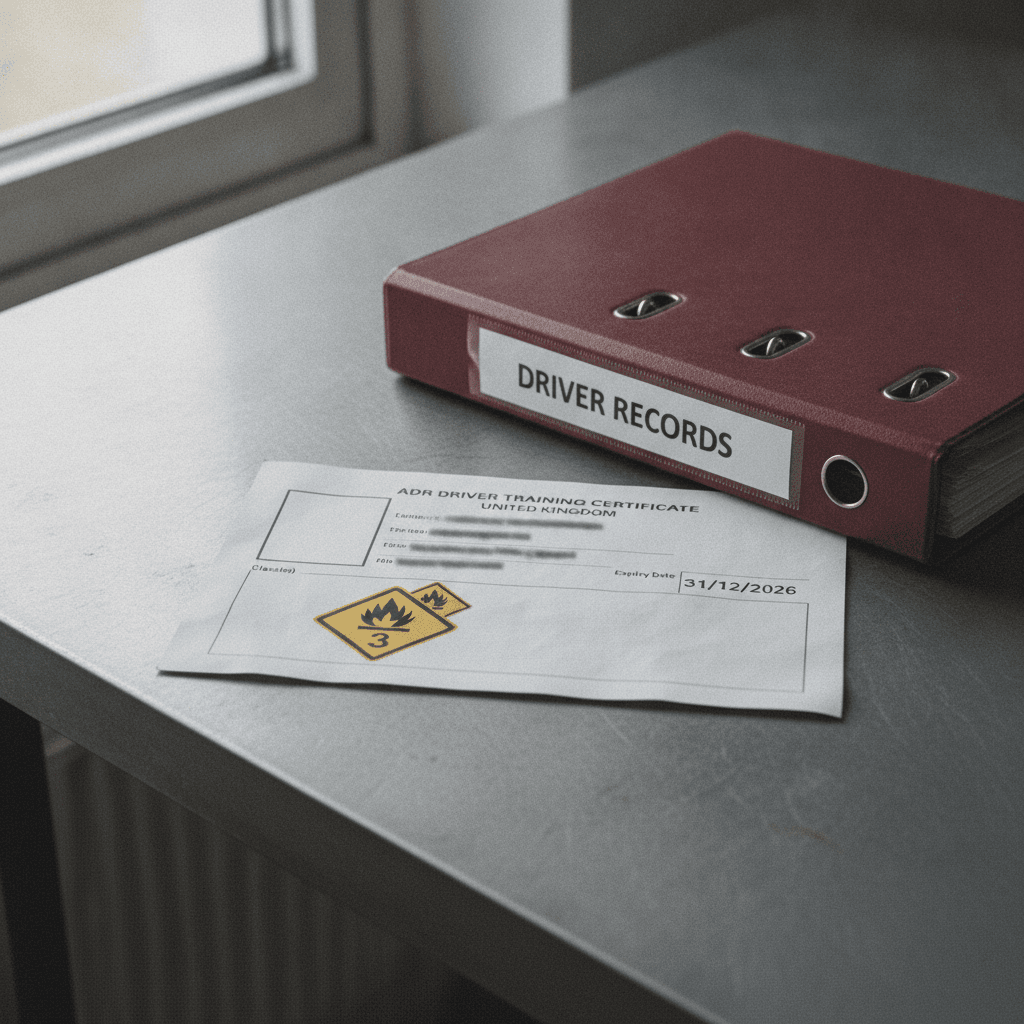
It was a shipment of industrial adhesives — Class 3 flammable liquids, proper dangerous goods requiring full ADR compliance. My driver had done the ADR training, passed the examination, held a certificate for years. What he hadn't done was renew it when it expired. By the time I noticed the expiry date on a routine licence check, he'd completed three ADR deliveries in the previous four months — all of them unlawful.
None of them had been intercepted. But the principle of operating vehicles carrying dangerous goods without a valid ADR certificate is a serious matter under the Carriage of Dangerous Goods and Use of Transportable Pressure Equipment Regulations 2009 (CDG 2009). And the paperwork problem it created — retrospective checks, consignment documentation review, notifying the dangerous goods safety adviser — was substantial.
ADR certificate tracking is one of those tasks that gets buried under the louder demands of driver CPC, tachograph downloads, and licence checks. Most compliance systems include a DQC expiry flag. Fewer flag ADR certificate expiry with the same urgency. Here's what you need to know.
Who needs an ADR certificate and for what
ADR — the European Agreement concerning the International Carriage of Dangerous Goods by Road, adopted into UK law via CDG 2009 — requires drivers carrying certain dangerous goods to hold a valid vocational training certificate. The requirement applies when the load exceeds the quantity thresholds that trigger full ADR compliance; there are limited-quantity and excepted-quantity exemptions that allow very small amounts of dangerous goods without a certificate, but these have specific conditions and packaging requirements.
The ADR certificate is divided into modules. A core module covers the basics — classification, marking, documentation, emergency procedures, driver safety. Additional modules cover specific classes of dangerous goods: Class 1 (explosives), Class 2 (gases), Classes 3-9 (flammable liquids, flammable solids, oxidisers, toxics, infectants, radioactives, corrosives, and miscellaneous dangerous substances). A driver needs the core module plus whatever class modules apply to the goods they're carrying.
A driver carrying only Class 3 flammable liquids needs the core module and the Class 3 module. A driver regularly carrying gases needs the core plus Class 2. A driver carrying a mix of hazardous categories might need several modules. The certificate specifies exactly which classes it covers — an examiner at a roadside check will verify the certificate matches the goods being carried.
How long the certificate lasts and how renewal works
ADR training certificates are valid for five years from the date of issue. This is set in Chapter 8.2 of the ADR agreement, incorporated into UK domestic requirements via CDG 2009.
The important distinction in renewal is between refresher training and re-examination. A driver who completes an approved refresher course before their current certificate expires retains continuity — the new certificate is typically backdated to the expiry date of the old one, so no gap appears in the record. A driver whose certificate has already expired when they undertake training must sit the full examination again, not just a refresher, and the new certificate starts from the date of passing that exam.
This matters because gaps in ADR certificate coverage — even short ones — mean any dangerous goods deliveries carried out during the gap were unlawful under CDG 2009. The consignor is also affected: they have obligations to verify that carriers are compliant, and a lapsed driver certificate can expose them to liability alongside the operator.
The practical risk in a fleet environment is that drivers don't flag expiries proactively. Most drivers are aware of their DQC card expiry because they carry it daily and it's checked at every employer. The ADR certificate is used less frequently, sits in a folder rather than a wallet, and doesn't trigger a card-reader rejection when it's expired. It requires a deliberate check — which means it has to be in your compliance calendar, not left to the driver to manage.
What the certificate looks like and what DVSA checks
UK ADR training certificates are issued in a standardised format by DVSA. They show the driver's name, date of birth, photograph, certificate number, and the modules covered. Critically, they show the expiry date clearly on the face of the certificate.
At a roadside check involving a vehicle carrying dangerous goods, the examiner will check the certificate against the type of goods being carried, the vehicle documentation (transport document listing the UN numbers and quantities), and the vehicle's ADR placards and equipment. If the certificate has expired, or if it doesn't cover the class of goods on board, the vehicle can be prohibited from continuing.
The CDG 2009 regulations create offences for both the driver and the operator. For the operator, carrying dangerous goods on a vehicle where the driver doesn't hold a valid certificate is a criminal offence under the Regulations. Penalty levels depend on the seriousness of the breach and whether any actual danger was created, but the starting point for a fixed penalty is significant — and the impact on your OCRS from a CDG enforcement is not trivial.
Building ADR expiry into your compliance calendar
The straightforward fix is to add ADR certificate expiry dates to whatever system you use to track driver compliance documents. If you track DQC, D4 medicals, and licence checks — add ADR certificate expiry to the same list.
Set a trigger at six months before expiry. That gives you time to book the refresher training, schedule it around driver availability, and complete it before the certificate lapses. Refresher training typically runs over two days and is available from DVSA-registered ADR training providers. The examination is set by DVSA and taken at an approved centre — it's a proper examination, not a tick-box exercise.
If you have drivers who hold ADR certificates for multiple classes, each class section of the certificate has its own expiry — or rather, the whole certificate expires together, but if a driver added class modules at different times via re-examination, there may be certificates with different dates in their file. Check the actual certificates rather than relying on a single date in your system.
For drivers who carry dangerous goods only occasionally — perhaps one hazmat delivery a month — the ADR certificate still needs to be valid for every single one of those occasions. There's no de minimis exemption based on frequency. If the goods being carried exceed the quantity thresholds requiring a certificate, the driver needs a valid one. Full stop.
The DGSA angle
If your operation carries dangerous goods regularly enough to require a Dangerous Goods Safety Adviser (DGSA) — which under CDG 2009 applies to most UK operators carrying more than limited quantities of dangerous goods — your DGSA has an obligation to oversee compliance with ADR requirements, including driver training records. If your DGSA is doing their job, a lapsed ADR certificate shouldn't slip through.
But the DGSA is an oversight function, not a management function. The daily compliance obligation — ensuring the driver in the cab has a valid certificate before the vehicle moves — sits with the transport manager. The DGSA reports on compliance annually. If you're waiting for the annual report to find out about a lapsed certificate, you're six months late.
My DGSA was the one who spotted the lapsed certificate during a routine records review. I was grateful, but it should have been me who spotted it three months earlier. The tracking system I use now flags ADR expiry at six months and again at three months. So far, no repeats.