Driver hours and tachograph: the 3 infringements DVSA fine most at roadside
Everyone knows the 4.5-hour limit. Fewer know the three overlapping rules DVSA stacks on top of it at a Lymm roadside check — and those are the ones that actually land the fine.
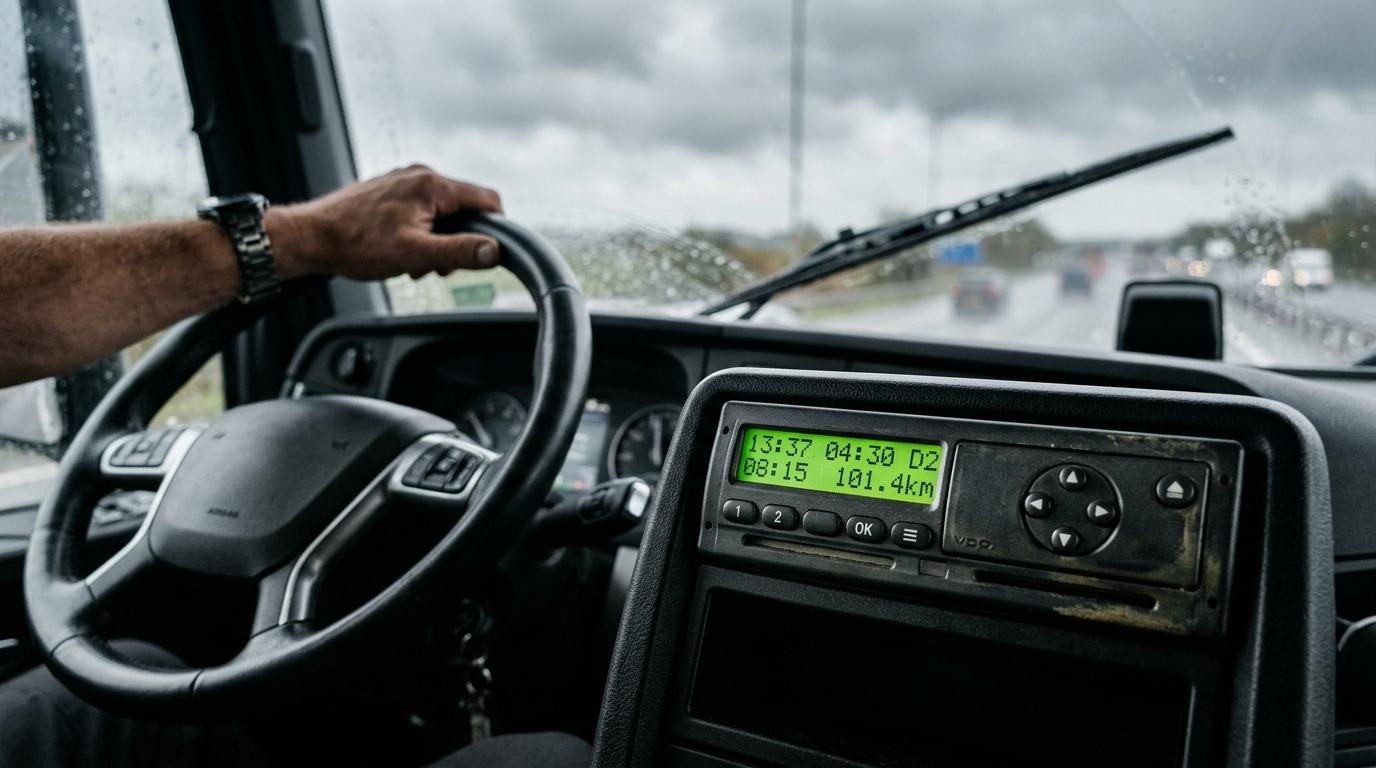
The call came from one of our drivers at the DVSA check site at Lymm on the M6. He had been pulled in, they were reading his driver card, and could I come down. By the time I got there the officer had printed the download and was pointing at a line showing 10 hours and 14 minutes of driving on a day the driver swore he had taken a full break. He had. The tachograph agreed he had taken a break. The problem was that he had taken it after 4 hours and 38 minutes of driving, not 4 hours and 30 minutes. Eight minutes over the 4.5 hour limit before a break. That was enough for a driver hours infringement, and the officer was not interested in how close to compliant the driver had been.
That 8 minutes cost the driver a fixed penalty of £300 and cost me a morning explaining to the operations director why our Operator Compliance Risk Score just went up. This is how driver hours enforcement works in practice. The rules are absolute, the tolerances are zero, and the tachograph does not care about traffic jams.
The rules: EU 561/2006 in plain language
Regulation (EC) No 561/2006 governs driving time, breaks, and rest for commercial drivers in scope. Here are the limits that actually matter for a fleet manager running HGVs in the UK, without the legal padding:
Daily driving: 9 hours maximum. You can extend to 10 hours, but only twice in the same fixed or rolling week. The extension is not a bonus. If a driver uses both 10 hour days in the first half of the week and then has a long run on Friday, they are stuck at 9 hours and there is nothing you can do about it.
Weekly driving: 56 hours maximum in a single week (Monday 00:00 to Sunday 24:00, or the fixed week you have declared).
Fortnightly driving: 90 hours over any two consecutive weeks. This is the one that catches operators who let drivers push 56 hours one week and then try to do 50 the next. 56 plus 50 is 106. The limit is 90.
Breaks: after 4 hours 30 minutes of cumulative driving, the driver must take a break of at least 45 minutes. This can be split into a 15 minute break followed by a 30 minute break (in that order, not reversed). Driving means any time the tachograph records as driving mode, including inching forward in a queue on the M25. If the driver gets out, switches to other work, moves a pallet, fills in paperwork, then gets back in and drives, the 4.5 hour clock was paused but not reset. Only a qualifying break resets it.
Daily rest: 11 consecutive hours in any 24 hour period. Can be reduced to 9 hours, but only three times between weekly rests. Can also be split into 3 hours followed by 9 hours (3+9, not the other way around, and not three blocks of 4 hours). Multi-manning has different rules involving 9 hours within a 30 hour period that I will not get into here because they confuse everyone including me.
Weekly rest: 45 consecutive hours, starting no later than the end of six consecutive 24 hour periods from the end of the last weekly rest. Can be reduced to 24 hours every other week, but the reduction must be compensated in full before the end of the third week following, attached to a rest of at least 9 hours. If you read that sentence three times and still do not understand the compensation rule, you are in good company. The short version: if you take a short weekly rest one week, you owe the missing hours back within three weeks, and you have to take them in one block attached to another rest period.
Where GB domestic rules differ
Some UK operations are exempt from EU 561 and fall under GB domestic hours rules instead. This mainly applies to vehicles not exceeding 3.5 tonnes used for certain purposes, and some specialist operations. The key differences:
- Daily driving limit of 10 hours (no extension mechanism because 10 is already the limit).
- Duty limit of 11 hours per day.
- No formal weekly driving limit, but the daily limits cap it in practice.
- A 30 minute break is required after 5.5 hours of driving, not 4.5 hours as under EU rules.
- 10 consecutive hours of rest in a 24 hour period, not 11.
If you are running a mixed fleet where some vehicles fall under EU rules and others under GB domestic, make sure your drivers know which set of rules applies to them on each shift. I have seen drivers switch between EU-scope and domestic-scope vehicles on consecutive days and have no idea which break rules they should be following. That is a training failure, not a driver failure.
What the tachograph actually records
The digital tachograph fitted to every in-scope HGV records four modes of activity: driving, other work, availability, and rest/break. The driver selects the mode manually except for driving, which is triggered automatically by vehicle movement.
What most drivers do not realise is that the Vehicle Unit, the tachograph hardware bolted to the dashboard, keeps its own independent record of vehicle movement, speed, and distance. If a driver removes their card and drives, the VU still records that the vehicle moved. DVSA can and does download VU data separately from driver card data, and any discrepancy between the two is treated as manipulation. This is classified as a Most Serious Infringement under the enforcement framework, and it carries the heaviest penalties.
The other thing the tachograph records that catches people out: the exact second of every mode change. A driver who switches from driving to other work at 16:31:42 and back to driving at 16:31:58 has not taken a break. They have recorded a 16 second gap that the analysis software will flag and the DVSA officer will ask about. Genuine breaks need to be genuine durations, and the tachograph knows the difference.
The five infringements DVSA catches most
- Insufficient break after 4.5 hours of driving. My Lymm example. The driver drove for 4 hours 38 minutes before stopping. Eight minutes is nothing in practical terms and everything in legal terms. This is the most common infringement because the 4.5 hour window is absolute and traffic does not respect it.
- Reduced daily rest taken too often. A driver takes a 9 hour rest instead of 11. That is allowed, three times between weekly rests. The fourth time is an infringement. Drivers lose count. Fleet managers who are not actively monitoring tacho downloads also lose count.
- Exceeded daily driving limit. Drove for 9 hours 12 minutes on a day when 9 hours was the maximum. Often caused by a delivery running late and the driver deciding to finish rather than park up and call the office.
- Missing or incomplete manual entries. When a driver starts a shift and the tachograph asks for a manual entry covering the time since the card was last removed, many drivers skip it, enter rest for the whole period, or enter a vague approximation. DVSA reads manual entries carefully, and if they do not match reality, for example if the driver claims rest but was actually at home loading a van under GB domestic rules, that becomes a falsification charge.
- Exceeded fortnightly driving limit. Two consecutive weeks add up to more than 90 hours. This one is almost never the driver's fault. It is a planning failure. The planner gave the driver work that could not be completed within the 90 hour envelope, and nobody checked the running total.
How DVSA reads your data
At a roadside check, the officer downloads the driver card on the spot using a handheld unit. They can see the last 28 days of activity. The analysis takes about 10 minutes and the software highlights infringements automatically, colour-coded by severity.
During an O-licence audit, the casework team requests VU downloads for a selection of vehicles and driver card downloads for named drivers. They cross-reference the two. If a vehicle was driven during a period when no driver card was inserted, that is flagged immediately. If a driver's card shows rest during a period when a VU shows the same vehicle moving, that is a potential manipulation finding.
The point of all this is that the data is forensic. The tachograph was designed to be tamper-evident, and DVSA has been reading these downloads for long enough that the tricks drivers think are clever are the first things the software checks for. If your compliance strategy involves any element of hoping DVSA will not look too closely, you do not have a compliance strategy.
What fleet managers should actually be doing with tacho downloads
Under EU 165/2014, operators must download driver cards at least every 28 days and Vehicle Units at least every 90 days. Most fleets I have worked with meet this minimum and do nothing with the data until someone asks for it.
The fleets that do not get caught out are the ones that run infringement reports weekly and act on what they find. That means reading the report, identifying drivers with repeated borderline breaches, having a documented conversation with those drivers, and adjusting the schedule if the breaches are caused by planning rather than driver behaviour.
FleetPad doesn't read or analyse tachograph data, so it doesn't replace your tacho analysis. What FleetPad's dashboard does show is estimated working hours based on the start and finish times drivers record in the app, alongside their vehicle check records. That's useful for spotting long days early, but it's an estimate, not a legal hours record. Either way, the tool is secondary. The habit is primary. If nobody in your fleet is reading infringement reports weekly, no software will save you from a call-up letter.
Frequently asked questions
Does the 4.5 hour driving limit reset if I stop for fuel?
Only if the stop qualifies as a break, which means the driver selects break mode on the tachograph and remains stopped for at least 15 minutes (as the first part of a split break) or 45 minutes (for a full break). Pulling into a fuel station, keeping the engine running, and filling the tank while the tachograph stays on other work does not reset anything. I have had this exact argument with a driver who insisted that 8 minutes at a pump counted as a break. The tachograph disagreed.
What happens if a driver's card is lost or stolen?
The driver must apply for a replacement within 7 calendar days. They can drive without a card for a maximum of 15 calendar days, but they must make printouts from the VU at the start and end of each day, and those printouts must be annotated by hand with the driver's name, card number, and manual mode entries. In practice, most drivers without a card should not be driving at all because the printout process is laborious and error-prone, and the risk of an infringement during the cardless period is high.
Can a driver take their weekly rest in the cab?
Not anymore, not the full 45 hour weekly rest. Since 2020, regular weekly rest periods of 45 hours or more cannot legally be taken in the vehicle. The driver must have access to suitable accommodation. Reduced weekly rests of 24 hours can still be taken in the cab if the vehicle is parked and the cab has adequate sleeping facilities. Most drivers I know interpret adequate loosely. Most DVSA officers do not.
How far back can DVSA check driver hours?
The driver card stores 28 days of data. The Vehicle Unit stores a year or more depending on the model. During an operator investigation, DVSA can request VU downloads covering the full stored period. So while a roadside check only looks at the last 28 days, an audit can go back much further. This is why the 90 day VU download cycle matters. If your VU data is not being downloaded and archived, you lose the ability to defend yourself because the data overwrites eventually.
Is there any tolerance on the driving limits?
Legally, no. Operationally, the DVSA officer at roadside has a small amount of discretion. In the Senior Traffic Commissioner's statutory guidance on penalties, a driving time exceeded by less than 15 minutes may attract a lower severity classification than one exceeded by an hour. But lower severity is not no infringement. The guidance does not say there is a tolerance. It says the gravity of the penalty may vary. Any fleet that plans routes on the assumption that 15 minutes of slack is built in is building on sand.
Driver hours enforcement is one of those areas where the gap between basically compliant and actually compliant gets measured in minutes, not hours. The fleets that stay clean are the ones where someone reads the infringement reports every week and makes changes before the next report. The daily walkaround check covers the vehicle side. This covers the driver side. Neither is optional, and both feed into the same OCRS score that decides whether DVSA takes an interest in your fleet.