Direct Vision Standard for HGVs in London: star ratings, safety permits and what TfL enforces from the cab
I got pulled at the Blackwall Tunnel approach for no HGV safety permit. Hadn't realised my new tractor unit needed a different permit from the old one. Here's how DVS actually works.
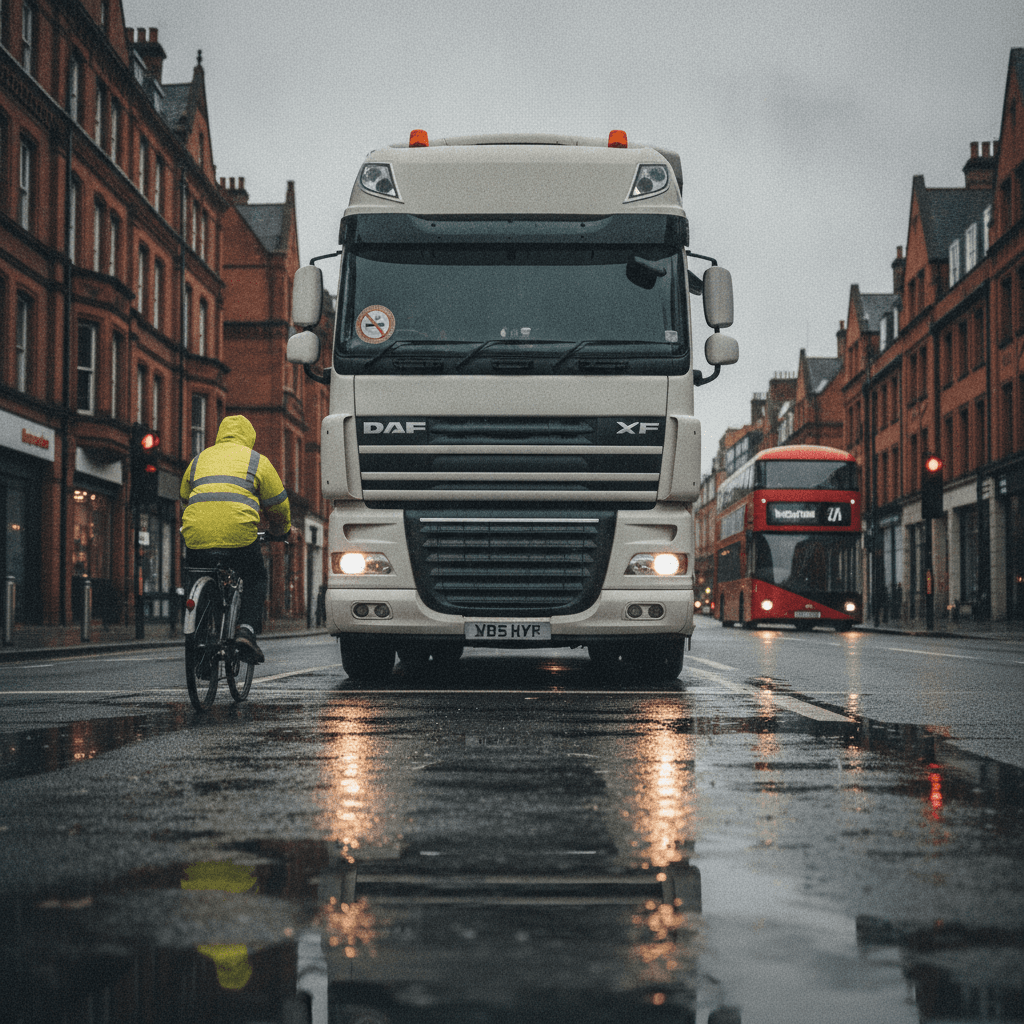
The HGV safety permit for London gets treated as one thing. It isn't. There's a basic permit and an enhanced permit, they have different requirements, and confusing them is what got one of my drivers flagged at the Blackwall Tunnel approach in October 2024. We had a permit. We just didn't have the right one for the new vehicle.
Direct Vision Standard — DVS — is TfL's system for measuring how much a driver can see directly from the cab without using mirrors, cameras or screens. A lower score means more blind spots. More blind spots means higher risk to pedestrians and cyclists at low speed in urban environments. The scheme is designed to get the worst-performing cab designs upgraded or off London's roads.
It applies to HGVs over 12 tonnes operating in Greater London. If your fleet does any work inside the Greater London boundary — deliveries, collections, construction logistics, whatever — and your vehicles exceed 12 tonnes, you need to know how DVS applies to your specific cab types.
The star rating system
DVS rates HGV cab designs on a scale from 0 to 5 stars. The rating reflects how much of the area directly around the cab the driver can see without any assistance from mirrors or technology. A 5-star cab has excellent direct sightlines — the driver can see a large proportion of the danger zones around the vehicle. A 0-star cab has very poor direct vision, relying almost entirely on mirrors.
The rating is assigned to the cab type, not to individual vehicles. Your Scania R-series has a different DVS rating from a DAF XF, which has a different rating from a Mercedes Actros. TfL maintains a database of rated cab types. If your vehicle is on that database, you look up the rating by make, model and approximate year of manufacture. If your cab type hasn't been formally rated, you can apply for a rating — TfL has a process for that.
Most current HGVs manufactured since around 2020 have been rated. The problem arises with older vehicles, niche configurations, and specialist bodies where the cab hasn't been through the formal process.
Basic permit vs enhanced permit
Before October 2024, the rules were simpler: most HGVs over 12 tonnes in London needed a basic HGV safety permit, which required meeting a minimum safety standard regardless of star rating. You could hold a basic permit with a 0-star cab if you met the baseline requirements.
From October 2024, the enhanced permit requirement came in for all HGVs over 12 tonnes operating in London. The enhanced permit requires a higher standard of safety equipment — typically a camera monitoring system covering the vehicle's blind spot areas, audible and visual warning systems, and in some configurations, sensor technology to detect vulnerable road users in the danger zones adjacent to the cab.
The specific equipment required under the enhanced permit depends on your vehicle's star rating. Higher-rated cabs may require less additional technology because their direct vision already covers some of the blind spot area. Lower-rated cabs require more. TfL's guidance sets out what each rating band requires.
The situation I described with my driver: the old vehicle had an enhanced permit based on its equipment fit-out. The new tractor unit had different baseline specifications, and the equipment from the old permit declaration didn't automatically transfer to the new vehicle. Each vehicle needs its own permit, based on its own star rating and equipment fit.
Applying for the permit
The permit is applied for through TfL's online system. You'll need the vehicle's VRM, the cab type and DVS star rating, and evidence that the required safety equipment is fitted. The permit itself is free — there's no charge from TfL for issuing it. The cost sits in the safety equipment, which for a camera monitoring system fitted to specification can run into the thousands per vehicle.
Permits are issued to vehicles, not to operators. If a vehicle changes operator, the permit doesn't transfer automatically. The new operator needs to apply for a new permit. And permits can be checked by TfL enforcement officers at any point — the database is live and a vehicle without a valid permit is immediately identifiable.
Apply before the vehicle does any work in London. Don't wait until you've got a London contract confirmed and then scramble. If the equipment needs fitting, lead times for camera system installation at a qualified installer can run to several weeks, especially if you've got multiple vehicles to retrofit.
Enforcement
TfL enforces the permit requirement using automatic number plate recognition cameras and targeted enforcement by traffic officers. Vehicles caught operating in London without a valid enhanced permit face a Penalty Charge Notice — typically £550, with a discount for prompt payment. The PCN goes to the registered keeper.
For fleet operators, that's not the end of it. A pattern of PCNs attracts TfL's attention beyond just the charge. Persistent non-compliance can result in referral to the Traffic Commissioner — because operating without a required permit is a breach of road traffic legislation, and repeated breaches of road traffic legislation are one of the nine grounds for TC action under the GVLOA.
I'm not saying a single PCN gets you a public inquiry. But if you've got ten vehicles running into London without enhanced permits and you're collecting PCNs across the fleet, you're building a record that looks exactly like the kind of systemic non-compliance the TC takes seriously.
Vehicles that are exempt
Not every vehicle over 12 tonnes that enters London needs a permit. Agricultural vehicles, military vehicles, mobile cranes, and a number of specialist vehicle types are exempt. Recovery vehicles on recovery operations are typically exempt from the permit requirement while carrying out a recovery.
There are also exemptions for vehicles entering London infrequently — check the current TfL guidance for the precise threshold, because this has changed over different phases of the scheme's implementation.
But the default position for a goods vehicle operator with HGVs running into London: your vehicles need an enhanced permit. Start from that position and work backwards to identify any specific exemptions that apply to you. Don't start from the assumption you're exempt unless you've confirmed it in the TfL guidance.
What to check on your fleet
Pull your list of vehicles over 12 tonnes. For each one that operates in London, confirm three things: the DVS star rating, whether the required safety equipment for that rating band is fitted and working, and whether you have a current enhanced HGV safety permit for that specific vehicle.
If any of those three answers is uncertain, that vehicle shouldn't be in London until you've resolved it. The permit check takes minutes. The equipment retrofit takes weeks. Plan accordingly.
One thing I do now that I didn't before the October 2024 change: when we add a vehicle to the fleet, the DVS permit is on the vehicle commissioning checklist. Not retrofitted after the fact. Not remembered at the last minute. Part of the process before the first wheel turns on a London job.