HGV MOT preparation: what actually causes failures and what the tester looks at first
Three of our five trucks failed their annual test on the same day. Two of them on brakes. The third on a cracked mudguard I had walked past every morning for a month. That was the day I stopped treating the annual test as a formality.
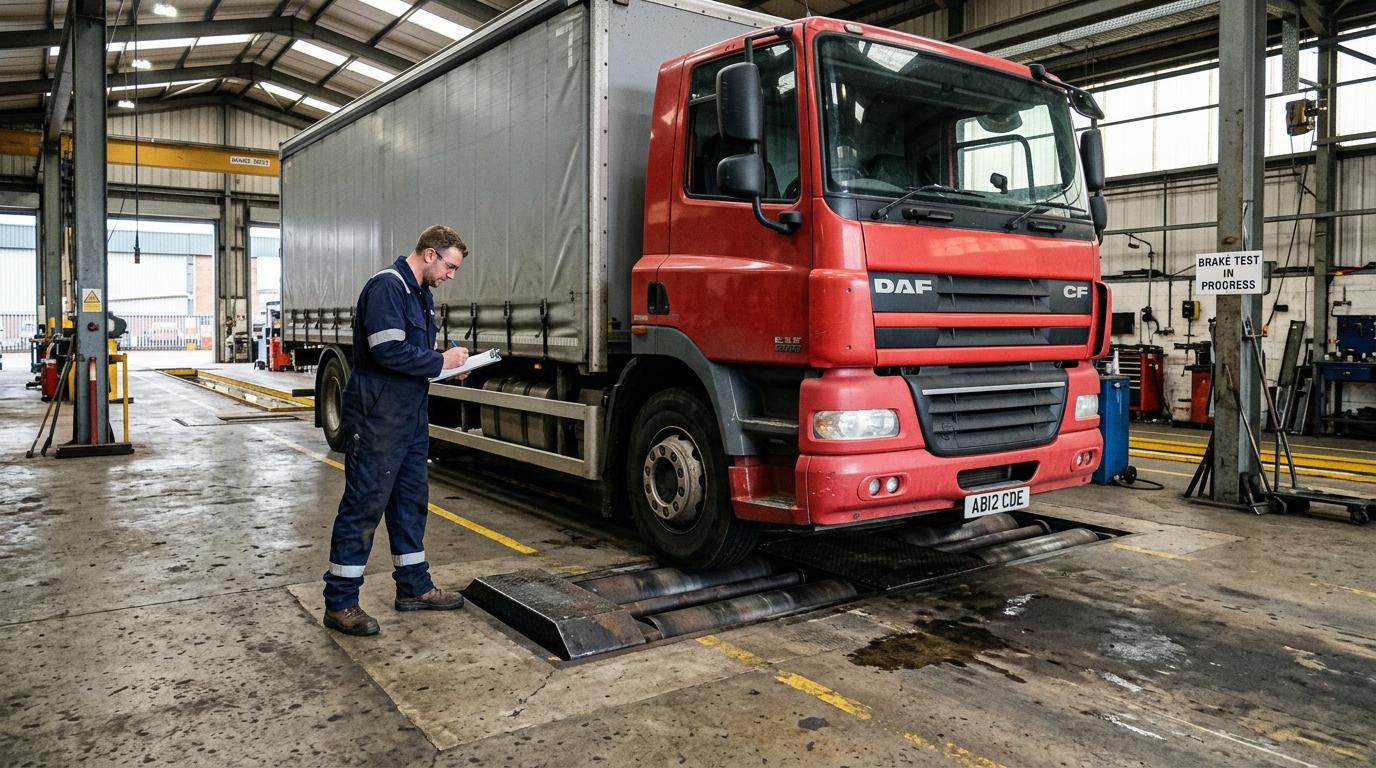
Three of our five trucks failed their annual test on the same day. Two of them on brakes. The third on a cracked mudguard I had walked past every morning for a month. That was the day I stopped treating the annual test as a formality and started treating it as the single most visible compliance metric on our O-licence file.
DVSA tracks your first-time pass rate. They do not publish a threshold above which everything is fine, but they notice when it drops, and the Traffic Commissioner's casework team reads it as one of the first data points when your file gets opened. A fleet that passes 90% of its vehicles first time is sending a different signal than one that passes 50%. The test itself is almost secondary to what the pass rate says about how you run the fleet.
What the annual test actually is
The HGV annual test is not technically an MOT, though everyone in the industry calls it one. It is administered by DVSA at Authorised Testing Facilities, and it covers a broader range of items than a car MOT. The test must be completed annually for every vehicle and trailer over 3.5 tonnes that operates on a public road.
The test fee is set by DVSA and published each year. When I last checked, a two-axle rigid was £97, a three-axle rigid was £120, and a trailer was around £65. You can book through DVSA's online system, and most ATFs will let you present the vehicle any time in the month before the current certificate expires without changing the renewal date. Use that window. Presenting on the last day with no margin for a retest is a decision made by optimists who have never had a vehicle fail on brakes.
What causes failures: the real numbers
DVSA publishes annual test statistics, and the pattern has been roughly stable for years. The top reasons for failure on HGVs, in order:
- Braking systems. This is the single biggest failure category, year after year, and it is not close. Brake roller test results account for more failures than the next three categories combined. The test measures braking efficiency as a percentage of the vehicle's gross weight, and the threshold for the service brake on a goods vehicle is 50%. That sounds generous until you have a vehicle with a seized caliper on one axle pulling the efficiency down to 42%. Brake imbalance between left and right sides is also tested, and that catches vehicles where one pad has worn significantly faster than the other.
- Suspension. Worn bushes, cracked springs, leaking air bags. The tester will check visually and by feel, and on an air suspension vehicle they will watch how the system responds when the bags are deflated and reinflated. A broken leaf on a multi-leaf spring is an immediate failure.
- Lighting and electrical. Bulbs, lenses, aim, and operation. This includes all marker lights, side repeaters, number plate lamps, fog lights, and reflectors. A cracked lens that allows water ingress is a failure even if the bulb still works. I have lost count of the number of times a rear marker light that nobody noticed was out caused an avoidable retest.
- Tyres and wheels. Tread depth (1mm minimum across the central three quarters for HGVs), cuts, bulges, exposed cords, and wheel fixing security. The inner sidewall on a twin setup is the one that gets missed, both on the daily walkaround and in pre-test preparation. If you only check one thing the day before the test, check the inner tyres.
- Chassis and body condition. Corrosion, cracks, loose body panels, security of the fifth wheel, condition of the turntable, mudguards, and spray suppression equipment. The cracked mudguard that caught me out would have been spotted by any fitter doing a proper pre-test inspection. It was not spotted because nobody looked.
Emissions is also a failure category, but modern Euro 6 trucks rarely fail on emissions unless the DPF has been tampered with or the AdBlue system is faulty. Older vehicles on Euro 3 or 4 are more likely to see emissions failures.
What the tester looks at first
The annual test follows a structured sequence. The tester works through a standard checklist, but there is an order to it, and the first things checked set the tone for everything that follows.
The test usually starts underneath, with the vehicle on a pit or raised on a ramp. The tester will look at the chassis rails, cross members, brake lines, suspension mounts, and the exhaust system. This underside inspection takes the longest and finds the most defects, because it covers everything a driver never sees.
After the underside, the brake roller test. Each axle goes over the rollers in sequence, and the readout gives braking efficiency and imbalance in real time. This is where most failures happen, and the numbers are binary. Either the vehicle hits 50% service brake efficiency with acceptable imbalance, or it does not. There is no subjective judgement involved.
Then the external walk-around: lights, reflectors, tyres, body condition, mirrors, windscreen, wipers. This is the part that most closely resembles a driver's daily walkaround, and it is the part where a fleet that does genuine daily checks will have almost nothing to worry about.
Finally, the cab interior: seatbelt condition and operation, instrument function, steering wheel play measured in degrees at the rim with published limits. The interior check is the shortest part of the test and the least likely to produce a failure.
How to actually prepare
There are two approaches to annual test preparation, and the difference between them is the difference between a fleet that passes first time and a fleet that pays for retests.
The first approach is what most fleets do: the vehicle comes back to the yard three or four days before the test date, a fitter does a once-over, replaces any obvious defects, and the vehicle goes to the ATF. This works for vehicles that have been well maintained all year. It does not work for vehicles that have been running with deferred defects, skipped PMIs, or bodge repairs that held up on the road but will not hold up under a pit inspection.
The second approach, and the one I eventually moved to, is to treat the test as the output of the maintenance system rather than an event to be prepared for. If your PMI cycle is right (every six weeks on a high-mileage HGV is the minimum I would run, and the DVSA Guide to Maintaining Roadworthiness suggests the same), if your daily walkaround checks are real, and if defects identified during the year are actually being fixed and closed out, the annual test prep reduces to a brake test on the rollers and a visual once-over. The vehicle should already be in testable condition because it was maintained to be in testable condition all year.
This is genuinely the point of the entire maintenance system. The vehicle records in FleetPad show the complete defect and repair history for each truck and trailer, which means the week before the test is about verifying, not discovering. If you are discovering defects the week before the test, your maintenance system has been failing quietly for months.
Trailers: the ones people forget about
Every trailer over 1,020kg unladen weight needs an annual test, and trailer failures are more common than truck failures because trailers get less attention. They sit in the yard. They get coupled and uncoupled by drivers who check the susies and the lights and nothing else. The landing legs rust. The brake chambers seize because the trailer has been standing for weeks. The mudguards crack because another driver reversed into them and did not report it.
The most common trailer failure I have seen is brake imbalance caused by seized chambers on one side. A trailer that has been standing unused for three or four weeks, particularly over winter, will almost certainly have at least one chamber that is not releasing fully. Get the trailer moving and apply the brakes repeatedly before the test. If a chamber is seized, you will know because one wheel will be dragging. Better to find that in the yard than on the rollers.
The other common trailer failure is lighting. Trailer wiring takes a beating. Connections corrode, bulbs blow, lenses crack. Check every light on the trailer the day before the test, with the trailer actually connected to a tractor and the electrics live. Do not assume the lights worked last time. They probably did. That was six weeks ago.
Frequently asked questions
How far in advance can you book an annual test?
You can present a vehicle for test up to one month before the current certificate expires. The new certificate runs from the old expiry date, not the test date, so you do not lose any time by testing early. I book everything two to three weeks before expiry. That gives enough margin for a retest if something unexpected fails, without the vehicle sitting idle waiting for a test slot.
What happens if a vehicle fails?
You get a Presentation Result Summary listing every failure item. You then have 14 calendar days to repair the defects and present the vehicle for a partial retest at the same ATF. The retest only covers the failed items and anything affected by the repair. If you miss the 14 day window, you pay for a full retest. The retest fee is lower than the initial test fee, but the 14 day clock starts from the date of the original test, not from when you collected the vehicle.
Does first-time pass rate really affect my O-licence?
DVSA tracks it and the Traffic Commissioner reads it. There is no published minimum percentage, but our post on O-licence audits explains what the TC looks at during a review. In practice, a first-time pass rate consistently below 80% will attract attention. A rate below 60% paired with any other compliance concern will almost certainly trigger a call-up letter. The national average hovers around 87% for goods vehicles, so anything significantly below that stands out.
Should I do a pre-test inspection myself or send the vehicle to a garage?
Both, if you can afford it. Your own pre-test should catch the obvious items: lights, tyres, body damage, visible leaks. But only a garage with a brake roller can tell you whether the vehicle will pass the braking efficiency test. Some ATFs offer a pre-test inspection service for a reduced fee. I used this on every vehicle for three years and it paid for itself many times over in avoided retests.
Are trailers tested at the same time as the tractor unit?
No. Trailers and motor vehicles are tested separately and have separate test certificates with potentially different expiry dates. A trailer can be presented for test attached to any suitable tractor unit. It does not have to be the one it usually runs with. This catches some operators out when they sell or replace a trailer and forget that the replacement has a different test date entirely.
The annual test is the one day a year where your maintenance system either proves itself or does not. Everything you did right shows up as a first-time pass. Everything you deferred, bodged, or failed to spot shows up as a failure item on the Presentation Result Summary. The fleets with high pass rates are not luckier than the rest. They just do not wait until the test to find out what is wrong with their vehicles.