O-licence conditions and undertakings: the maintenance commitment explained line by line
Most operators sign the O-licence undertakings without reading them closely. I've read them closely. Here's what the maintenance commitment actually requires — and the three parts that catch operators at audit.
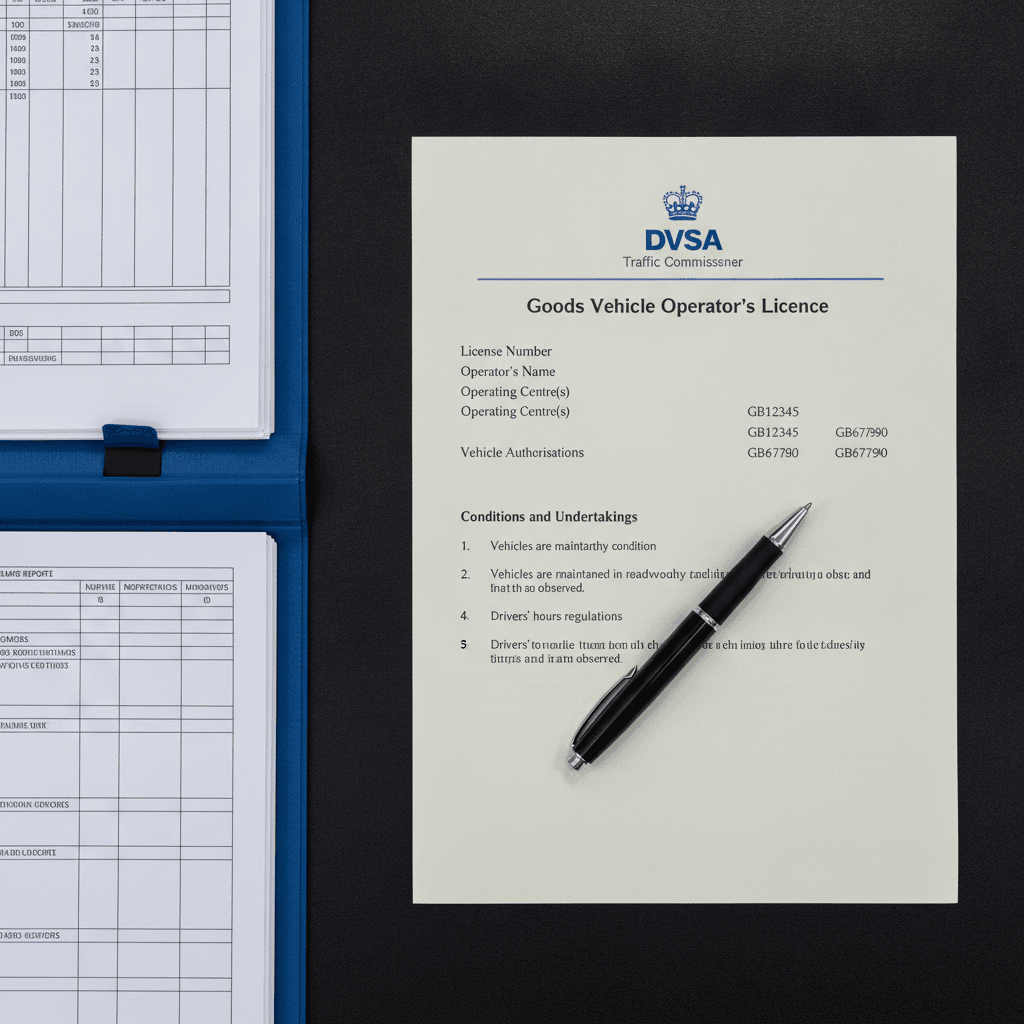
The standard national O-licence undertaking is a short document. It's not long, not particularly dense, and most operators sign it and file it away and don't look at it again until something goes wrong. I've been through two Traffic Commissioner hearings in 16 years, and both times the question that cut sharpest was the same: 'Mr [name], can you explain why the undertakings you gave on your licence weren't being met?'
If you haven't read your undertakings recently, read them now. They're on your licence document. They describe, in plain terms, what you committed to when you were granted the licence. The Traffic Commissioner's job, at an inquiry, is partly to measure what's happened against what you promised.
What you're actually agreeing to
When you're granted a standard goods vehicle operator's licence, the undertakings you sign commit you to several things. The maintenance undertaking is the one that generates the most enforcement activity.
In essence, you're promising that you have satisfactory facilities and arrangements for maintaining your vehicles in a fit and serviceable condition. Not that you have them sometimes. Not that you aim to have them. That you have them, in place, continuously, for the duration of the licence.
That sounds straightforward until you unpack what 'satisfactory facilities and arrangements' actually means. The Traffic Commissioner's guidance is that this covers: a documented maintenance system with defined PMI intervals appropriate to your operations, records of all inspections and repairs, a mechanism for drivers to report defects and for those defects to be addressed and signed off, and either in-house workshop capacity or a maintained contract with an outside workshop.
The PMI interval commitment
Your O-licence maintenance undertaking includes a commitment to specific PMI (Periodic Maintenance Inspection) intervals. These are the intervals you stated on your licence application — typically six weeks for standard HGV operations, though operators with lighter work patterns sometimes operate on eight-week cycles with Traffic Commissioner approval.
The six-week interval isn't a guideline. It's the commitment you made. A vehicle that runs 7 or 8 weeks between inspections isn't just slightly behind schedule — it's operating outside the terms of your licence. Three vehicles running overdue PMIs at a DVSA operator visit is the kind of thing that triggers a 'maintenance failure' outcome, which sits on your OCRS and which the TC will want to discuss.
The interval commitment has one important nuance: it applies to vehicles in service. A vehicle that's been properly taken off-road (VOR-notified, SORN'd where applicable) isn't required to run PMIs during the off-road period. But the moment it returns to service, the PMI clock restarts. Returning a vehicle to service after a 12-week off-road period without running a fresh PMI first is a common mistake.
Financial standing: what you must be able to demonstrate
The O-licence also carries a financial standing undertaking. For a standard national licence, the figures as set by the Traffic Commissioner are £8,000 for the first heavy goods vehicle on the licence, and £4,500 for each additional vehicle. These are the current rates (confirmed by Statutory Document 2: Finance, Version 21.0, March 2025).
This isn't a fee you pay once. It's capital that must be available at all times. The requirement is ongoing — not just at the point of application. The TC can ask you to demonstrate financial standing at any time, and at a public inquiry it will almost certainly come up. 'Available' means either liquid funds (bank balance, instant-access savings), or a confirmed overdraft facility of at least that amount.
For a 10-vehicle fleet, that's £8,000 plus 9 × £4,500 = £48,500 that you need to be able to put your finger on. Not all operators realise that a company with a marginal cash position may technically be in breach of their licence undertaking. The TC has referred operators to formal inquiry specifically for failure to maintain financial standing — not for an accident, not for a prohibition, for a balance sheet that couldn't cover the requirement.
Bank statements are the normal form of evidence. Three consecutive months of statements is the standard request. The TC looks for an average balance over the period, not a single high-water mark. Engineering a £50,000 one-day balance the day before you submit statements, with a normal running balance of £10,000, won't pass scrutiny.
The 28-day notification rule
One of the most consistently breached undertakings is the requirement to notify the Traffic Commissioner of relevant changes within 28 days. The list of notifiable changes includes:
- Changes to the operating centre (new address, significant increase in vehicles parked)
- Changes to the named transport manager
- Changes to the company's legal structure (new directors, change in ownership)
- Any conviction of the operator, directors, or transport manager for a relevant offence
- Any material change to the company's financial standing
The 28-day window is not generous, and it starts from the date of the event — not from when you notice it. A transport manager who resigns on a Friday and whose departure isn't notified to the TC until someone gets round to it six weeks later is a 28-day breach. The TC doesn't need the problem resolved within 28 days — they need to know about it.
I've seen operators held at inquiry on the 28-day rule alone. Not for the underlying event — the departed TM, the new director, whatever it was — but for the delay in notification. The TC views late notification as evidence that the operator doesn't take the licence management function seriously. It's a credibility problem as much as a procedural one.
The driver undertaking: correct licences, training, and hours
The O-licence also commits you to ensuring that any drivers you use have the correct licence and any necessary training — meaning CPC for Category C and D vehicles where required. This is the undertaking that catches operators who use agency drivers without verifying their entitlements, or who put a driver on a vehicle category their licence doesn't cover.
It also commits you to ensuring drivers comply with drivers' hours rules. Not merely that you've issued the rules. That you have systems in place to ensure compliance: download procedures, infringement analysis, follow-up action. The undertaking is yours, not the driver's. A driver who persistently breaks hours rules while the operator does nothing about it is an operator who's breaching their undertaking.
What DVSA looks for at an operator inspection
The DVSA Guide to Maintaining Roadworthiness describes what an operator inspection typically covers. In practice, the examiner will look at your maintenance records, your driver defect records, your tachograph download and analysis records, and your operating documentation. They're not just looking for individual failures — they're looking for whether your system, as a whole, is capable of meeting your undertakings.
An operator with one missed PMI and good records everywhere else tends to get a written improvement notice. An operator with three missed PMIs, incomplete defect records, and a spreadsheet that hasn't been updated since last year tends to get a Traffic Commissioner referral. Same number of actual maintenance failures, very different system of maintenance. The undertaking is about the system, not just the individual instances.
Restricted licences: different financial standing, same maintenance standard
If you hold a restricted goods vehicle operator's licence — which covers operators who only carry their own goods and don't operate for hire or reward — the financial standing requirement is lower: £3,100 for the first vehicle, £1,700 for each additional. But the maintenance undertaking is identical to the standard licence. Restricted licence holders sometimes assume that holding a 'simpler' licence means lighter maintenance obligations. It doesn't. The same PMI intervals, the same defect reporting requirements, the same driver entitlement checks. The restriction is on the type of carriage, not on the compliance standard.
The undertaking is a living document
The biggest mistake operators make with their O-licence undertakings is treating them as something they agreed to once and can now ignore. They're not a historical record. They're a description of how you're operating today.
When the Traffic Commissioner at a public inquiry asks 'are you currently meeting your licence undertakings?', they're asking about right now. The maintenance system running today. The financial standing available today. The notification processes active today. If the answer is 'mostly' or 'we've been meaning to address that', the conversation tends to go in one direction.
Read the undertakings again. Check your fleet against each one. Where there's a gap between what you committed to and what you're doing, that gap is your risk. Address it before someone else points it out.