Traffic Commissioner public inquiry: how to prepare your own evidence bundle
I've been to two TC public inquiries. One I hired a solicitor for. One I represented myself. The self-represented one went better. Here's the bundle I built.
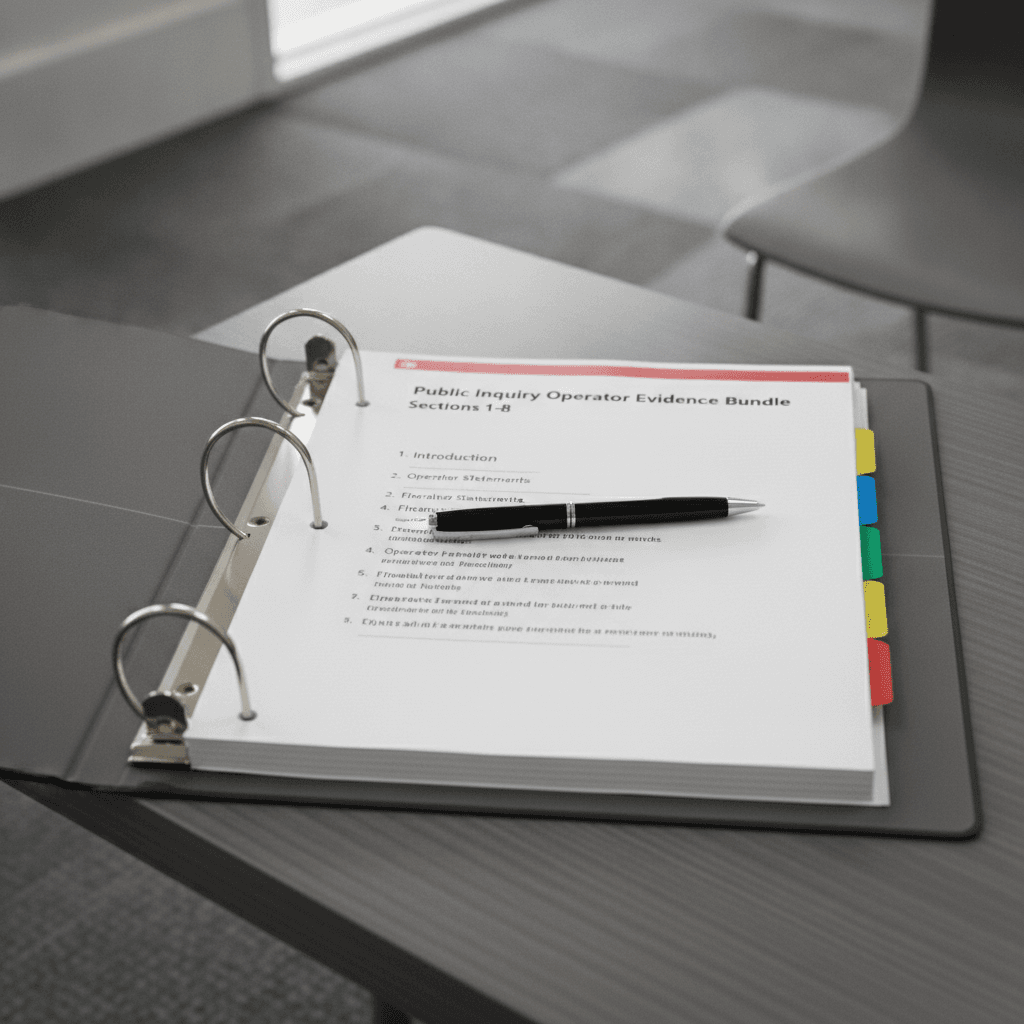
You don't have to bring a solicitor. But you do have to bring evidence.
Traffic Commissioner public inquiries are not criminal trials. The Traffic Commissioner is not a judge in the usual sense. The rules of evidence are less strict, the room is smaller than you expect, and in most cases the operator sits at a table opposite a DVSA traffic examiner while the TC asks questions from a raised bench.
That doesn't mean it's informal. The TC has the power to revoke your licence, curtail it, suspend it, or impose conditions. Under Section 28 of the Goods Vehicles (Licensing of Operators) Act 1995, they can also disqualify you from holding an O-licence in the future. These are serious outcomes. The inquiry matters.
But I've now been through two of them — 2014 and 2023 — and the second one, which I prepared for myself without a solicitor, went significantly better than the first. What made the difference was the evidence bundle, not the legal representation.
What an evidence bundle is
The evidence bundle is the set of documents you bring to the inquiry to demonstrate that your operation is — or has become — compliant. DVSA will have already prepared their own bundle, which they usually share with you or your representative in advance. Yours is your response to it.
Think of it as your case. Not a statement of intent. Not a list of promises. A documentary record that shows the TC what your operation looks like right now, and what you've done since the issues that triggered the inquiry.
The TC reads it before you walk in. They'll have questions. Your job is to make sure every question they might ask has an answer in that bundle, with a document behind it.
What the bundle should contain
Structure it in sections with a numbered index at the front. Don't make the TC flip through 80 pages trying to find your maintenance records. Tab everything.
Section 1: Your response statement. Two to three pages. What the inquiry is about (briefly — they know). What the problems were. What you've done to fix them. Keep this factual and specific. 'We have improved our processes' is not specific. 'We engaged a contracted maintenance provider in August, introduced a digital walkaround check system in September, and completed tachograph analysis training for the transport manager in October' is specific.
Section 2: Transport manager evidence. Current CPC certificate. Any relevant training completed since the inquiry was called. If your TM is new, their CV and the date they were named on the VOL system. If your TM is the one under scrutiny, a personal statement addressing the specific concerns is appropriate.
Section 3: Maintenance records. Six months of PMI records for each vehicle, tabbed by registration. Include any repair orders that followed inspections, showing defects found and rectified. If you have a maintenance contract, include the contract and the workshop details. Include roller brake test records — four per year, evenly spaced, laden where required.
Section 4: Tachograph records and analysis. Download records showing vehicle unit downloads (every 90 days) and driver card downloads (every 28 days). Analysis reports. Infringement debrief records — specifically the signed debriefs where infringements were found, showing the driver was told and acknowledged it. If you use tachograph analysis software, print a summary report.
Section 5: Financial standing. Three months of bank statements. If the inquiry has raised financial standing as a concern, a letter from your accountant or bank confirming working capital levels. The TC needs to see that you can fund the operation compliantly.
Section 6: Driver records. Licence check records for all drivers, showing recent DVLA checks. Driver CPC DQC card copies. Any driver briefing records relevant to the issues raised. If the inquiry arose from a roadside stop, any briefing you've done with that driver since.
Section 7: Operating centre evidence. If there have been operating centre concerns — parking arrangements, vehicle numbers exceeding the authorised disc, neighbour complaints — show what you've done. Photographs help. A statement from the site manager confirming compliance with O-licence disc numbers is stronger than nothing.
Section 8: Action log. A table: issue identified, action taken, date completed, evidence reference. This is the single document that shows the TC you've understood the problems and worked through them systematically. Keep it short. Five to fifteen rows, depending on the issues.
The cover letter
Address it to the TC's office, headed with your O-licence number and the inquiry reference. State what the inquiry is about, that you've prepared the enclosed bundle in response, and that you will attend on the date specified. If you're bringing witnesses — a workshop manager, an accountant, a driver — name them in the letter.
Send the bundle to the TC's office at least five working days before the hearing. Keep a copy. Bring three physical copies to the inquiry: one for you, one you can hand to the TC if requested, one spare. The TC will usually have your bundle from the advance submission, but not always.
On the day
You'll usually wait in a public area. The TC's clerk will call you in when the room is ready. DVSA's traffic examiner is typically already seated. The TC may have a deputy or a legal assessor present.
You'll be asked to confirm who you are and your role. The DVSA examiner will present their evidence. You'll be given the opportunity to respond. The TC will ask questions.
Answer directly. If you don't know an answer, say so and offer to provide it in writing afterwards. Don't speculate. Don't be defensive about problems that clearly happened. Own them and explain what you've changed. The TC sees hundreds of these hearings. They know the difference between an operator who has genuinely fixed problems and one who's hoping to talk their way through.
The most effective thing you can do is say: 'At page 14 of my bundle, you'll see the maintenance contract we put in place in September. At page 22, there are six weeks of PMIs completed under that contract. At page 31, the infringement debriefs from the same period.' Let the documents carry the weight. Your job is to point to them.
Common mistakes
Bringing a bundle with no index. The TC should never have to hunt for a document. If they're flipping through pages looking for something, you've lost momentum.
Promising future actions. 'We intend to introduce a new maintenance system next month' is meaningless without evidence. If it's not done, don't mention it. If it is done, show the records.
Arguing with the DVSA evidence. If the traffic examiner has found a defect record missing, it's almost certainly missing. Challenge specific errors — wrong dates, wrong registration numbers, misattributed infringements — but don't try to argue that the overall picture is wrong if the documents support it. The TC has read both sides.
Leaving gaps in the chronology. If the inquiry covers problems from April to June, make sure your improvement evidence runs from July onwards and is continuous. A bundle that ends in August and the inquiry is in November leaves two months unaccounted for. Fill it.
Whether to use a solicitor
There are situations where specialist transport solicitors add real value. A Section 28 disqualification case. An inquiry that runs across multiple days. One where the issues are technically complex — something involving criminal prosecutions of directors, or very large penalties. In those situations, legal representation is money well spent.
But for a single-issue inquiry — say, an OCRS concern following a period of roadside stops, or a maintenance shortfall identified at a documentary audit — a well-prepared operator with a thorough evidence bundle can absolutely represent themselves. The Traffic Commissioner is required by statute to conduct the inquiry fairly. They will tell you the case against you. They will give you time to respond. They will ask if you have anything to add.
The bundle is the preparation. The day is the delivery. Get the bundle right and the day looks after itself.