Your 4.25t electric vans come out of tacho rules on 1 June - three things to sort first
From Monday my GB-only electric 4.25-tonners drop out of tacho and the assimilated hours rules. Good news - until you remember the Northern Ireland bit.
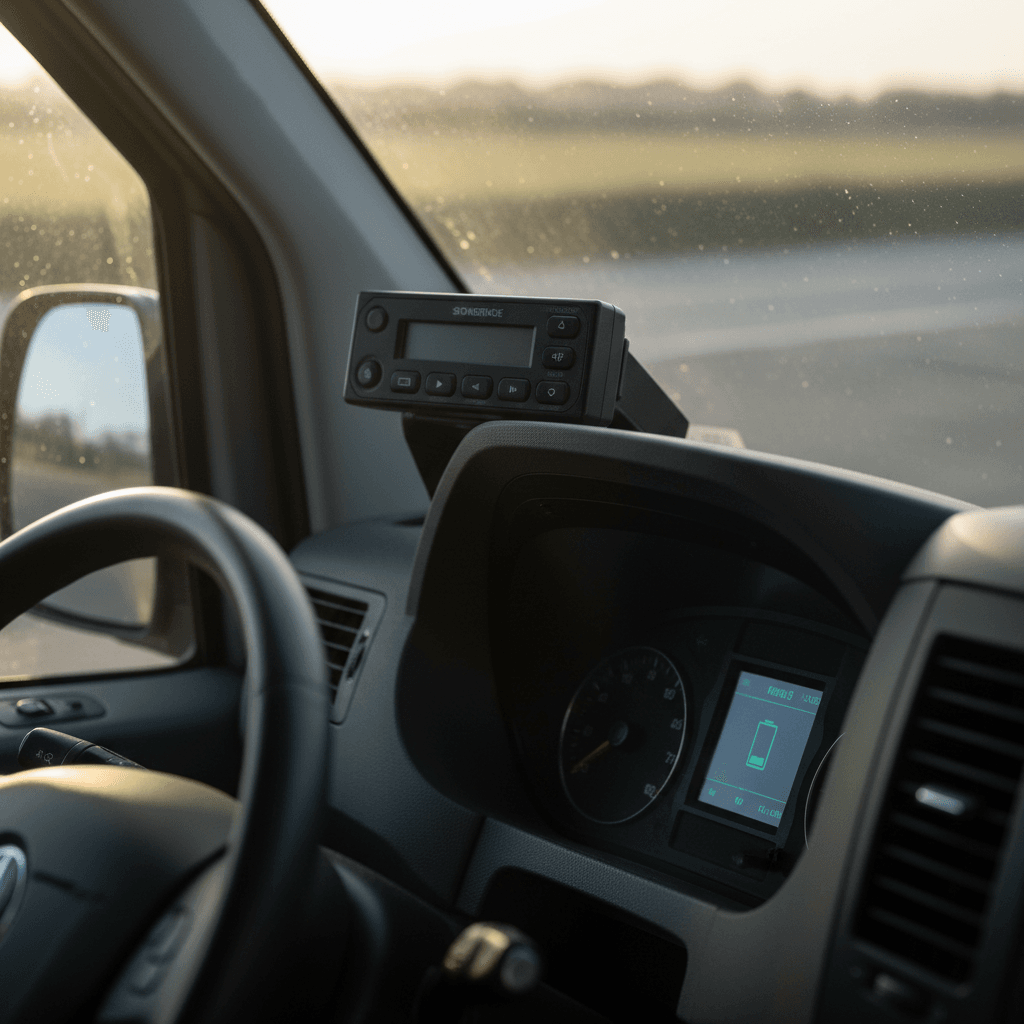
Right. If you run electric vans in the 3.5 to 4.25 tonne band - the Ford E-Transit, the Mercedes eSprinter, a Vauxhall Movano Electric on the heavy plate - Monday matters to you. The 1st of June. That's when The Goods Vehicles (Testing, Drivers' Hours and Tachographs etc.) (Amendment) Regulations 2026 come into force, and they pull your zero-emission 4.25-tonners out of the tachograph rules and the assimilated drivers' hours rules altogether.
I know how that reads. A regulation with that much punctuation in its title usually means more work, not less. Not this time. This one's a relief. The catch is that "relief" and "do nothing" aren't the same thing, and a couple of the details will bite the fleets that assume they are.
Here's what's actually happening, what it doesn't touch, and the short list I'd work through before the weekend's out.
Why these vans were a headache in the first place
Quick bit of background, because it explains why this change is such a faff-saver. A standard category B car licence lets you drive a goods vehicle up to 3.5 tonnes. Battery packs are heavy, though, so a like-for-like electric version of a 3.5t diesel van tips over the line on weight alone. To stop that killing electric van uptake, there's a weight uplift that lets a category B driver take a zero-emission van up to 4.25 tonnes, where the extra mass is down to the powertrain.
Fine for the licence. The problem was everything that hangs off the 3.5-tonne line. Cross it and, on paper, you're a "proper" goods vehicle: in scope of the assimilated drivers' hours rules - that's retained Regulation (EC) 561/2006, the old EU regime we kept after Brexit and renamed - with a tachograph fitted, a driver card, the 4.5-hour driving limit, the daily and weekly rest, all of it. For a last-mile electric van doing 70 miles of drops a day, that was a sledgehammer. The only real let-out most of us used was the national derogation for electric and gas vehicles up to 7.5 tonnes working inside a 100km radius of base - 62 miles, give or take - which covered a lot of urban delivery work but fell over the moment a van did a longer trunk leg.
So fleets ended up fitting tachographs to vans that, by any sensible reading, were just heavier Transits. That's the bit that ends on Monday.
What changes on 1 June
From 1 June 2026, zero-emission goods vehicles over 3.5 tonnes but not over 4.25 tonnes, used to carry goods for a business and operating solely within Great Britain, come out of the tachograph rules entirely. They also move out of the assimilated drivers' hours rules and into the GB domestic rules instead.
That's the whole change in one sentence. Two rulebooks you were juggling, gone, replaced by a lighter one. No tachograph requirement. No driver-card routine for those vehicles. If you've been running a fleet of E-Transits on the assimilated rules purely because the heavier battery pushed them over 3.5 tonnes, that overhead disappears.
One word to read carefully: zero-emission. Not "alternatively fuelled" in the broad sense. The licence uplift covers some gas and other alternative fuels, but this drivers' hours and tachograph change is written for zero-emission vehicles - battery-electric and hydrogen fuel cell. If you've got a CNG van in that weight band, don't assume it's caught by this. Check the fuel type against the wording before you change a thing.
The Northern Ireland bit nobody mentions
"Solely within Great Britain." Read that twice.
The exemption is England, Scotland and Wales. If one of those vans does a journey between GB and Northern Ireland - a trunk run to a depot near Belfast, say, or anything that crosses on the ferry as part of the job - it stays in scope. Tachograph required. Assimilated hours apply. Unless some other exemption catches it, which for general haulage it usually won't.
So if your operation is purely mainland, the change lands clean and you can stop reading after the checklist. But if you've got even one or two units that cross to NI, you can't strip the tacho out of those. You're running a split fleet now - GB-only vans on the new lighter regime, cross-border vans on the old one - and your planning has to know which van is which. I'd flag the cross-border vehicles in the system this week, before anyone books a Belfast load onto a van whose compliance has been treated as GB-only.
"Out of tacho" doesn't mean "no rules"
This is where I watch fleets talk themselves into bother. Coming out of the assimilated rules doesn't drop you into a free-for-all. It drops you into the GB domestic rules, and those have teeth of their own:
- You must not drive more than 10 hours in a day.
- You must not be on duty more than 11 hours in any working day - though that duty limit doesn't apply on a day you don't drive at all.
- Drivers still have to record their hours, on a weekly record sheet or a tachograph.
That last point is the one that trips people. No tachograph requirement is not the same as no records. Under the GB domestic rules a driver logs duty and driving time on a weekly record sheet, and a DVSA examiner can ask to see it. If you've spent years on neat digital downloads, a paper or app-based weekly sheet feels like a step backwards - but it's a real obligation, and a gap in it is its own offence. Don't let record-keeping lapse just because the card reader's gone quiet.
Worth being honest about the trade here. You're swapping a tight, well-understood ruleset that your analysis software polices for you, for a looser one that leans on the driver writing things down. Looser isn't the same as easier to evidence. More on that below.
What it doesn't change - so don't get cocky
The headline is narrow on purpose. It's about tachographs and drivers' hours. It is not a general "electric vans are off the hook" announcement, and a few things carry on exactly as before:
The Working Time rules. Drivers' hours and the working time limits are two separate rulebooks sitting on the same driver, and this change only moves one of them. I've written before about the overlap that catches operators out - it's the classic way a fleet stays legal on driving hours and still gets a letter. Worth a re-read if you've not thought about it lately.
Your O-licence. A 4.25-tonne van is still over the 3.5-tonne line, so don't assume coming out of tacho rules has done anything to your operator-licensing position. That's a separate question with a separate answer - check how your licence treats these vehicles rather than guessing that one change rolls into the other.
The annual test and roadworthiness. Nothing here touches your maintenance obligations, your inspection intervals, or the brake performance an examiner wants to see at the roadside. The daily walkaround still matters, and a defective van is still a prohibition waiting to happen.
Smart 2, for anything that still needs a tacho. Since 24 December 2025 any newly registered goods vehicle that does need a tachograph has to have a smart tachograph version 2 fitted - the latest VDO DTCO 4.x or the equivalent Stoneridge head. That rule's untouched. It simply stops applying to your GB-only 4.25t electric vans, because they don't need a tacho at all now. Your cross-border ones, and the rest of your HGV fleet, are still firmly in it.
Don't rip the tachograph out
Tempting, isn't it. The unit's exempt, the workshop's quiet, pull the Stoneridge SE5000 and reclaim the dash. Don't - not yet, anyway.
Two reasons. First, the Northern Ireland point above: if there's any chance that van crosses, you'll want the head still in and calibrated, and a calibration is a booked workshop job, not a five-minute swap. Second, a working tachograph is still the cleanest way to evidence a driver's hours even under the GB domestic rules. It satisfies the record-keeping requirement without anyone filling in a sheet by hand. If the kit's already fitted and working, leaving it in and using it voluntarily is the low-effort path. The exemption frees you from having to run it. It doesn't order you to stop.
Where the saving is real is the new vans. If you've got 4.25t electric units on order for GB-only work, that's money straight back in your pocket - no tacho to spec, fit, calibrate or download for the life of the vehicle. Take it there, on the new kit, rather than tearing working gear out of vans that already have it.
Don't bin your old tacho data either
One more, because I've seen it go wrong. Coming out of the rules from Monday does nothing to the records you've already generated. The data you pulled off those vehicle units and driver cards over the past year is still subject to the retention period, and DVSA can still ask for historic records covering the time the vans were in scope. So don't take "we're exempt now" as licence to wipe the lot.
If your download and archiving routine is a bit ad hoc - and whose isn't, on a busy yard - this is a decent moment to tidy it. I've gone through what you actually have to keep and for how long elsewhere. Get the historic data filed properly before you mentally close the book on these vehicles.
A worked example, because it's never as tidy as the rule
Say you run twelve vans. Eight are electric E-Transits and eSprinters on the 4.25t plate doing parcel work around Greater Manchester. Three are diesel 3.5-tonners. One's an eSprinter that does a weekly run over to a customer in Northern Ireland.
From Monday: the eight mainland electric vans come out of tacho and assimilated hours, onto the GB domestic 10-and-11 with a weekly record sheet. The three diesels were never in this in the first place - under 3.5 tonnes, used in the UK, no tacho needed anyway, and a quick check against the rules DVSA actually enforce at the roadside confirms it. And the one cross-border eSprinter? It stays exactly where it was: tacho in, card in, full assimilated rules, because it crosses to NI. Same model as the eight, different rulebook, purely because of where it goes.
That single van is the one that'll catch you out. It looks identical to its mainland siblings on the yard. Treat it the same and you've got an untachographed cross-border journey, which is precisely the kind of thing that turns up on an OCRS profile and then in a letter from the Traffic Commissioner.
The short list before Monday
If you do nothing else this weekend, do these three:
- List your 4.25t zero-emission vans and split them GB-only versus cross-border. The GB-only ones are the ones the exemption helps. The NI-touching ones stay on the old regime, tacho and all.
- Set up the weekly record sheet now for any van you're moving onto the GB domestic rules, so there's no gap in records on day one. A lapse in records is an offence in its own right, exempt-from-tacho or not.
- Tell your drivers what's actually changed. "No tacho" gets heard as "no rules", and that's how you end up with a 12-hour duty day someone genuinely thought was fine. Spell out the 10 and the 11 in plain words.
That's it. It's a good change - one of the few bits of fleet regulation in recent memory that takes work away rather than piling it on, and a sensible nod to the fact that a battery-electric delivery van isn't the same animal as a 38-tonne artic. The vans that get their operators in bother over the next few months won't be the ones that read the rule. They'll be the ones that heard "exempt" and stopped listening.
Sort the three things above, mind the Northern Ireland van, and you'll walk into Monday clean.