Driver infringement debrief form: the 11 fields every record needs, with a template
A field-by-field guide to the driver infringement debrief record: what goes in each box, a worked example, a copyable template and the mistakes that make a debrief worthless at a DVSA visit.
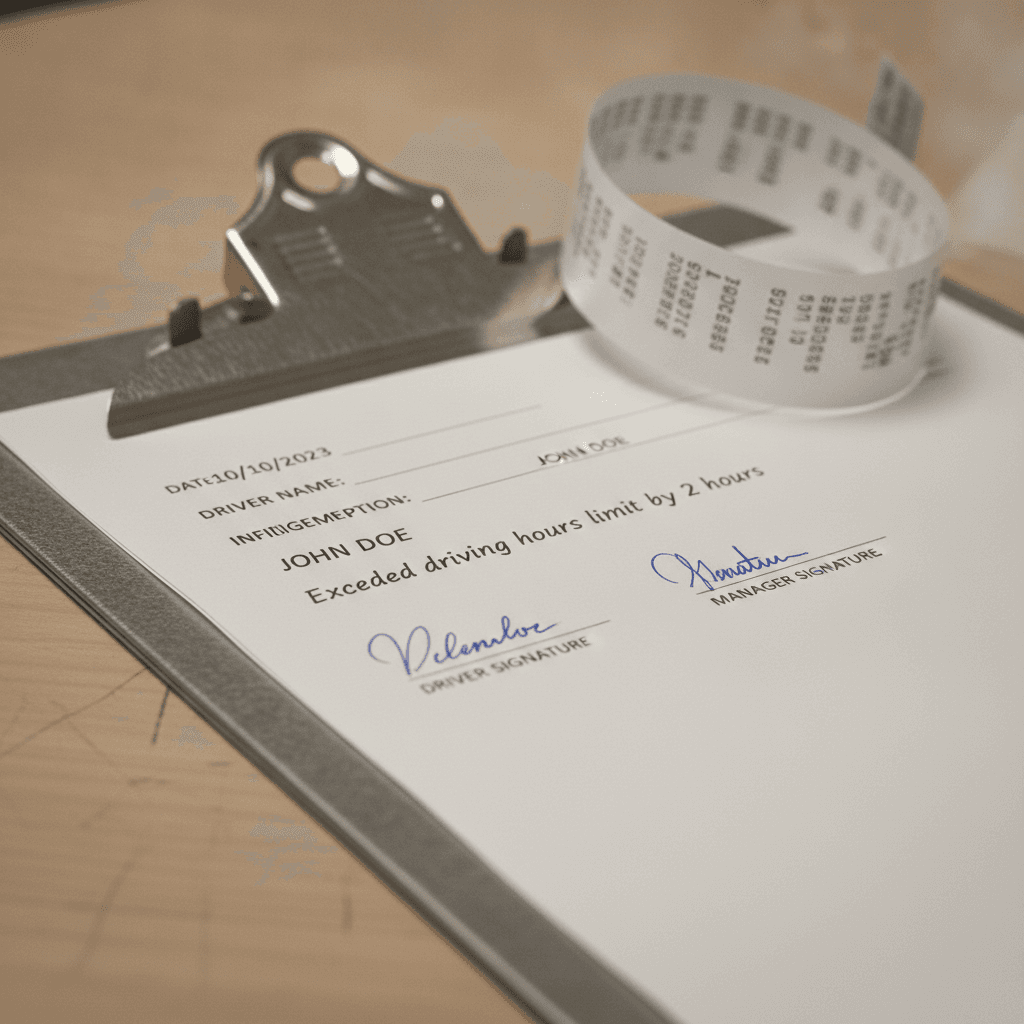
Most debrief records I've been shown fail in the same way. The conversation happened. The driver was told. But the sheet of paper that's supposed to prove it says "discussed break infringement with driver, verbal warning", with a scrawled initial and no date. If a traffic examiner picks that record out of the file, it proves almost nothing.
This post is about the record itself: what goes in each box, why, and what a filled-in one looks like. There's a template you can copy at the end. If you want to know where the 28-day debrief deadline comes from and when the clock starts, I covered that separately in where the 28-day debrief rule comes from. I won't repeat it here.
What the rules actually say about the record
Less than you'd think. The assimilated drivers' hours rules (Regulation 561/2006), the tachograph regulation (165/2014) and the Road Transport (Working Time) Regulations 2005 make you download the data and take reasonable steps to keep drivers compliant. The gov.uk drivers' hours guidance, the one people still call GV262, tells you to check the records regularly and act on what you find. None of them gives you a debrief form or a deadline.
The only published DVSA standard that describes the record is the Earned Recognition HGV audit standard 4.8, infringement reporting. Criterion 4.8.3 asks for evidence of drivers being debriefed on infringements, signed, dated and showing the corrective action taken. Strictly, that's an audit standard for scheme members, not the law. But it's the clearest written benchmark there is, and it's a sensible floor for anyone. Signed, dated, corrective action. Build your form around those three and add what makes the record useful to you.
The fields, one by one
1. Driver name and card number
Both. I've seen files kept by card number only, which is fine until a driver renews their card and the history splits in two. Name first, card number second.
2. Infringement date and time
The day the rule was broken. Not the download date, not the analysis date. If you're in Earned Recognition this is the date your 28 days run from, so it has to be on the record.
3. Date the infringement was identified
The date your analysis flagged it. Put this next to the infringement date and you can see at a glance how long your analysis takes. If that gap is regularly three weeks, you've found your problem before an auditor does.
4. What the rule is, in plain words
"Break infringement" isn't enough. Write what happened and which rule it broke. For example: "Split break taken as 30 minutes then 15 minutes on 6 October. Article 7 needs the 15-minute part first, so no qualifying break was taken before 4.5 hours' driving ran out." That tells anyone reading it that you understood the infringement, not just that the software printed a red line. If the split rule trips your drivers up a lot, this post on the 45-minute break and its split is worth handing out.
5. Severity and whether it's a repeat
Most analysis packages grade infringements. Copy the grade across and note whether this driver has had the same type before, and when. This one box is what lets you show pattern monitoring later (ER criterion 4.8.4 asks for exactly that).
6. Debrief date and who held it
The date you actually spoke to the driver, and the name of whoever did it. It doesn't have to be the named transport manager. A trained supervisor can handle routine ones, but the record should say who it was.
7. The driver's explanation
This is the box most people leave blank, and it's the one that proves a conversation took place. Traffic on the M6, a late load at Daventry, didn't realise the split had to go 15 then 30. Write down what they said, in their words if you can. Even when the explanation doesn't excuse anything, it shows the debrief was real and not paperwork made up afterwards.
8. Your findings
Short. Was the explanation checked? Did it hold up? Was it a planning problem on your side (an unrealistic schedule is your infringement as much as theirs)? If the driver disputes the record, say a card left in another vehicle or a manual entry error, note what you checked and what you concluded. A disputed infringement with a written investigation looks far better than a blank.
9. Corrective action
The 4.8.3 requirement, and the box that's most often too vague. "Verbal warning" on its own doesn't say what will stop it happening again. Be specific: rule explained with the printout, toolbox talk booked for 20 October, route re-planned to add a break point at Lymm, written warning issued under the disciplinary procedure. Corrective action can sit on your side too. If the schedule caused it, the action is fixing the schedule.
10. Follow-up check
A date to look again, usually the next download, and a line to say what you found. This is how you close the loop. Without it, a file full of debriefs can't show whether any of them worked.
11. Signatures and dates
Driver signs and dates. The person who held the debrief signs and dates. The driver's signature confirms they've seen the record and that their explanation is written down fairly. If a driver refuses to sign, write "refused to sign", date it, and get a witness to initial it. Don't just leave it empty.
A worked example
Here's what a completed record might look like for the split break above.
| Field | Entry |
|---|---|
| Driver / card | J. Patel / card ending 4471 |
| Infringement date | Tue 6 Oct, 13:40 |
| Identified | Fri 9 Oct (weekly analysis run) |
| What happened | Break split 30 then 15. No qualifying break before 4.5 hours' driving (Art. 7) |
| Severity / repeat | Serious per analysis software. First of this type in 12 months |
| Debrief held | Wed 14 Oct by S. Hughes, shift supervisor |
| Driver's explanation | Thought any 45 minutes in two parts counted, whatever the order |
| Findings | Genuine misunderstanding. Schedule allowed a full break, so not a planning issue |
| Corrective action | Rule explained with printout. Break guidance sheet issued. Added to Driver CPC refresher topics |
| Follow-up | Check next card download (due 2 Nov). Result: ________ |
| Signatures | Driver: ________ date ____ / Supervisor: ________ date ____ |
Nothing fancy. But it answers every question an examiner is likely to ask about that infringement without you having to explain anything out loud.
The template
Copy this into a form, a spreadsheet row or your system of choice. One record per infringement, not one per driver per month.
- Driver name:
- Driver card number:
- Vehicle registration:
- Infringement date and time:
- Date identified at analysis:
- What happened and which rule it broke:
- Severity grade:
- Previous infringements of this type (dates):
- Debrief date:
- Debrief held by:
- Driver's explanation:
- Findings / what was checked:
- Corrective action (driver and operator):
- Follow-up check date and result:
- Driver signature and date:
- Debriefer signature and date:
Mistakes that make a record worthless
- Batch debriefs. One sheet saying "all infringements for October discussed" can't be matched to anything. The examiner wants a record against each infringement the analysis flagged.
- An automated email instead of a conversation. Plenty of software sends drivers a "you have an infringement" message. Useful as a flag. It isn't a debrief, because there's no explanation and no corrective action.
- The same action every time. Fifteen records each saying "verbal reminder" for the same driver tells an examiner the system isn't working. Escalate: conversation first, written warning on a repeat, then your disciplinary procedure. The thresholds are yours to set, but the file should show them being used.
- Missing dates. Without the infringement date and the debrief date, nobody can tell whether you acted in weeks or months.
- Filed away from the data. Keep the debrief with the download and analysis report it relates to, and keep it for at least as long. That's 12 months for drivers' hours records and 2 years where the tacho data is also your working time evidence. More in tachograph retention periods.
It's an HR document too
A debrief record lives in two worlds. It's your O-licence evidence, and if you ever need to take disciplinary action over repeated infringements, it's part of the history that justifies it. That's another reason the driver's signature and the explanation box matter. Keep a copy on the driver's personnel file, or at least cross-reference the two, so the compliance file and the HR file tell the same story.
Where this fits
The record is the last step in a longer chain: download on time, analyse, find the infringement, talk to the driver, write it down. If the earlier steps aren't solid yet, start with what operators must do after the download. If they are, pull ten debrief records from last quarter and check them against the eleven fields above. You'll know within ten minutes whether your file would stand up.