Real DVSA fines: what they cost, who pays, and how to stop getting them
The £300 fixed penalty was the cheap part. The OCRS point, the insurance renewal conversation, and the Traffic Commissioner's letter that arrived six weeks later cost significantly more. Here is what DVSA fines actually look like from the operator's side.
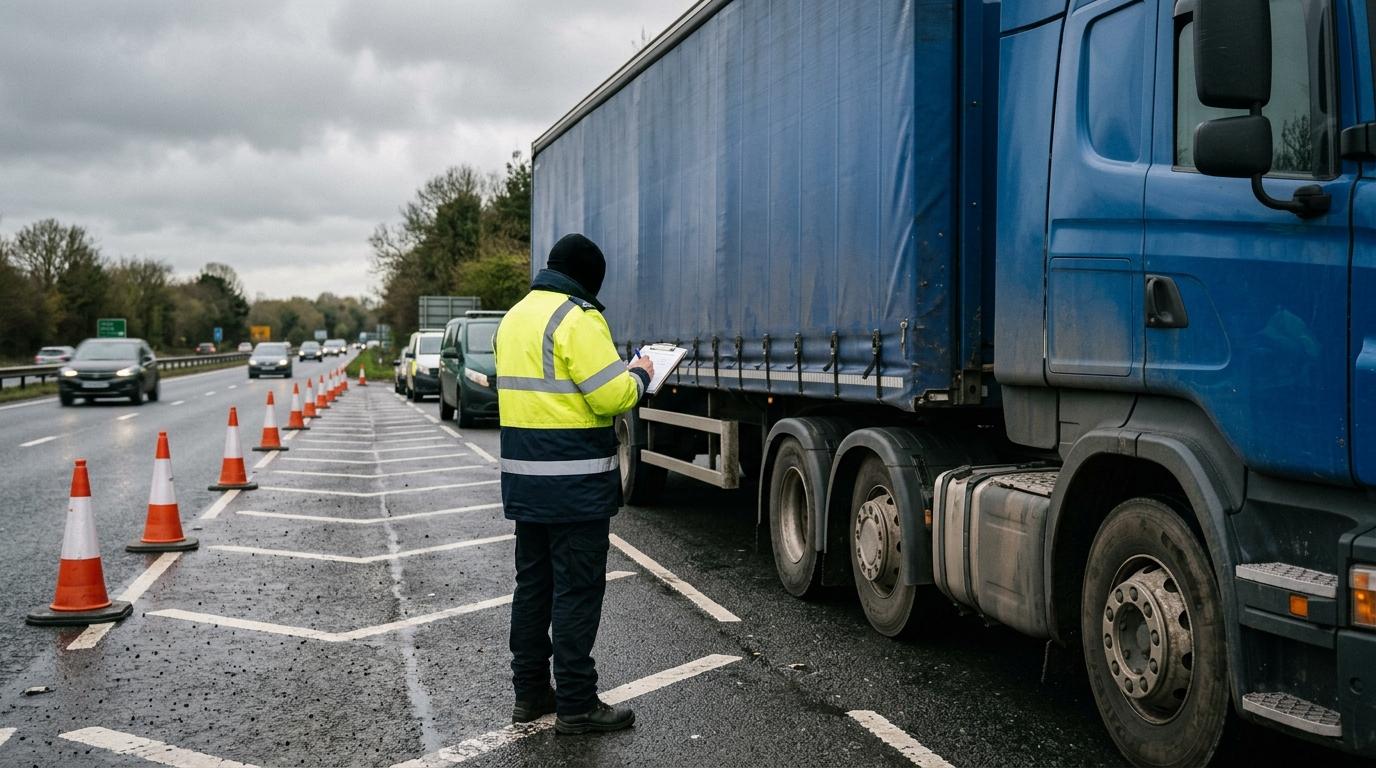
The first fine one of our drivers brought back was a £300 fixed penalty for exceeding the 4.5 hour driving limit by 12 minutes. He was apologetic. I was annoyed but not worried. Three hundred pounds, lesson learned, move on. What I did not understand at the time was that the £300 was the least significant cost of that penalty.
The DVSA roadside encounter generated an OCRS point against our operator licence. That OCRS point raised our compliance risk score from green to amber. That amber rating meant our vehicles were more likely to be pulled in at future check sites. Within three months we had two more roadside encounters, one of which found a cracked mudguard that would not have been noticed if we had not been flagged for a stop. That generated another OCRS point. Six months after the original £300 fine, the Traffic Commissioner's office sent a letter asking for our maintenance records for review. The £300 fine had triggered a chain of events that ended up costing us a week of management time, a workshop inspection, and a warning on our O-licence file. The actual cost of that 12 minute overrun was closer to £5,000 when I added up the time, the disruption, and the insurance renewal increase the following year.
This is the thing most fleet managers do not understand about DVSA fines until it happens to them. The fine is a receipt, not the bill.
How DVSA enforcement works
DVSA has three main enforcement tools for roadside offences, and which one the officer uses depends on the severity of the finding:
Fixed penalty notice. Issued on the spot for most common offences. The amounts are graduated by severity. A minor driver hours breach might attract a £100 penalty. A more serious one, like exceeding daily driving by more than an hour, is £300. The driver can pay and accept the penalty, or contest it in court. Most drivers pay. The fixed penalty also generates an OCRS entry against the operator.
Graduated deposit scheme. For non-UK-resident drivers and operators, DVSA can require a cash deposit at roadside before the vehicle is allowed to continue. This is effectively a fine paid on the spot, with the amount reflecting the severity. It exists because pursuing fixed penalties through foreign courts is impractical.
Court prosecution. Reserved for the most serious offences, repeat offenders, or where the officer believes the fixed penalty does not reflect the gravity of what they found. A court prosecution can result in much higher fines, and for the most serious offences involving death or serious injury, imprisonment. Court prosecutions also generate the strongest OCRS entries and are almost certain to be raised at any future O-licence review.
What the fines actually are
I am going to list the real amounts because I have seen too many fleet managers surprised by a fine they did not know existed. These are the current graduated fixed penalty amounts for the most common HGV offences:
Driver hours breaches (EU 561/2006): £300 per infringement. This covers exceeded daily driving time, insufficient break, insufficient daily rest, and insufficient weekly rest. Each infringement is a separate £300 penalty. A driver who exceeded the 4.5 hour driving limit on the same day they took a short daily rest without being entitled to one has committed two infringements. That is £600, not £300. I have seen a driver leave a check site with three separate FPNs totalling £900 from a single card download covering a bad week. Our post on driver hours rules explains what the tachograph records and how DVSA reads it.
Tachograph offences: £300 FPN for most offences, including failing to use the tachograph, incorrect manual entries, and driving without a driver card. Tachograph manipulation, such as driving with no card inserted while the VU records movement, using a magnet, or using another driver's card, is treated as fraud and prosecuted in court. On conviction, the maximum fine is £5,000 and the driver can be disqualified from driving.
Defective vehicle offences: £300 FPN for using a vehicle with a defect that renders it in a dangerous condition. This is the fine that accompanies an immediate PG9 prohibition. A bald tyre, a cracked windscreen in the driver's line of sight, or a defective steering component all fall here. For tyres specifically, the fine on court conviction is up to £2,500 per defective tyre, and the driver can receive 3 penalty points per tyre on their personal licence. A twin-axle trailer with four bald tyres is a theoretical maximum of £10,000 and 12 penalty points. I have not seen anyone actually receive that maximum, but I have seen a driver pick up 6 points and £3,000 for two bald tyres on a single axle.
Overloading: £300 FPN for minor overloading, up to about 5% over the maximum gross weight or axle weight. Above that, the vehicle may be immobilised until the excess load is removed, and the penalty increases. On court conviction, the maximum fine for an overloading offence is £5,000. The costs of actually dealing with an overloaded vehicle at roadside (unloading, reweighing, recovery of the excess load, delay to the delivery) usually dwarf the fine itself.
No operator licence or breach of licence conditions: up to £5,000 on court conviction. This covers operating without a valid O-licence, operating more vehicles than the licence authorises, and operating from an unlicensed centre.
Who pays: driver vs operator
This is the question that causes arguments in every transport office. The legal answer is straightforward: the fixed penalty is issued to the person committing the offence. For driving offences such as driver hours, tachograph, speeding, and mobile phone use, the driver receives the FPN and is personally liable. For vehicle condition offences, the driver may be liable if they drove a vehicle they knew or should have known was defective, and the operator may be liable under the user provisions if the defect was caused by a systemic maintenance failure.
The practical answer is messier. Most operators I have worked with have an informal policy: if the driver was genuinely at fault (ignored the tachograph warning, skipped the walkaround check, chose not to stop for a break), the driver pays their own FPN. If the offence was caused by the operator's systems (overloading from the loading bay, a defect that was reported and not fixed, a schedule that made compliance impossible), the operator covers it. This only works if your culture allows drivers to report honestly without fear of being blamed for the outcome.
The hidden costs
The fine itself is the simplest cost. The costs that actually hurt are:
OCRS impact. Every roadside encounter generates an OCRS entry. Adverse findings push the score up. A high OCRS score means more frequent stops at check sites, which means more disruption, more delays, and a higher probability of finding something else wrong. The scoring is weighted by severity and decays over time, but a cluster of points in a short period can move a fleet from green to red in a matter of months.
O-licence implications. OCRS scores feed into the Traffic Commissioner's view of your operation. Our post on O-licence audits covers what happens when the TC opens your file. A pattern of FPNs and prohibitions is exactly the kind of evidence that triggers a call-up letter.
Insurance. Fleet insurers track claims and compliance history. A fleet with a rising OCRS score and multiple prohibitions will pay more at renewal. The insurers do not always tell you why the premium went up, but the underwriting team has access to the same DVSA data the Traffic Commissioner does.
Management time. Every roadside encounter generates paperwork. Someone has to record the FPN, update the OCRS tracking, review the driver's file, decide on internal action, and file the response if there is a follow-up from the traffic area office. On a single fine, this is a couple of hours. On a cluster of fines, it becomes a significant drain on the transport manager's week.
Driver retention. Drivers who receive FPNs, particularly for vehicle condition offences they feel were not their fault, become unhappy. Drivers who receive multiple FPNs look for other work. In a market where experienced HGV drivers are already difficult to recruit, losing a driver over a £300 fine that was caused by a deferred maintenance defect is an expensive outcome.
How to actually reduce your fine rate
There is no trick to this. The fleets with low fine rates are the ones where compliance is part of the daily routine rather than a reaction to enforcement.
Run genuine daily walkaround checks and fix defects before the vehicle leaves the yard. Monitor driver hours infringement reports weekly and act on what you find. Keep PMI intervals on schedule. Prepare properly for the annual test. These are not separate activities. They are the same activity viewed from different angles: maintaining the fleet to the standard you promised on your O-licence application.
The FleetPad dashboard was built to give the transport manager a single view of where the compliance gaps are before DVSA finds them. But the dashboard is just a mirror. If the underlying processes are broken, no software will fix them. The fine rate drops when the fleet is actually compliant, not when the fleet gets better at avoiding check sites.
Frequently asked questions
Can a driver contest a fixed penalty notice?
Yes. The driver has 28 days to pay the fixed penalty or request a court hearing. If they choose court, the case is heard at the magistrates' court nearest to where the offence was detected. The risk is that a court can impose a higher fine than the fixed penalty, and costs can be awarded against the driver. In practice, most drivers pay the FPN unless the circumstances were genuinely exceptional or the officer made a clear procedural error. I have only ever seen one FPN successfully contested, and it was because the officer had downloaded the wrong driver card.
Does a DVSA fine give the driver penalty points?
Not automatically. A fixed penalty notice for a driver hours or tachograph offence carries a financial penalty only, no points. Penalty points are only imposed on conviction in court, and only for specific offences. The main ones that carry points are tyre offences (3 points per tyre), speeding, mobile phone use, and dangerous condition of the vehicle. A driver who accumulates 12 points faces disqualification under the totting-up provisions, which for an HGV driver means they lose their livelihood.
How long does an OCRS point stay on record?
OCRS entries are weighted by recency. The exact scoring formula is not published, but in practice an entry from more than three years ago carries very little weight. The most recent 12 months have the strongest influence on the score. A fleet that had a bad quarter can recover within 18 to 24 months of clean roadside encounters, assuming the underlying issues are genuinely fixed.
What is the most expensive single DVSA fine?
On fixed penalty, £300 per offence is the current maximum for most graduated offences. On court conviction, using a vehicle in a dangerous condition carries a maximum of £5,000, and operating without an O-licence also carries £5,000. But the single most expensive outcome I have personally seen was a combination of four tyre offences prosecuted in court, which resulted in a £7,200 total fine plus £1,200 in costs plus 12 penalty points. The driver lost his licence. The operator received a call-up from the Traffic Commissioner. The total cost to the business, including the driver's replacement, the legal representation, and the management time, was over £15,000.
Should I tell my insurer about DVSA fines?
Check your policy wording, but most fleet insurance policies require disclosure of regulatory enforcement actions at renewal. Some require mid-term notification of serious incidents, including immediate prohibitions. Failing to disclose and then making a claim can void the policy. It is cheaper to be honest at renewal than to discover your cover is invalid after an accident.
DVSA fines are the symptom, not the disease. The disease is the gap between the compliance standard you declared on your O-licence and the compliance standard you are actually running at. Close the gap and the fines stop. Leave it open and the fines are the least of what is coming.